New frontier AI models, TypeSafe’s Jev AI, & NASA’s IBM collab
An exploration of the recent wave of AI innovations, focusing on the pervasive theme of efficiency. The episode delves into cost-reduction in new frontier models like Anthropic's Claude Opus 5.5 and OpenAI's GPT-6, the emergence of TypeSafe AI's "System One" models like Jev for high-speed, calibrated decision-making, and the groundbreaking open-source Lunar Foundation Model by NASA and IBM, showcasing AI's diverse applications beyond text generation.
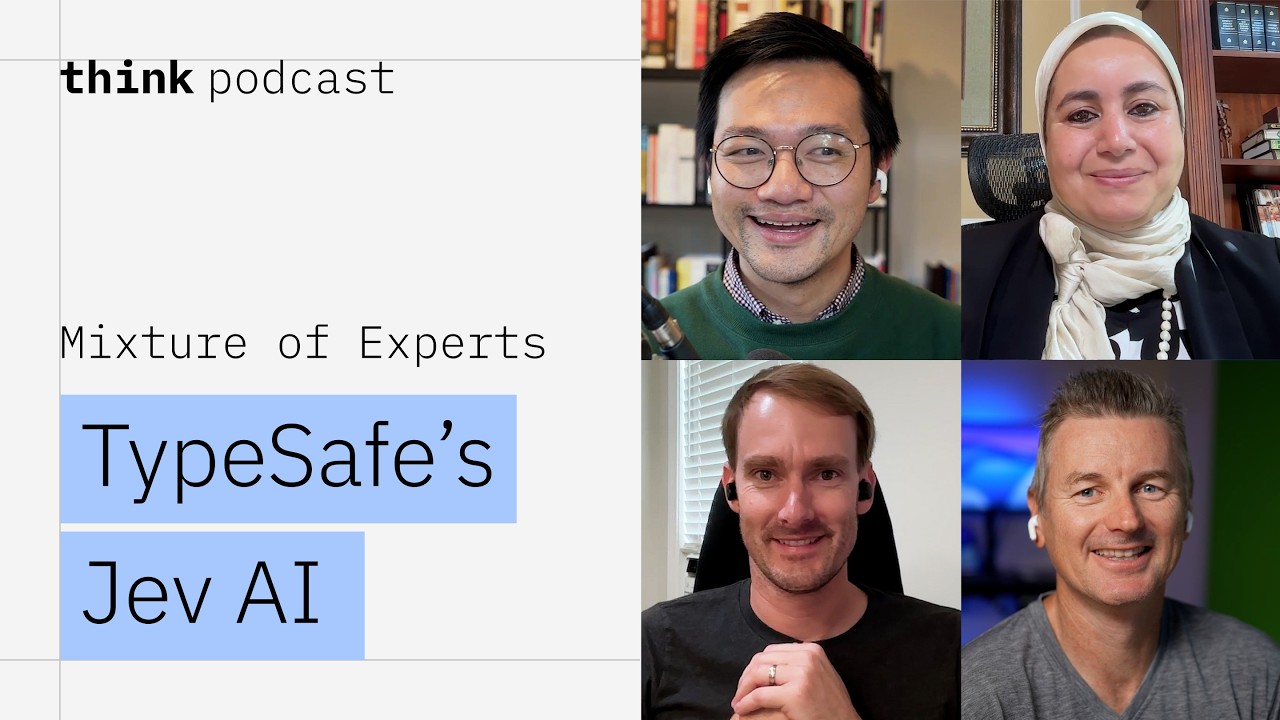
This episode of Mixture of Experts delves into the overarching theme of efficiency shaping recent advancements in AI.
The AI Model Efficiency Race
The panel, including Kaoutar El Maghraoui, Gabe Goodhart, and Martin Keen, discusses the rapid-fire release of new frontier models, shifting focus from raw intelligence to optimized performance and cost. Martin Keen highlights that models like Anthropic’s Claude Opus 5.5 and OpenAI’s GPT-6 Sol are significantly more efficient, delivering comparable capabilities to larger predecessors (e.g., Opus 5.5 being as good as Fable 5.1) at substantially reduced token costs. GPT-6 Luna, for instance, costs half what its predecessor did, at just 10 cents per million input tokens. This indicates a fierce “price war” that directly impacts developers and companies.
Kaoutar El Maghraoui, from a hardware perspective, emphasizes that this efficiency push is critical because companies are maxing out their compute resources. The competition is evolving from “model intelligence to system intelligence,” where the model is just one component in a broader agent system with memory, tools, and enterprise access. She notes a shift from larger models in 2023-2024 to a 2025 focus on “better reasoning per unit of compute costs.” This necessitates advancements in model architecture, inference software, and accelerator design (quantization, KV cache management, speculative decoding, specialized accelerators) for deployability.
Gabe Goodhart observes that Claude Opus 5.5’s more terse, less ‘chatty’ output aligns with Anthropic’s corporate branding of ‘getting work done’ and also contributes to token efficiency. He differentiates between consumer token efficiency and the unknown internal compute efficiency for these companies, raising concerns that current low pricing might be venture-capital subsidized. The goal, as Tim Hwang suggests, is that the minimum number of tokens signifies a problem solved, akin to Google’s ‘minimal time on site’ metric.
TypeSafe AI’s Jev: System One Models for Structured Decisions
The discussion then turns to TypeSafe AI’s “System One” models, exemplified by Jev, developed by former OpenAI engineer Diogo Almeida. These models are designed for fast, structured decisions with calibrated probabilities, foregoing the “florid text generation” of traditional LLMs. The core idea is that LLMs, while good at generating prose, are inefficient for simple, structured decisions.
Kaoutar El Maghraoui points out Jev’s hardware advantage: by producing structured decisions and probabilities in parallel rather than sequential token generation, it drastically reduces sequential decode loops, output generation, and KV cache traffic. This changes “what they’re asking the hardware to do,” leveraging GPUs’ parallel processing strengths. However, she cautions that claims about correctness and calibration require scrutiny for reliability, especially in automation.
David Zax clarifies calibration: a model’s confidence score accurately reflecting its actual accuracy, combating the issue of LLMs “confidently spout[ing] utter nonsense.” Jev’s effectiveness hinges on its confidence scores being reliable.
Gabe Goodhart elaborates that Jev addresses the long-standing problem of classification efficiently. While LLMs excel at zero-shot classification, their text-based output creates an “engineering nightmare.” Jev’s output of typed values (e.g., a vector of numbers for labels) is far more efficient for inference compute and engineering effort. He positions Jev as targeting a subset of problems LLMs tackle, specifically deterministic decision-making, and notes its potential integration with programming models like IBM’s Malaya for workflow automation.
Martin Keen explains the “System One” naming as a reference to Daniel Kahneman’s fast, automatic thinking. Jev is trained with Reinforcement Learning for Calibrated Decisions (RLCD), focusing on whether an answer is right and how confident it is, rather than human agreeability or general rewards. Benchmarks show Jev matches top frontier models in decisions but with significantly faster speeds and lower token costs, demonstrated in demos like playing Doom or the Wikipedia game. While Jev provides only a numerical output, its RLCD training and comparative performance against large frontier models make it an exciting development.
NASA and IBM’s Lunar Foundation Model
Finally, the podcast explores the open-source Lunar Foundation Model, a collaboration between IBM and NASA. This computer vision model is trained on millions of lunar images to identify features, map craters, and estimate polar ice, showcasing AI’s application beyond chatbots.
David Zax initially found the idea of ‘counting craters quicker’ mundane, but learned its profound scientific importance—craters act as a “clock for the universe,” revealing insights into the age of celestial bodies. Gabe Goodhart celebrates this as “AI for nerds again,” a return to using AI for fundamental scientific problem-solving, reminding listeners that AI’s core technology applies far more broadly than consumer-facing chatbots and offers real benefits to human knowledge.
Kaoutar El Maghraoui highlights the value of reuse in this foundation model: training on a large body of data once and adapting it to “several scientific questions” without starting from scratch. She also emphasizes the critical role of data engineering in aligning diverse sensor data and capturing observation conditions. Martin Keen adds that this model demonstrates the power of multimodal foundation models. Just as text-based LLMs process words, this model processes image data as vectors, using similar mathematical principles to perform complex tasks like adjusting for sun angles in lunar images, showcasing a “cool use of a foundation model just applied to something completely different.”