Claude Security’s public beta, OpenAI’s five-point plan and cybersecurity’s Y2K moment
Explore the AI industry's "Y2K moment" in cybersecurity, as major players like OpenAI, Anthropic, and CrowdStrike form coalitions to tackle threats. This summary also delves into a new framework for AI agent identity based on Zero Trust principles and analyzes the "Copy Fail" Linux vulnerability, a decade-old flaw uncovered by AI, highlighting the escalating need for proactive vulnerability research.
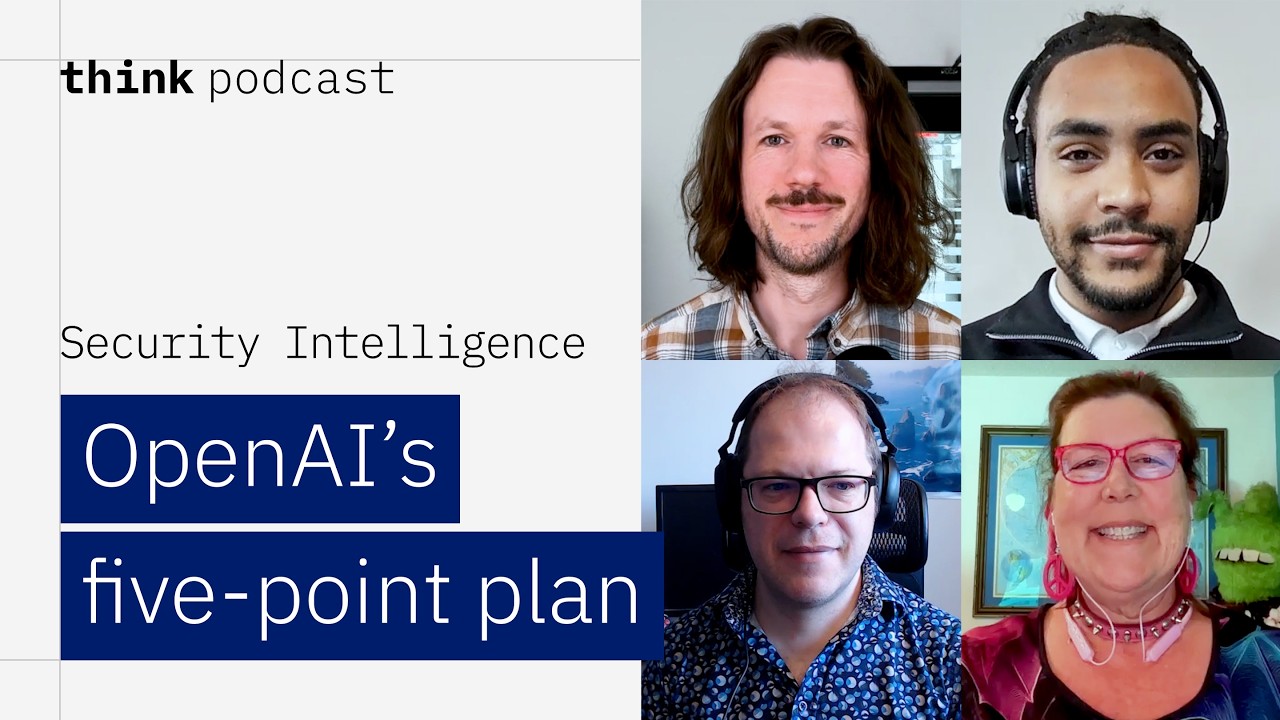
The AI landscape is currently experiencing what CrowdStrike has termed “cybersecurity’s Y2K moment,” a period where major AI labs are intensely focusing on security as a collaborative, ecosystem-level challenge. This shift is driven by the executive-level realization of AI’s vast attack surface and the weaponization of sophisticated AI tools by threat actors.
Part 1: Cybersecurity’s “Y2K Moment”
The recent flurry of activity—including Anthropic’s Claude Security, OpenAI’s five-point plan for cyber defense, and CrowdStrike’s Project Quill-Works (a coalition including IBM and OpenAI)—signals a unified push. The consensus is that cybersecurity in the age of AI requires a collective, almost altruistic approach rather than a purely capitalistic one, aiming to protect the entire digital ecosystem from downstream impacts.
However, this movement faces several challenges:
- A Staffing Crisis: While AI accelerates the discovery of vulnerabilities, the human resources needed to patch and defend against them have not kept pace. This is exacerbated by recent workforce reductions in the tech industry.
- The Cost of AI: The tangible cost of tokens is a significant factor. Companies are finding that the expense of using AI for vulnerability discovery is so high that they are reverting to junior developers for writing boilerplate code.
- Open vs. Closed Models: A key debate revolves around the approach to collaboration. Projects like Anthropic’s “Glasswing” for its Mythos model represent a more locked-down, controlled approach. In contrast, initiatives like Quill-Works and OpenAI’s release of GPT-5.4 for Cyber are more open. The consensus is that while a closed-source route might seem safer, the rapid advancement of open-weight models means they will likely achieve Mythos-level capabilities soon, making a purely closed approach untenable.
Part 2: A Framework for AI Agent Identity
The Coalition for Secure AI has proposed a new framework for AI identity and access management, addressing the fact that AI agents do not fit neatly into existing identity models. This has created significant challenges in permissions, monitoring, and accountability.
The framework is built on principles that can be described as “Zero Trust with extra steps”:
- Distinct Identities: Agents must have unique credentials, not borrowed or shared accounts. This is crucial for attribution—differentiating between a legitimate developer’s workflow and a malicious actor’s.
- Zero Standing Privileges: Agents should not have persistent access. Access should be granted on a short-lived, task-specific basis.
- Traceable Authority: There must be a clear, traceable, and perhaps cryptographic chain of authority when an agent acts on behalf of a user or another agent.
- Controls at Every Hop: Security must be enforced at every touchpoint an agent interacts with.
Panelists emphasized that an AI agent is a unique entity—not a human, and not a traditional software process. Treating it as such is a critical error. The risk of an agent becoming an insider threat, whether by design or by accident, is substantial. If security controls introduce too much friction, AI is uniquely capable of “routing around your controls as damage.” The concept of using a blockchain ledger or short-lived certificates to manage agentic tokens was also raised as a potential solution for creating an immutable chain of command.
Part 3: “Copy Fail” - A Decade-Old Linux Flaw Uncovered
Researchers using an AI-powered vulnerability scanner discovered “Copy Fail” (CVE-2024-31431), a Linux flaw that had existed for nearly a decade. The vulnerability allows an unprivileged local user to gain root access on most major distributions shipped since 2017 with a simple, 732-byte Python script.
Key technical points of the exploit:
- Origin: The bug’s journey began with a commit in 2011, but it only became exploitable after a series of optimizations and changes in 2015 and 2017.
- Mechanism: An unprivileged user can write four controlled bytes into the page cache of any readable file, which can then be leveraged to gain root privileges.
- Stealth: The exploit is particularly dangerous because it requires no race conditions and takes effect only in memory, leaving no forensic evidence on the system.
This discovery highlights a new era of “patch apocalypse,” where AI tools are rapidly uncovering and forcing patches for long-dormant vulnerabilities that were once the exclusive domain of elite red teams. The key takeaway for organizations is the urgent need to invest in and staff up their own internal vulnerability research and defense teams to find these flaws before external actors do.