Every AI Company Is Accidentally Building a Bank — Dor Sasson, Stigg
Dor Sasson argues that the 2026 AI pricing crises at Anthropic, OpenAI, and GitHub were infrastructure failures: usage was checked after invoicing rather than before inference. He proposes synchronous entitlement checks with asynchronous settlement, borrows banking concepts such as holds, double-entry bookkeeping, and credit sources, and outlines four patterns for selling AI at scale.
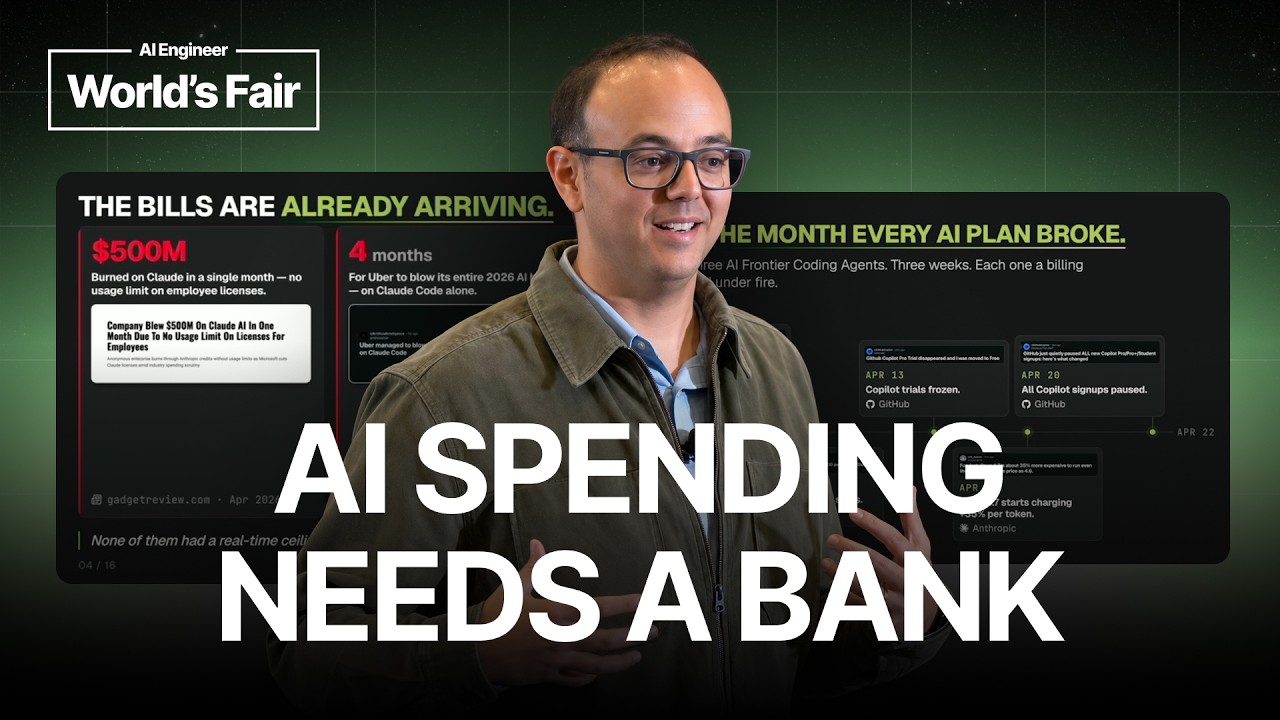
Dor Sasson opens with a provocation: every AI company is accidentally building a bank. He does not mean this as a marketing metaphor. He argues that the mechanics AI products now depend on, such as metering, entitlements, prepaid credit pools, and spend limits, behave like the financial systems banks have run for decades, and that most teams are building them without the matching infrastructure.
April’s pricing emergencies
Sasson describes a single month in which several major AI providers had pricing crises at once. Anthropic removed access for OpenClaw and other third-party agents to its subscription plans. OpenAI changed how its Pro tier consumed tokens. GitHub ended free trial access to Copilot. He also cites a company that burned through a large cloud-credit contract with a few employees, Uber using up its annual AI consumption budget within weeks, and Replit showing that three users in one org can drain the whole org’s credit pool.
His case study is Anthropic and OpenClaw. Subscribers paid a few dollars a day, while the compute cost to Anthropic was reportedly in the range of roughly 150 to 750 dollars per user. Sasson’s reading is that this was a business problem on the surface but an infrastructure problem underneath: Anthropic had no reliable way to separate API consumption from subscription consumption, so it had to cut access abruptly.
Checks happen after the invoice
His central diagnosis is that in every one of these cases, entitlement checks (who is allowed to do what, and how much) ran after usage was logged and invoiced, not before. Spend is reconciled only after the damage is done, which produces sticker shock, overages, and margin problems for the vendor. He argues that AI systems are now mission critical, so the financial controls around them need to be designed in from the start.
He frames the shift as a change in how software is architected and shipped. AI changes what gets valued, who the users are, and what is actually being paid for, so systems must handle the complexity of usage that happens at runtime and before billing.
Check first, settle later
Sasson proposes a split architecture. On the hot path, entitlements are checked synchronously before inference and balances are held. Everything downstream, including the final cost and the ledger update, is settled asynchronously. His analogy is an ATM: the machine verifies you can withdraw before it hands over cash, not after.
He points to OpenAI’s published account of its internal financial engineering work as evidence that this is already happening at scale. According to Sasson, OpenAI describes a decision waterfall that evaluates feature access, rate limits, trial status, and promotional eligibility at request time, before any invoice exists. He draws three lessons from it. The evaluation is synchronous and happens at the request. The priority order of rules is deterministic and known in advance. And the system is a financial decision-making layer in its own right, not just billing. He expects this pattern to become standard across AI products.
Banking primitives AI is missing
Sasson moves through several banking concepts that software has largely taken for granted but AI has not.
Concurrency and double spend come first. If two parties see the same balance and draw it down simultaneously, a naive system lets both succeed. Banks solve this with holds, settlement, and double-entry bookkeeping. Agents make the problem worse: thousands of agents can read the same pool and act at once. He suggests hold-and-settle flows, idempotency, and auditability of each request.
Credit sources are the second concept. Not every credit is equivalent. Promotional, earlier-granted, and purchased credits come from different sources, and the system needs a rule for which to draw down first. Sasson argues that storing all of this in a single integer balance will not hold up as products grow.
Third are hierarchies and governance. Software used to have a flat structure of users and organizations. Now credit pools sit at many levels. An enterprise buyer who signs a seven-figure annual commit wants to know how credits are consumed over the contract’s life, and which team, user, or agent consumed them, with fine-grained spend caps at each level. Sasson calls this high-cardinality dimensionality across models, users, and features.
Four patterns for selling AI at scale
He closes the technical section with four recurring patterns.
- Reserve before inference, settle actuals after. He expects this to reshape accounting and concurrency handling.
- Keep metering inside the customer’s or vendor’s VPC. Latency, cost, and data sovereignty are pushing companies to avoid sending every usage event over the internet to a third-party system.
- Check balances for agentic workflows. Because an agent’s total cost cannot be known in advance, the system must reserve an allowance up front, check balances as the agent works, and reconcile afterward.
- Provide spend visibility. Finance and IT leaders increasingly expect to see AI consumption across models, features, and products as a baseline requirement before they sign a contract.
He also points out that OpenAI’s April change was in effect a pricing change made through infrastructure. The per-token cost stayed the same, but the rate at which tokens were burned increased. Changing consumption rates in that way is an infrastructure task as much as a financial one.
An industry waiting for its Stripe moment
To finish, Sasson compares the present to the early 2010s, when companies needed checkout, security, and easy developer tooling to sell online, and Stripe supplied them. He suggests the AI industry still lacks equivalent primitives for metering, entitlements, credit pools, and settlement. His advice to teams is that if they are effectively building a bank, they should know the banking requirements early, before the complexity becomes expensive to retrofit.
The talk is a pitch for Stigg’s product, but the core argument stands on its own: the checks that prevent AI cost blowouts belong before inference, and they require financial-system design rather than an invoicing afterthought.