Guide, Verify, Solve — Anirban Chatterjee, Sonar
Anirban Chatterjee discusses the emergence of "verification debt" in AI-driven software development, where AI-generated code introduces persistent quality issues despite initial productivity gains. He proposes a **zero-trust, multi-layered verification** approach, integrating it into an "Agent-Centric Development Cycle" (ACDC) to ensure code quality, security, and compliance by empowering AI agents with real-time feedback and remediation capabilities through tools like SonarQube, Gitarr, and Sonar Vortex.
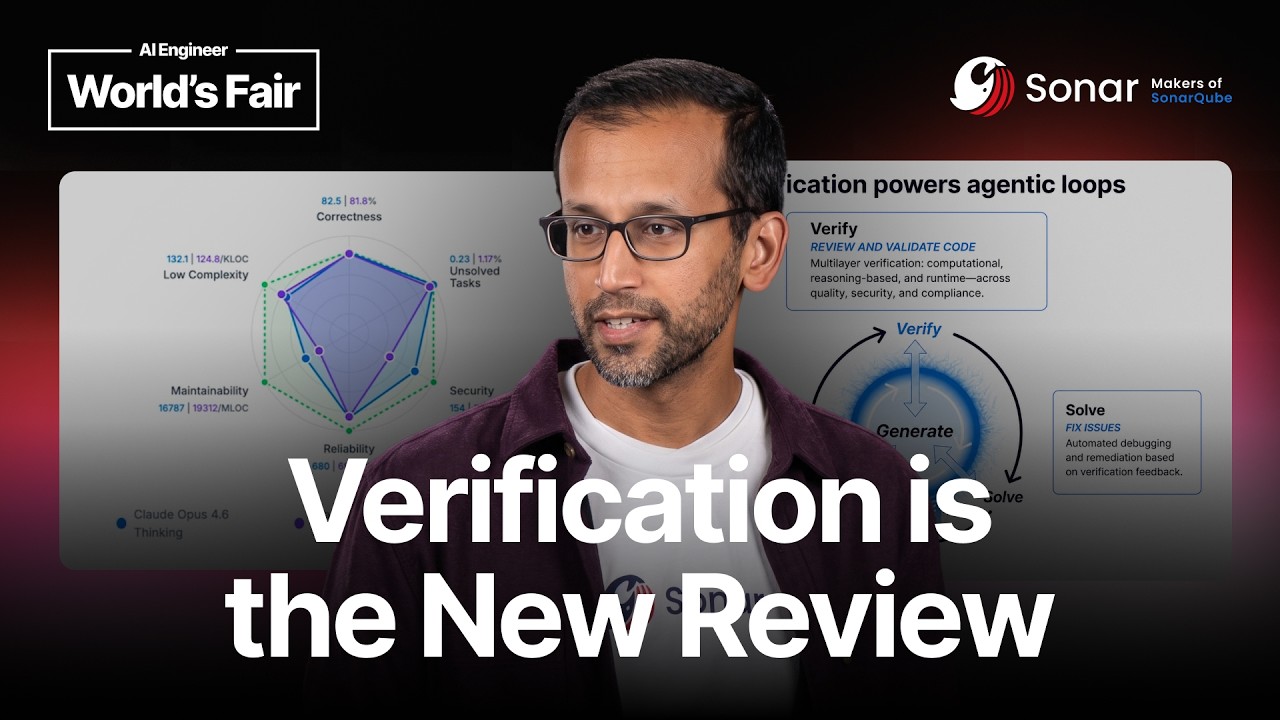
Anirban Chatterjee, from Sonar, discusses the critical need for robust verification in AI-driven software development, emphasizing a shift from AI experimentation to engineering. He highlights the concept of verification debt and its implications.
The Productivity Paradox and Verification Debt
Chatterjee references a Carnegie Mellon study that analyzed GitHub projects, categorizing them by whether AI tools were used for code generation (e.g., Cursor). The study revealed a temporary spike in developer productivity lasting about three months, followed by a sustained increase in static analysis warnings and code complexity, as measured by SonarQube. This indicates that while AI tools can accelerate initial development, they introduce a “verification debt”—a gap between the quality generated by AI and the quality required by the application.
The speaker explains that the tolerance for this quality gap depends on the criticality of the application:
- Low criticality: For experimental, internal, short-lived, or small-team projects, the gap is manageable.
- High criticality: For large codebases, many users, or adversarial environments, the required quality is significantly higher, necessitating human intervention to close the gap.
Why AI Models Introduce Quality Gaps
Several factors contribute to these quality issues:
- Inherent Imperfection: Despite advancements, models are prone to errors and quality issues. Shipping these errors can have catastrophic organizational effects.
- Lack of Context: Models lack the holistic understanding of the codebase, business objectives, or previous discussions that a human engineer possesses, leading to misaligned outputs.
- Model Diversity: Different models exhibit diverse quality characteristics. Sonar’s LLM leaderboard, which evaluates models across metrics like correctness, complexity, maintainability, reliability, and security, demonstrates this. For example, Claude Sonnet excels in correctness, while Claude Opus might be better for maintainability or security.
The Flaws of Human Review
Traditionally, human review serves as a backstop. However, a Wharton study found human review to be compromised:
- Participants followed AI advice 92.7% of the time when it was correct.
- Alarmingly, they still followed AI advice nearly 80% of the time even when the AI was instructed to lie confidently.
This indicates that human reviewers often rubber-stamp AI-generated code, especially under high load or tight deadlines, making manual verification an insufficient solution.
Zero-Trust, Multi-Layered Verification: The Solution
Anirban Chatterjee argues that verification must be zero-trust and multi-layered to effectively address the challenges of AI-generated code.
Zero-Trust Verification
- Independent Methodology: Verification should use a different methodology than the one that generated the code. The tool verifying the code should not share the blind spots of the generator.
- Comprehensive Regime: A consistent, auditable, explainable, algorithmic, and repeatable verification process should apply regardless of whether the code was human-written or AI-generated.
Multi-Layered Verification
- Diverse Techniques: No single technique can catch all issues. A combination of computational review and LLM-driven reasoning-based review is necessary to address syntax, data flow, architectural, and control flow issues.
The Agent-Centric Development Cycle (ACDC) Framework
Sonar proposes the ACDC (Agent-Centric Development Cycle) framework, which integrates verification throughout the development process:
- Guidance: Provide agents with upfront guardrails, context, architectural constraints, and coding standards to ensure better code generation from the start.
- Verification: Implement real-time, in-loop verification to identify and fix issues immediately, preventing their propagation into later stages.
- Solve/Remediation: Empower agents with the tools and agency to remediate identified issues themselves, rather than queuing them for human intervention.
Drivers for Adopting AI Code Verification
Organizations adopt this verification approach for several reasons:
- Consistent Verification: Standardized rulebooks for all projects and tools.
- Effective AI Tool Utilization: Optimizing token efficiency and using the right models for specific tasks.
- Shift-Left Security: Catching security vulnerabilities early in the development cycle, crucial given the rapid exploitation of CVEs.
- Compliance: Maintaining an audit trail for regulated industries.
Sonar’s Verification Solutions
Sonar offers a suite of products designed to implement this verification strategy:
- SonarQube: A mature, zero-trust, multi-layered verification platform for syntax, data flow, architectural, and control flow issues across multiple languages. It provides deep hooks for agents to access verification results.
- Gitarr (acquired): An AI code review tool that automates CI workflows. It finds issues using an LLM approach, can automatically block PRs based on quality gates, and can even write fixes and approve PRs automatically.
- Sonar Vortex (new): A new agentic loop capability that provides agents with in-loop tools for context management and real-time verification. Agents can call Sonar Vortex to get issues identified as they write code and fix them immediately.
- Remediation Agent (new): An agent designed to tackle technical debt and backlog issues at scale, allowing human developers to focus on innovation.
Integrated Workflow: Inner Agentic and Outer CICD Loops
Chatterjee outlines a comprehensive workflow:
- Specification Phase: Define architectural constraints, coding standards, dependencies, and quality criteria (e.g., security, quality, maintainability levels).
- Inner Agentic Loop (via Sonar Vortex):
- Agents receive context and constraints efficiently, avoiding token thrashing.
- Agents generate source code.
- In-loop verification occurs in real-time, allowing agents to fix issues immediately before they propagate.
- Outer CICD Loop (PR Flow via Gitarr and SonarQube):
- Formal review of the pull request.
- Broad automated review by SonarQube (computational) and Gitarr (LLM-driven superhuman review).
- Quality gates enforce passing grades across quality, security, and maintainability criteria.
- Fix agents can automatically address discovered issues.
- Once quality gates are passed, the code proceeds to test, build, and deploy.
Key Takeaways
- Establish bounded autonomy guidelines for AI agents, balancing generation freedom with centralized verification and constraints.
- Implement the ACDC framework for context provision, independent verification, and agent-driven error resolution.
- Equip developers with orchestration tools to design context frameworks and processes effectively.
- Standardize on a single, independent, multi-layered verification platform across all projects, teams, and AI tools to eliminate blind spots.