AI Agents vs Business Rules: Which Should Make Decisions?
This video contrasts deterministic business rules with probabilistic AI agents for enterprise decision-making. It argues that instead of one superseding the other, a hybrid approach combining rules-first processing with AI agent escalation for complex, unstructured, or judgment-heavy cases, augmented by deterministic guardrails and human oversight, leads to optimal automation.
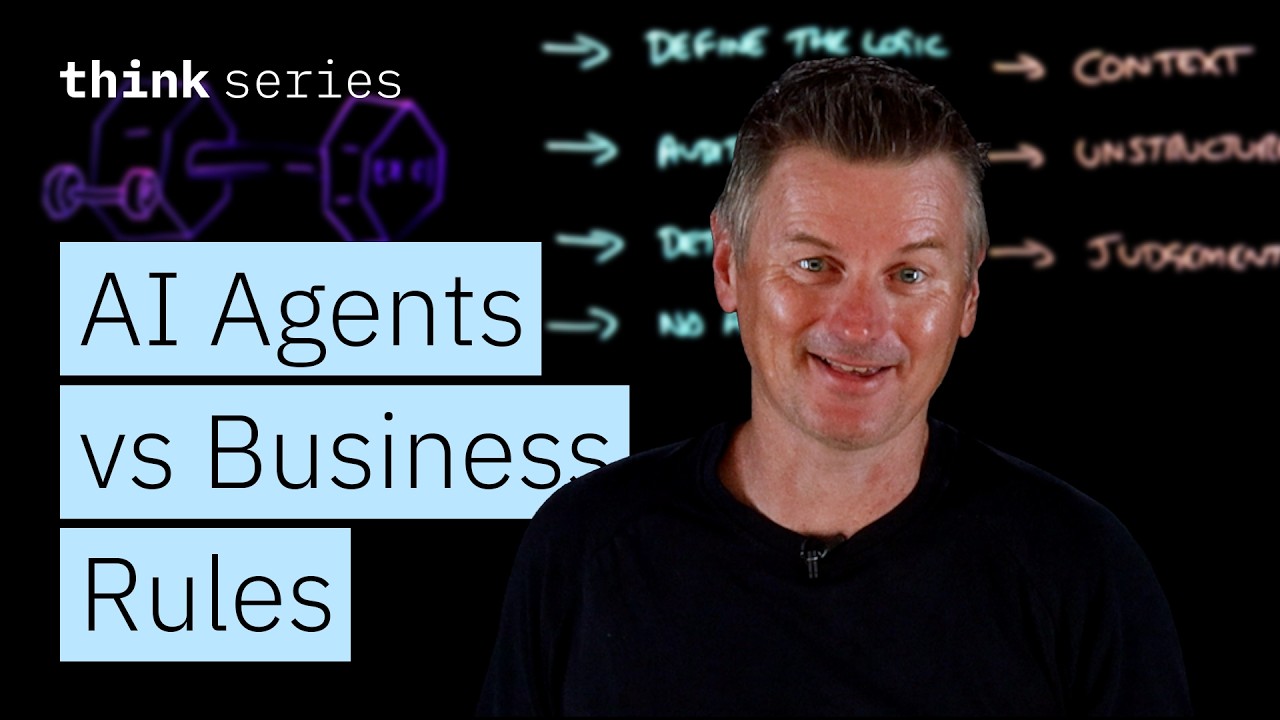
The presentation explores the nuanced relationship between business rules and AI agents in automating enterprise decisions, such as approving refunds or flagging transactions. While both aim to streamline decision-making, they operate on fundamentally different principles.
Business Rules: Deterministic and Explicit
Business rules, executed by a business rules engine, embody logic explicitly defined by human experts. These rules consist of specific conditions and corresponding actions. For instance, a rule might state: “IF an order is less than 30 days old AND the item was NOT marked as a final sale, THEN approve the refund.”
Key characteristics of business rules include:
- Determinism: Their output is a fixed and predictable function of the input, relying on simple boolean logic. Given the same inputs, the outcome is always identical, ensuring consistency.
- Clarity and Auditability: Each decision directly corresponds to an activated rule, providing a clear explanation for regulatory compliance and audits.
- Testability: Their deterministic nature allows for straightforward unit testing of each branch, guaranteeing consistent behavior in production.
- Efficiency: They run without requiring AI inference, incurring no additional AI-related computational costs.
Business rules are best suited for well-defined scenarios where logic can be precisely codified in advance, such as refund policies, loan eligibility checks, or insurance pricing tiers, especially when inputs are structured.
AI Agents: Probabilistic and Contextual
In contrast, AI agents do not follow predefined rules. Instead, they are provided with a goal, context, and access to a suite of tools. The agent then autonomously determines the necessary steps to achieve its objective. For example, rather than explicit refund rules, an AI agent might be given customer details, order policy, and order history, with the instruction to “sort it out.”
Core distinctions of AI agents:
- Probabilistic Nature: Built upon Large Language Models (LLMs), agents predict the next tokens, generating responses based on patterns learned during training. This means decisions are derived from a probability distribution over possible outcomes, making them inherently probabilistic. Running the same request twice can potentially yield different, albeit likely, results.
- Contextual Understanding: Agents excel when logic cannot be predetermined, particularly when decisions hinge on understanding the broader context, handling messy or unstructured inputs (e.g., free-form text descriptions, images), or addressing unanticipated scenarios.
- Judgment and Generalization: They are adept at making judgment calls, such as evaluating the merits of an unusual refund request (e.g., dumbbells returned for being “too heavy”), which is difficult to capture with deterministic rules. Agents generalize from patterns, enabling them to handle inputs for which no explicit rule exists.
- Tool Utilization: Agents can dynamically call upon various tools (e.g., vision models for image analysis, querying external databases) without explicit scripting, orchestrating their use based on the situational demands.
A Hybrid Approach: Rules First, Agents for Complexity
The prevailing solution in real-world systems is not to replace business rules with AI agents but to integrate them in a hybrid model. This typically involves a “rules-first” approach:
- Initial Request Processing by Rules Engine: All incoming requests first pass through the business rules engine. This step is cost-effective and fast.
- If a request clearly meets or violates defined policies (e.g., within auto-approve limits, or clearly outside policy), the rules engine makes the final decision (approve or decline) efficiently.
- Escalation to AI Agent: Only when the rules engine cannot make a clear decision—due to ambiguous data, unstructured inputs, or the need for nuanced judgment—is the request escalated to an AI agent.
- Data Handling: Agents are particularly valuable here, processing unstructured data like free text or images, which rules engines struggle with.
- Tool Orchestration: The agent dynamically identifies and uses appropriate tools to gather more context or perform specific analyses (e.g., using a vision model for a defective product photo).
- Agent Recommendation with Guardrails: After processing, the AI agent provides a recommendation. However, this recommendation is then subjected to a set of deterministic guardrails.
- Human-in-the-Loop: For decisions exceeding a certain risk threshold or involving high stakes, the guardrails can route the agent’s recommendation to a human for review and final approval, ensuring oversight.
- Automated Decision: Below this threshold, the agent’s recommendation might proceed directly to a final decision.
Conclusion
Ultimately, AI agents have not superseded hard-coded business rules. Instead, they complement each other effectively. Business rules provide efficiency, determinism, and auditability for clear-cut cases, while AI agents bring adaptability, judgment, and the ability to handle complexity and unstructured data. Their combined application, orchestrated with intelligent guardrails and human oversight, enables more robust and effective automated decision-making.