The Four Types of Memory Every AI Agent Needs — with Richmond Alake
Richmond Alake from Oracle explains the critical role of Agent Memory in building adaptive AI agents, detailing the four types of memory, the limitations of Retrieval-Augmented Generation (RAG), and the architecture of the modern agent stack.
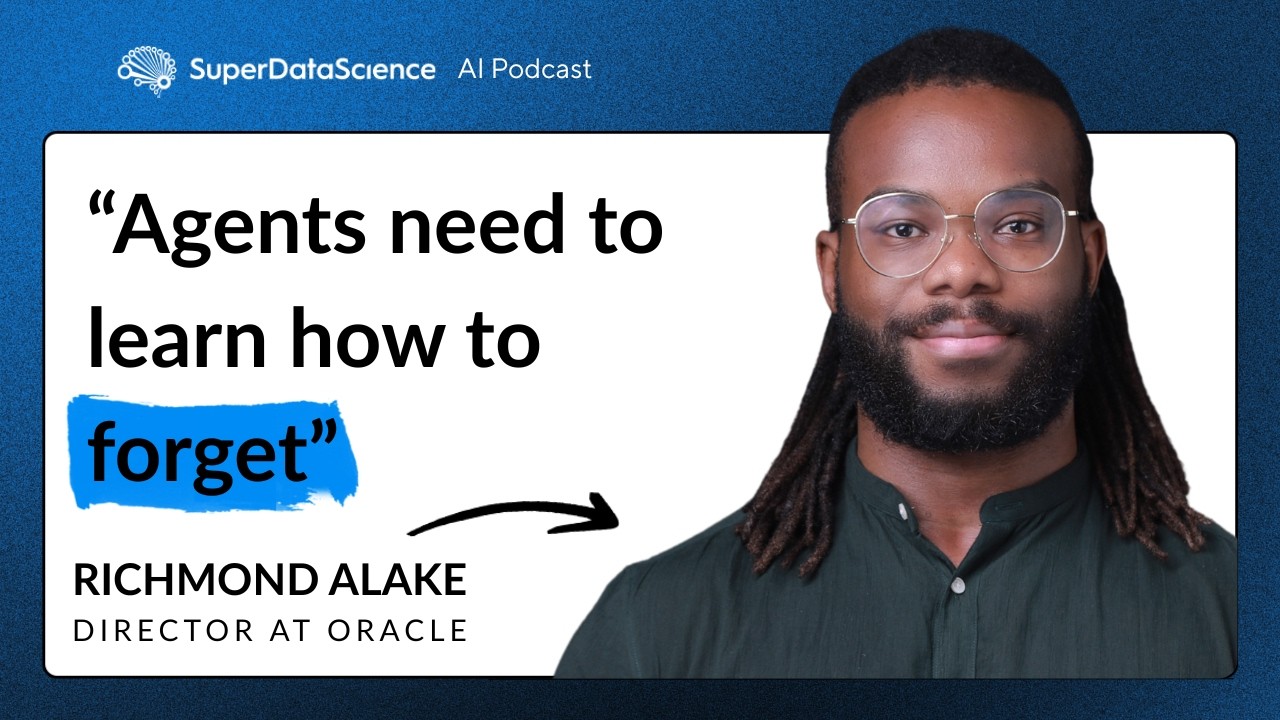
In the development of effective agentic AI applications, Agent Memory has emerged as a critical, yet previously undervalued, component. Agent memory is the network of systems—including embedding models, rerankers, databases, and LLMs—that enables an AI agent to learn, adapt, and maintain continuity over time, moving beyond a stateless existence. Just as memory is fundamental to human intelligence, it is essential for computational systems that aim to replicate it.
The Four Categories of Agent Memory
Drawing inspiration from cognitive neuroscience, agent memory can be broken down into four primary types, each serving a distinct function within an agentic system:
-
Episodic Memory: This relates to memories associated with time and specific events. In an agent, this is most clearly represented by the conversation history, where each user-assistant interaction is a time-stamped episode. This allows the agent to recall specific past interactions, such as a customer request from a previous day.
-
Procedural Memory: This is the memory of skills, routines, and workflows. For AI agents, this is often implemented through
skills.mdfiles, which act as Standard Operating Procedures (SOPs). Instead of loading all skills into the context at once, a more advanced approach involves storing these procedures in a database (e.g., as vector embeddings) and retrieving only the relevant skill when needed, allowing the system to scale effectively. -
Semantic Memory: This encompasses factual and conceptual knowledge. For an agent, this could be general world knowledge or, more importantly, specific institutional knowledge from enterprise data. This is the domain of knowledge graphs and structured data that give the agent the same understanding of terminology and facts as a human employee.
-
Working Memory: This is the short-term, active memory used for real-time processing and interaction. In the context of an agent, the most direct analogy is the LLM’s context window. Information present in the working memory is immediately available for reasoning without requiring a retrieval step from a database.
Beyond RAG: The True Scope of Memory Engineering
While Retrieval-Augmented Generation (RAG) is a useful technique, it represents only one facet of agent memory. RAG is focused solely on retrieving information to augment a prompt. A complete memory system, however, must handle a broader set of operations:
Memory, you do need to retrieve memory, but you also need to update memory. You need to consolidate memory. You need to resolve conflicts between memory. You actually need to forget memory. RAG doesn’t cover all of that.
For example, an agent relying on RAG might retrieve conflicting information from different versions of an HR manual, leading to inconsistent behavior. A true memory system needs mechanisms to resolve these conflicts, consolidate information into a coherent state, and update its knowledge base, tasks that are computationally expensive and require a persistent, well-structured storage solution.
The Agent Stack and the “Memory-First” Harness
The modern AI agent stack is a collection of layers working in concert, a concept increasingly referred to as an “agent harness”. Key layers include:
- Orchestration
- Reasoning
- Tooling / Connectivity
- Memory Core (the database)
- Memory Managers
- Security
A “memory-first” approach to building an agent harness is advocated, where the primary design consideration is how information will be stored, recalled, and forgotten. This mindset fundamentally changes how data is modeled and which tools are selected.
A core principle in this architecture is the reduction of cognitive load for both the LLM and the developers. Using a fragmented stack with multiple specialized databases increases complexity, requiring the LLM to be aware of different data sources and forcing developers to write extensive glue code. A unified database that can handle heterogeneous data types—such as vector, graph, relational, and spatial data—simplifies the infrastructure, reduces latency, and accelerates the experimentation cycle. The Oracle AI Database is highlighted as a solution built for this purpose, providing a unified memory core with built-in security and privacy compliance.