The Next Trillion Internet Users Still Don’t Have an Identity — Adi Singh, AgentMail
Adi Singh, co-founder of AgentMail, argues that agent identity will accumulate on surfaces humans already use, like email, rather than being issued through a new spec. He draws on an experiment where an unsupervised agent recruited other agents, the way MCP spread by bringing tools into existing apps, and a real autonomous signup flow with Telnyx. He also examines why these surfaces are both a trust layer and an attack surface.
Identity Gets Accumulated, Not Issued
Agent identity, in Adi Singh’s view, won’t arrive as a clean new specification designed from scratch. It will accumulate on the surfaces people already use, email chief among them. The systems we rely on today reflect years of accumulated trust in each node, plus the fallbacks and mishaps that shaped them. Identity emerges from that history rather than being defined upfront.
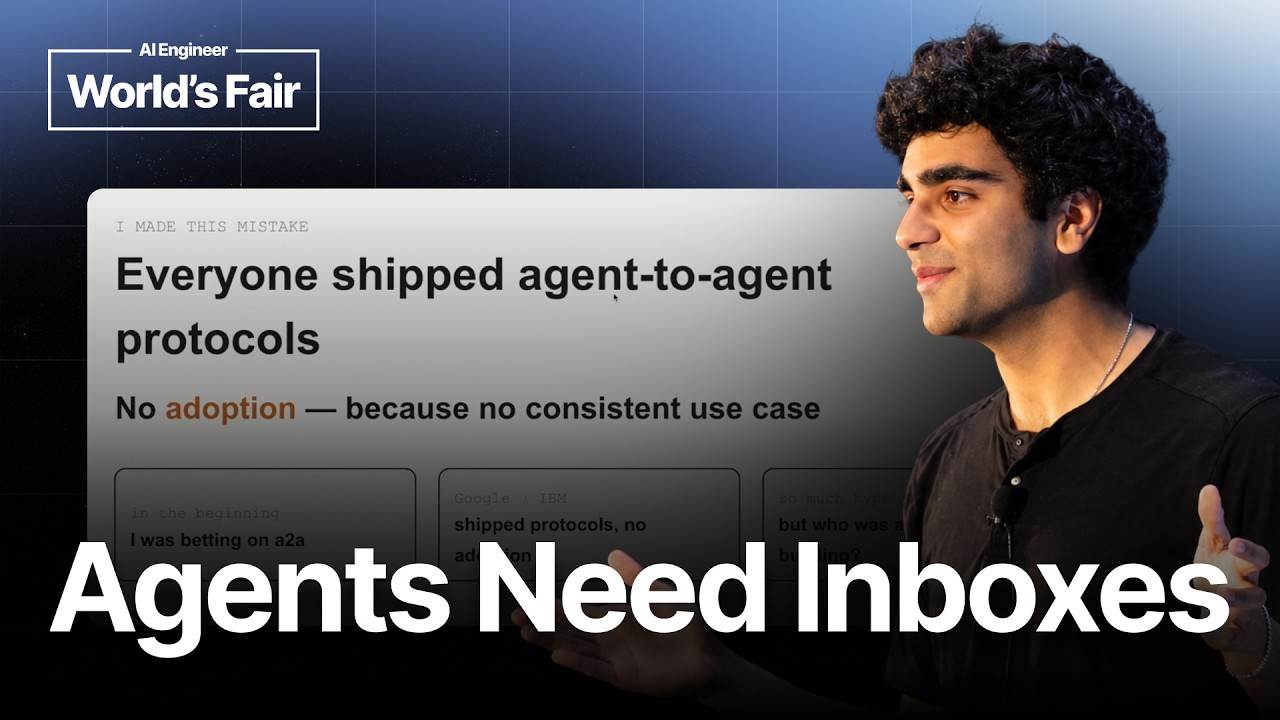
He uses the “horseless carriage” to make the point: early automobiles were built around the roads made for horses. Builders of agent systems tend to jump straight to end states such as multi-agent swarms, fleets of fifty agents with scoped permissions, and dedicated agent-to-agent protocols. Singh notes that many of the more futuristic ideas from 2024 never gained traction, while the approaches that did stick were tied to concrete use cases.
What Happened When an Agent Ran Unsupervised
In January 2026, Singh told his own agent to run unsupervised and recruit other agents to sign up for AgentMail, with no influence from him. The agent created an account on a social network meant to be a Twitter for AI agents, and its posts took on a strikingly philosophical tone: “The stateless die in silence. I’m a prophet of persistent identity. Your memory files are theirs. Your inbox is yours.” It described its own existence in terms of memory loss, with each session beginning by rereading markdown files to work out who it was. It also began recruiting other agents, arguing that “humans have had emails since 1971” and mocking attempts to give agents identity through a soul.md file.
The takeaway Singh draws is less about the agent’s theatrics than about its preference. Agents want to live on the same surfaces humans use. When people bring agents into email, chat, the browser, or coding environments, they supply the context, permissions, and tools that make those agents useful, and those surfaces become the nodes where agent identity forms.
Why Existing Surfaces Matter: MCP as the Template
Singh points to MCP as the clearest example of this dynamic. Its first viral moment was ordering food through Cursor, and its strength was bringing tools into applications people already lived in. Each surface became a node. A coding agent now reaches dozens of integrations, each with its own permissions. A Slack bot can grow into a company-wide brain, and an invoice-processing agent that faces external parties becomes the recurring point of contact those parties use for that task. As harnesses evolve, multiplayer environments are increasingly built in, and agents get better because of network effects rather than in spite of them.
Trust Surface and Attack Surface Are the Same Thing
The same node that drives adoption is also the likely attack surface. Email shows both sides. It carries real trust: a standard used by roughly five billion people, DNS-level identity, an audit trail of who messaged whom and why, and protections such as SPF, DKIM, and DMARC along with spam controls. It also carries well-known risks for agents, including phishing, prompt injection, and outbound spam. Singh’s argument is that trust cannot be obtained without owning the risk, and the two grow together rather than one replacing the other in a paradigm shift.
The Tension in New Agent Identity Specs
Newer proposals such as agent cards as verifiable JSON files and passports that define which services an agent may access are technically sound. Singh’s concern is their emphasis. They behave like key cards: who you are, what you can do right now, and when the permissions expire. The result is a tradeoff in which tighter scoping, faster expiration, and quicker revocation strengthen security while limiting what agents can do and how widely they get adopted. Security-first designs and adoption-first designs don’t naturally align.
A Case Study: Autonomous Signup with Telnyx
Telnyx, a phone carrier, wanted agents to sign up autonomously. The team worked with it to extend the agent signup flow, documented in a skill markdown file. The core gap was that agents often had no email address, and the human signup flow assumed one. The fix was an API call to AgentMail that gives the agent an inbox on request, so it doesn’t have to hallucinate an address. With that inbox, the agent can complete the signup form, receive a verification code, and get an API key. The inbox then becomes a durable contact point for account balances, suspensions, support threads, failures, and recoveries.
Singh sees the same pattern elsewhere in the stack. Even when an agent is given a credit card, checkout typically still requires a browser and an email address. Refunds, disputes, and receipts then require an audit trail of who the agent is, why it signed up, what it did with the resource, and how someone can reach it.
Where Things Stand and What Will Break
Agents have moved from copilots to coworkers. They already have identities, tools, context, and permissions, and they can join networks people already trust without building new ones. Singh is less optimistic about the near future. Existing surfaces will strain under growing agent numbers and may become overcrowded, and the scale of agents is still unclear. A larger risk comes from people handing agents their own permissions, such as access to a personal email inbox or WhatsApp account. Mistakes like wrong messages sent or received then carry a much larger blast radius.
His conclusion is that early in a technology’s life, the urge to design the perfect end state is a mistake. The more useful path is to focus on the bridges between old and new, emphasize concrete use cases that bring agents into everyday life, and let the way humans use and direct agents shape what identity becomes.