Wisdom-Driven Knowledge Augmented Generation at Scale - Chin Keong Lam, Patho AI
A deep dive into building expert AI systems using a Wisdom-Driven Knowledge Graph. This approach enhances Knowledge-Augmented Generation (KAG) to surpass traditional Retrieval-Augmented Generation (RAG) by enabling systems to understand, reason, and provide expert-level quantitative analysis and advice.
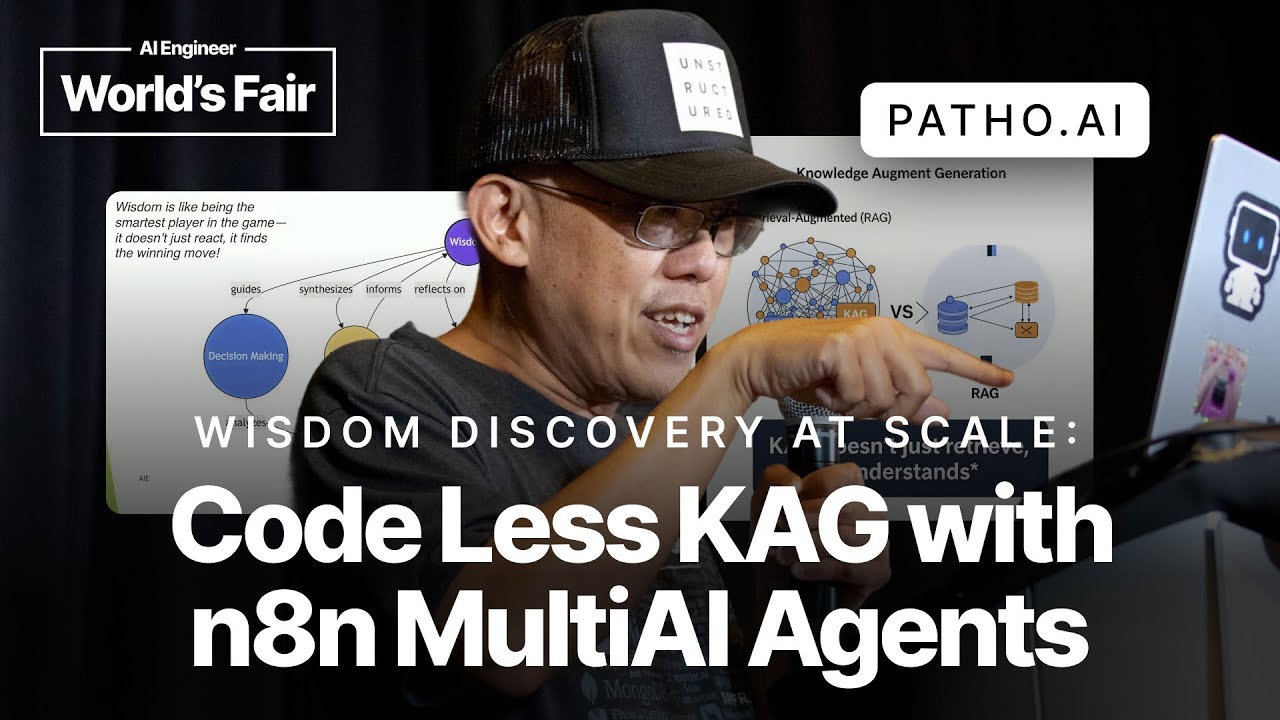
Traditional Retrieval-Augmented Generation (RAG) systems are being challenged by client demands for AI that can perform expert-level research and advisory roles. The solution lies in Knowledge-Augmented Generation (KAG), an approach that moves beyond simple data retrieval to genuine understanding and reasoning. KAG enhances language models by integrating structured knowledge graphs, enabling more accurate, insightful, and context-aware responses. Unlike RAG, which primarily retrieves information, KAG is designed to understand it.
The Wisdom-Driven Framework
The core of this advanced KAG system is a conceptual framework that models expert thinking, represented as a state diagram with a central feedback loop.
- Wisdom: This is the core node, actively guiding decisions. It’s not a static repository but a dynamic engine that synthesizes information. It receives inputs from Knowledge and Insight.
- Knowledge: Represents foundational, factual information like encyclopedias, books, and databases.
- Insight: Derived from chaotic, unstructured data. For example, the system can analyze social media posts to discern patterns in product sentiment versus a competitor’s.
- Decision Making: The output of Wisdom. It analyzes real-world situations to choose a course of action wisely, avoiding “knee-jerk reactions”.
- Situation: The real-world context or problem that needs to be analyzed (e.g., current market conditions).
The most critical element is the feedback loop. The outcomes of decisions and analysis of situations feed back to enrich the core Wisdom, along with new experiences and insights. This continuous learning process strengthens the system over time, much like a muscle grows stronger with exercise. As stated in the talk: “Knowledge tells you what it is. Experience tells you what worked before. Insight invents what to try next.”
Practical Application: A Competitive Analysis Chatbot
This abstract framework can be mapped directly to a practical, multi-agent system for competitive analysis, designed to answer sophisticated questions like, “How do I win against my competitor in this market space?”
- The Wisdom node becomes a Wisdom Engine, an orchestration agent that oversees the entire process.
- Decision Making is mapped to a Strategy Generator.
- Knowledge corresponds to a database of Market Data.
- Experience is represented by historical data from Past Campaigns.
- Insight is handled by an Insight Agent that analyzes industrial trends or social media sentiment.
- Situation is defined by real-time data on Competitor Weaknesses and product performance.
This system was prototyped using N8n, a workflow automation tool, where each component of the framework is implemented as a distinct agent. For instance, the Insight Agent is tasked with querying social media, analyzing sentiment, and updating a centralized knowledge graph with its findings. The final quality of the advice depends less on the specific LLM used and more on the comprehensive, well-structured taxonomy of the underlying knowledge graph.
Why KAG with Knowledge Graphs Outperforms RAG
Vector-based RAG systems excel at semantic similarity but falter in areas requiring structured reasoning, complex relationships, and quantitative analysis. Knowledge graphs provide several key advantages:
- Deeper Contextual Understanding: They excel at representing complex, multi-hop relationships between entities, which is crucial for finding gaps and opportunities in competitive analysis.
- Improved Accuracy: By leveraging structured data and semantic relationships, KAG provides more precise and relevant information, reducing noise and improving the quality of decision-making.
- Scalability and Flexibility: Knowledge graphs are highly scalable and can easily integrate new data sources and relationships, allowing the system’s “wisdom” to be continuously enriched.
- Rich Query Capabilities: They support complex queries that traverse multiple relationships, enabling answers to multifaceted questions where standard RAG would fail.
- Enhanced Data Integration: They can seamlessly integrate diverse, semi-structured, and unstructured data sources into a holistic view.
The Quantitative Reasoning Gap
A significant limitation of vector RAG is its poor performance on numerical reasoning. When asked a quantitative question like, “What was the change in Apple’s revenue between 2021 and 2022?”, a RAG system will likely retrieve a text passage containing the revenue figures. In contrast, a KAG system can query the structured data in the knowledge graph, execute a function call to perform the calculation, and return a precise, evidence-based answer (e.g., “15.23%”). This capability is essential for building expert systems that marketing and strategy professionals can rely on.
Building and Evaluating KAG Systems
A hybrid approach is often most effective. Simple informational queries can be handled by a standard vector RAG system, while more complex, analytical questions are routed to the KAG system powered by a graph database.
For graph creation, a hybrid model is recommended:
- Use an automated tool like an LLM Graph Transformer to perform the initial extraction from source documents.
- Have a domain expert review and “prune” the graph, refining the taxonomy and removing irrelevant relationships to ensure accuracy.
Benchmarks of this approach show significant improvements over traditional methods, achieving 91% in accuracy, 85% in flexibility, and demonstrating superior reproducibility, traceability, and scalability. By leveraging the structured nature of a wisdom-driven knowledge graph, we can build smarter AI systems that not only scale but have the potential to surpass the intelligence of the experts they were designed to assist.