Knowledge graphs

AI on Your Lakehouse: Context Comes in Shapes, Not Queries — Zach Blumenfeld, Neo4j

AI on Your Lakehouse: Context Comes in Shapes, Not Queries — Zach Blumenfeld, Neo4j

AI agents often struggle with context in lakehouses, leading to confident but incorrect answers. This workshop by Zach Blumenfeld introduces three Neo4j graph shapes built on lakehouse data—Connections (semantic layer), Trees (document outlines), and Communities (themes)—to provide essential context, enabling agents to accurately navigate structured and unstructured data, answer complex estate-level questions, and overcome limitations of traditional Text2SQL and vector search.

Citation Needed: Provenance for LLM-Built Knowledge Graphs — Daniel Chalef, Zep AI

Citation Needed: Provenance for LLM-Built Knowledge Graphs — Daniel Chalef, Zep AI

Daniel Chalef discusses how LLM synthesis destroys data provenance, making it difficult to trace information back to its sources. He introduces Graphiti, an open-source temporal graph framework, and Zep, an agent memory infrastructure built upon it. This system models provenance as a graph, treating sources as 'episodes' and derived facts as interconnected nodes and edges. This approach enables robust lineage tracing, handles entity merges and fact invalidation through temporal mechanisms, facilitates metadata-driven trust evaluation, and allows for compliant data deletion (e.g., GDPR) based on source support. The benefits include enhanced compliance, improved data veracity, and debuggable AI agents, addressing a critical engineering challenge in LLM applications.

Why Agentic Systems Need Ontologies — Frank Coyle, UC Berkeley

Why Agentic Systems Need Ontologies — Frank Coyle, UC Berkeley

Frank Coyle discusses the inherent flaws of purely probabilistic LLMs in agentic systems and proposes a neuro-symbolic solution. He advocates for wrapping LLM tool-use loops with external ontologies and validation mechanisms (like RDFS, OWL, and Pydantic) to provide logical guardrails, preventing common, critical errors that probabilistic reasoning alone cannot reliably avoid.

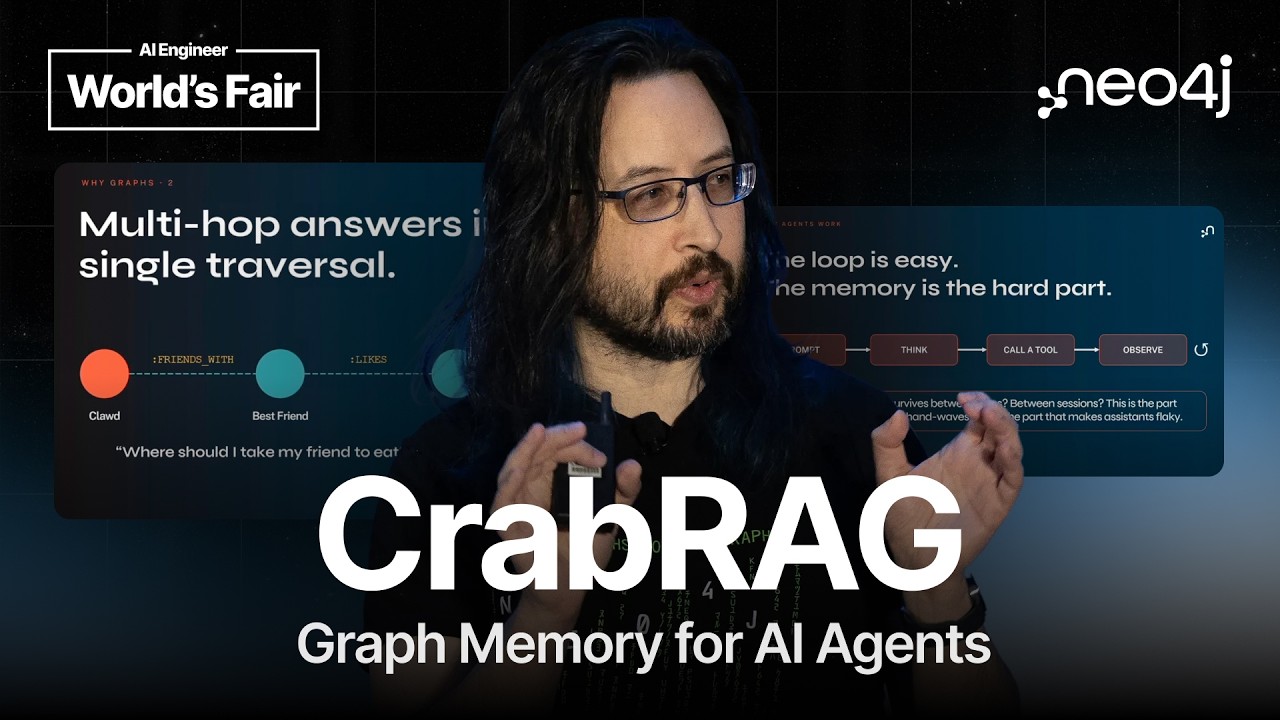
CrabRAG: Why Automated Assistants Need Graph Memory, Not More Tokens — Stephen Chin, Neo4j

CrabRAG: Why Automated Assistants Need Graph Memory, Not More Tokens — Stephen Chin, Neo4j

Stephen Chin demonstrates how current LLM agent memory systems, relying on markdown files or vector databases, lead to token inefficiency, hallucinations, and a lack of multi-hop reasoning. He showcases graph databases as a superior alternative, providing precise, explainable, and auditable answers for complex, large-scale problems through a live demo of a home lab digital twin.

Sandboxing, Agent Harnesses, and Agent Teamwork

Sandboxing, Agent Harnesses, and Agent Teamwork

Shahram Anver, CEO of Cleric, details how AI agents for SRE are evolving beyond fast triage to continuous learning and operational memory. He discusses Cleric's architectural shifts, from complex early designs to simpler, sandboxed query agents, and the unique challenges SRE agents face in diverse production environments. A core focus is on human-agent interaction, redefining roles as managers overseeing agents, and how agents learn from unstructured data like Slack to build robust, actionable knowledge for autonomous, self-healing infrastructure. The discussion also touches on the future of software, differentiating between durable systems and rapidly developed "skills" or "vibe-coded" solutions.

A Practitioner's Guide to Graphs - Tim Ainge, Good Collective

A Practitioner's Guide to Graphs - Tim Ainge, Good Collective

A speed-run through the fundamentals of graphs for AI engineers, covering how to build effective graphs from unstructured text using schema-first approaches and entity resolution, and then exploring powerful graph-native algorithms like Personalized PageRank, Shortest Path, and Subgraph Matching, all illustrated with real-world applications to create smarter, cheaper, and more reliable AI solutions.