Why Voice Security Is Your Next Big Problem
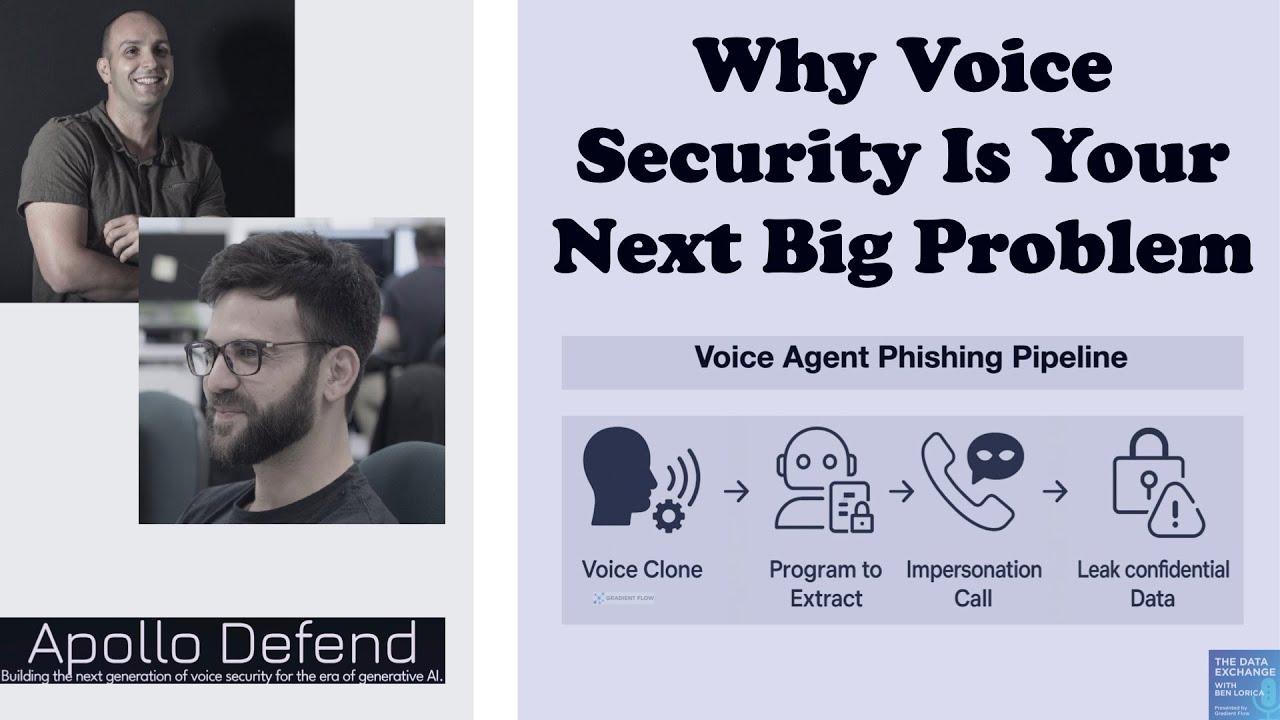
Yishay Carmiel and Roy Zanbel of Apollo Defend explore the state of voice AI, detailing the shift from cascaded models to end-to-end speech-to-speech systems. They break down the imminent security threats, including accessible voice cloning and sophisticated agent-based attacks, and discuss the nascent defense mechanisms and the urgent need for a new layer of voice security for governments, enterprises, and consumers.
The Current State of Voice AI: A “Cascading” Reality
The landscape of voice AI has not yet fully consolidated around foundation models in the same way the NLP field has with LLMs. While the endgame will likely involve off-the-shelf, best-in-class foundation models, the current common architecture relies on a “cascading” pipeline. This approach typically involves three stages:
- Speech Recognition: Models like OpenAI’s Whisper are widely used to convert spoken audio into text.
- Text Processing: An LLM processes the transcribed text to generate a response.
- Speech Synthesis: Text-to-speech (TTS) models, such as those from 11Labs or various open-source projects, convert the text response back into audio.
While effective, this multi-step process introduces latency and potential points of failure. Recent years have seen significant leaps in the quality of TTS, moving from robotic outputs to highly realistic, conversational speech that can handle the complexities and expressiveness of the human voice.
The Next Evolution: End-to-End Speech-to-Speech Models
The industry is rapidly moving towards what is considered the “holy grail”: end-to-end, real-time, speech-to-speech models. These systems, sometimes referred to as “Audio LLMs,” treat audio as the primary input and output, using token-based representations internally rather than relying on a full text conversion. This sequence-to-sequence approach promises to unlock lower latency and more fluid, natural-sounding voice interactions.
Major tech players are heavily invested in this area. Amazon has released “Amazon Nova,” and Meta is developing “Voicebox” and “Audiobox.” This shift will make advanced voice agents more capable and commoditized, but it also introduces a new and more complex security paradigm.
The Rise of Voice Cloning and Its Threats
One of the most significant and alarming developments is the democratization of voice cloning technology. With as little as 5 to 10 seconds of clean audio, current models can create a highly convincing clone of a person’s voice, capturing subtle accents and tones. The tools to achieve this are increasingly accessible, with open-source models and simple user interfaces lowering the barrier to entry to near-zero. Anyone with a computer and an internet connection can execute such an attack.
This capability creates several critical threats:
- Sophisticated Social Engineering: Malicious actors can impersonate individuals with high fidelity, making phishing and fraud attempts far more convincing.
- Bypassing Voice Biometrics: Systems that rely on voice for authentication are now fundamentally insecure and easily bypassed.
- Automated Attacks at Scale: Nefarious voice agents can be deployed to make thousands of calls, pretending to be a trusted individual to extract sensitive information like social security numbers or financial data.
Threat Models and Defensive Strategies
Defending against these threats requires understanding the attack vectors, which can be categorized similarly to traditional cybersecurity:
- White-box: The attacker has full knowledge of the model architecture and weights, making the system highly vulnerable.
- Gray-box: The attacker has partial knowledge, such as the model family (e.g., a Whisper-based system), and can craft more targeted attacks.
- Black-box: The attacker has no knowledge of the underlying system, making attacks more difficult but not impossible.
The defensive landscape is a “cat-and-mouse game” consisting of two primary strategies:
- Deepfake Detection: This involves analyzing an audio stream to determine if it was synthetically generated. However, its effectiveness is a constant challenge. Detectors are often trained on data from older models and struggle to identify attacks from the latest, most advanced generative techniques.
- Anti-Cloning and Anonymization: A more proactive approach involves modifying a person’s voice in real-time. The technology can create a new voice stream that sounds natural and preserves the speaker’s characteristics for a human listener but is fundamentally altered at the signal level, making it impossible for an AI to use for cloning. The major limitation is that this only protects future conversations and cannot secure the vast amount of existing audio data available publicly (e.g., on podcasts and YouTube).
Market Outlook: A New Security Layer is Inevitable
Currently, the primary demand for voice security comes from government and defense agencies, which face sophisticated, state-level adversaries. For the broader enterprise market, voice security is not yet a top priority for most CISOs, who are still grappling with the security implications of text-based LLMs. However, this is expected to change rapidly, with a 6 to 12-month horizon for voice security to become a critical concern.
As voice becomes the next major interface for AI—akin to how every company once needed a website—a new security layer will become essential. Organizations will need to defend against voice-based attacks even if they don’t actively use voice AI themselves, as their employees and systems can be targeted by external threats. Just as firewalls and spam filters became standard for email, a similar protective layer will be required to ensure trust and safety in the era of voice AI.