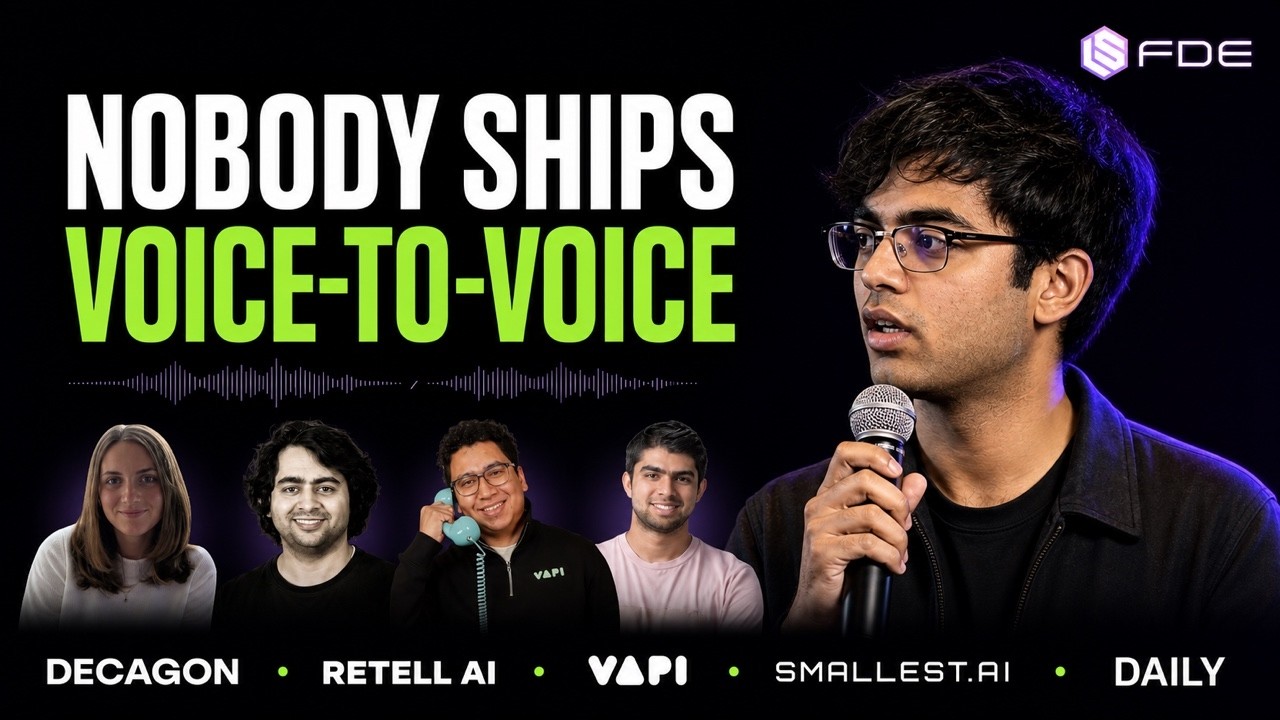
Speech to speech

⏭️ Forward Deployed: Voice AI on what works in 2026

⏭️ Forward Deployed: Voice AI on what works in 2026

This podcast episode delves into the pragmatic realities of building and deploying voice agents in enterprise. Featuring leaders from Decagon, Vapi, Retell, Daily, and Smallest AI, the discussion uncovers why the current state-of-the-art relies on cascaded pipelines (STT -> LLM -> TTS) instead of direct voice-to-voice models. Key challenges explored include managing latency versus intelligence, ensuring system reliability through fallback models, the complexities of turn-taking, and architectural strategies to overcome LLM context limitations and optimize costs. The experts also touch upon the differences between inbound and outbound use cases, multilingual considerations, and the potential future of hybrid voice agent architectures.

Voice AI: when is the "Her" moment? — Neil Zeghidour, Gradium AI

Voice AI: when is the "Her" moment? — Neil Zeghidour, Gradium AI

Neil Zeghidour, CEO of Gradium AI, deconstructs the gap between current voice AI and the "Her" ideal. He argues that while cascaded systems are practical, they are architecturally flawed for natural conversation. The future lies in full-duplex, speech-to-speech models that not only solve latency but also integrate deep paralinguistic understanding and overcome significant cost barriers.

Building Voice Agents Just Got Easier

Building Voice Agents Just Got Easier

Anoop Dawar from Deepgram discusses the evolution of voice AI, from basic transcription to sophisticated, real-time voice agents. He covers the key technical challenges in production, such as latency and interruption handling, and introduces Deepgram's Flux system. The talk concludes with a look at the future of speech-to-speech models that can understand emotional nuance, moving closer to passing the audio Turing Test.

Build Hour: Voice Agents

Build Hour: Voice Agents

A deep dive into building sophisticated voice agents using OpenAI's Realtime API and Agents SDK. The session covers architectural patterns like chained vs. end-to-end models, the use of multi-agent systems with handoffs for specialized tasks, and best practices for production including debugging with traces, implementing guardrails, and creating robust evaluations.

Introducing gpt-realtime in the API

Introducing gpt-realtime in the API

An overview of the new GPT-realtime speech-to-speech model and the general availability of the Real-Time API, detailing its architecture, advanced capabilities like image input and multilingualism, training methodology, and new enterprise-ready features.

Pipecat Cloud: Enterprise Voice Agents Built On Open Source - Kwindla Hultman Kramer, Daily

Pipecat Cloud: Enterprise Voice Agents Built On Open Source - Kwindla Hultman Kramer, Daily

A deep dive into the challenges of building production-grade, low-latency voice AI agents, and how the open-source, vendor-neutral framework Pipecat provides a comprehensive solution for development, deployment, and scaling. Learn about voice AI architecture, the trade-offs between speech-to-speech and text-based models, and practical deployment strategies.