No Priors Ep. 141 | With Sunday Robotics Co-Founders Tony Zhao and Cheng Chi
Tony Zhao and Cheng Chi, co-founders of Sunday Robotics, discuss the state of AI robotics, framing it as being between a "GPT moment" (the core technology is known) and a "ChatGPT moment" (a scalable consumer product). They detail the key research, data collection innovations, and full-stack engineering required to build Memo, their general-purpose home robot designed to free humanity from chores.
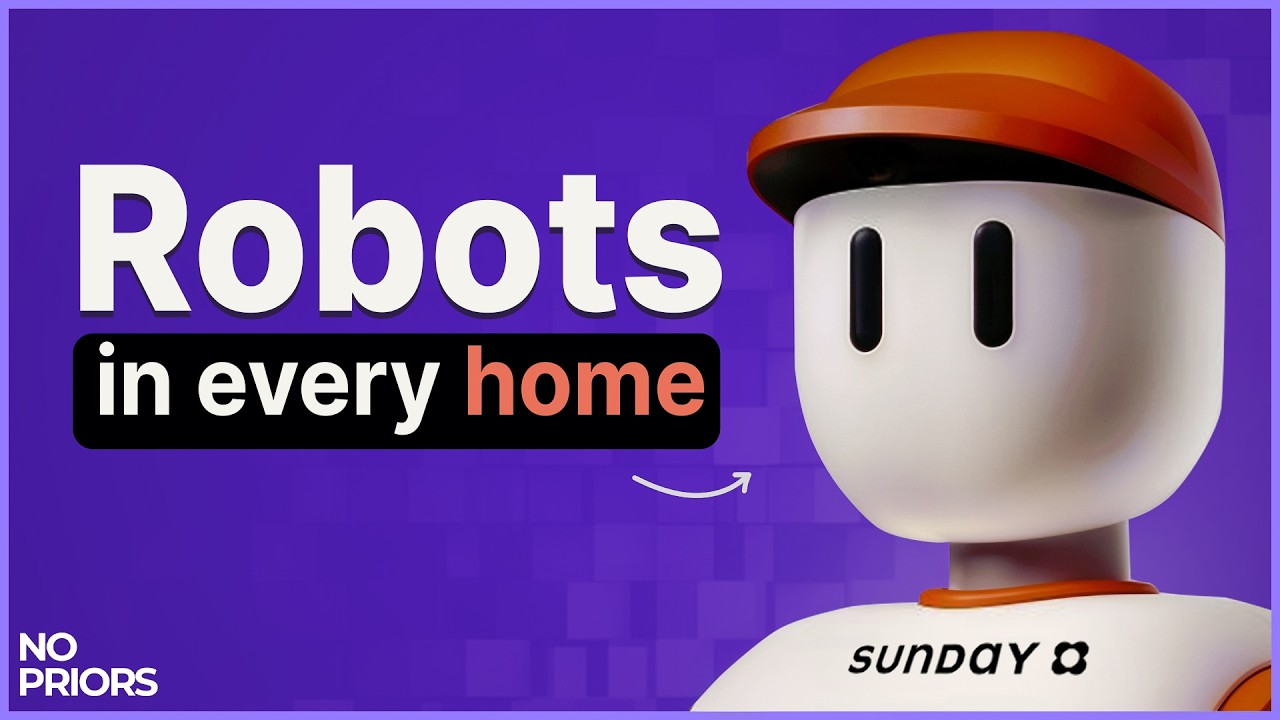
The field of robotics is at an inflection point, moving from a technological breakthrough phase to a product-focused one. We have a recipe that can be scaled, analogous to the transition from GPT to ChatGPT, but the industry has not yet scaled it to the point of creating a great consumer product. The consensus in academia and industry is shifting towards end-to-end learning models, a significant departure from classical robotics.
From Classical to End-to-End Robotics
Previously, robotics was dominated by a modular “sense, plan, act” approach. This required engineers to manually design interfaces for each module and for every specific task and environment. This lack of generalizability meant that work was often discarded when moving to a new task, resulting in slow progress.
The current paradigm, however, is built on scalable, generalizable AI algorithms, fueled by several key research breakthroughs.
Key Research and Algorithmic Advances
-
Diffusion Policy: This algorithm was a critical step for imitation learning. Previously, imitation learning was notoriously “finicky,” often requiring a single expert to collect all data to ensure consistency. Diffusion models unlocked the ability to capture multiple modes of behavior (multimodality) from the same observation while maintaining training stability. This enabled more scalable data collection from multiple, even untrained, people.
-
Transformers and Dextrous Data (ACT & ALOHA): The application of Transformers to robotics was unlocked by the advent of higher-quality, dextrous datasets. Systems like ALOHA made teleoperation more intuitive and responsive, reducing lag and making it feel more like playing a video game. This higher-fidelity data was crucial for Transformers to be effective; before this, deep models like ResNets or Transformers often performed worse than simple three-layer MLPs.
-
Action Chunking: Predicting a trajectory or a “chunk” of actions, rather than a single action at each millisecond, proved vital. This approach mirrors how humans act—perceiving and then executing a sequence of motions—and leads to more consistent and stable robot behavior.
The Data Collection Bottleneck: Enter UMI
The primary limitation for scaling these models was the reliance on complex, lab-based teleoperation setups. To build a robot that works “in the wild,” data must also be collected in the wild.
This led to the development of UMI, a system for collecting robotics data without a robot. The core insight was that the essential components are paired observation and action data. By using a wearable glove and a GoPro, it’s possible to capture hand and finger movements (action) along with a first-person video feed (observation). This decoupled data collection from the physical robot, allowing a small team to quickly gather one of the largest robotics datasets by performing tasks in everyday environments like restaurants. This data was instrumental in training the first end-to-end model that could generalize to unseen environments.
Sunday Robotics: A Full-Stack Approach
Building a real product required moving beyond research demos. Sunday Robotics was founded to bring together expertise in mechanical engineering, software, AI, and supply chain to build a complete system.
Design Philosophy
The goal is to build a useful robot as soon as possible by simplifying wherever possible without sacrificing capability.
- AI-Centric Hardware: With AI providing the “eyes,” the robot can perceive and correct for its own mechanical inaccuracies. This allows for the use of low-cost, compliant, and inherently safer actuators, rather than the stiff, precise, and expensive hardware used in traditional blind industrial robots.
- Simplification for Cost: The robot’s hand has three fingers, combining the function of several human fingers that are often used together for grasping. This reduces mechanical complexity and cost while retaining most of the necessary functionality for home chores.
- Friendly Appearance: To make the robot ubiquitous, it is designed to be friendly and cute, like a character from a cartoon, rather than an intimidating “Terminator.”
Scaling the System
Scaling up the entire pipeline—from data collection to training to hardware—is a significant challenge. The data collection glove has gone through five major versions and over 100 small iterations to ensure it is a precise and reliable device at the scale of 500+ users. Maintaining data quality at scale is paramount, requiring automated pipelines for calibration, error detection, and data filtering.
The Path to a Home Robot
- Timeline: A beta program is planned for 2026, where robots will be placed in homes to learn about human-robot interaction and refine the product. A mass-market release could follow in 2027 or 2028. This is years, not a decade, away.
- Cost: While current prototypes cost between $6,000 and $20,000, scaling up manufacturing through techniques like injection molding is expected to bring the bill-of-materials cost under $10,000.
On Evaluating Robotics Demos
It is crucial to look at demos with a critical eye. Key questions to ask are:
- Is it autonomous or teleoperated?
- Does it show generalization to different objects, people, or environments? If not, assume it cannot generalize.
- How long is the sequence of interactions? Longer, more complex sequences demonstrate higher reliability, as every interaction is a potential point of failure.
Sunday’s demos are designed to showcase generalization (zero-shot performance in new homes), long-horizon tasks (cleaning an entire table and loading a dishwasher), and fine-grained dexterity (operating an espresso machine, folding socks), which requires nuanced force control that is difficult to achieve with teleoperation.