What Engineers Get Wrong About Liquid Cooling - Wendy Luiten | Podcast #163
Thermal engineer and 2024 Thermy Award winner Wendy Luiten discusses the impending energy and water crisis driven by AI data centers. She explores how computational fluid dynamics (CFD) and a shift to sustainable liquid immersion cooling, particularly with plant-based oils, can mitigate the environmental impact while ensuring performance.
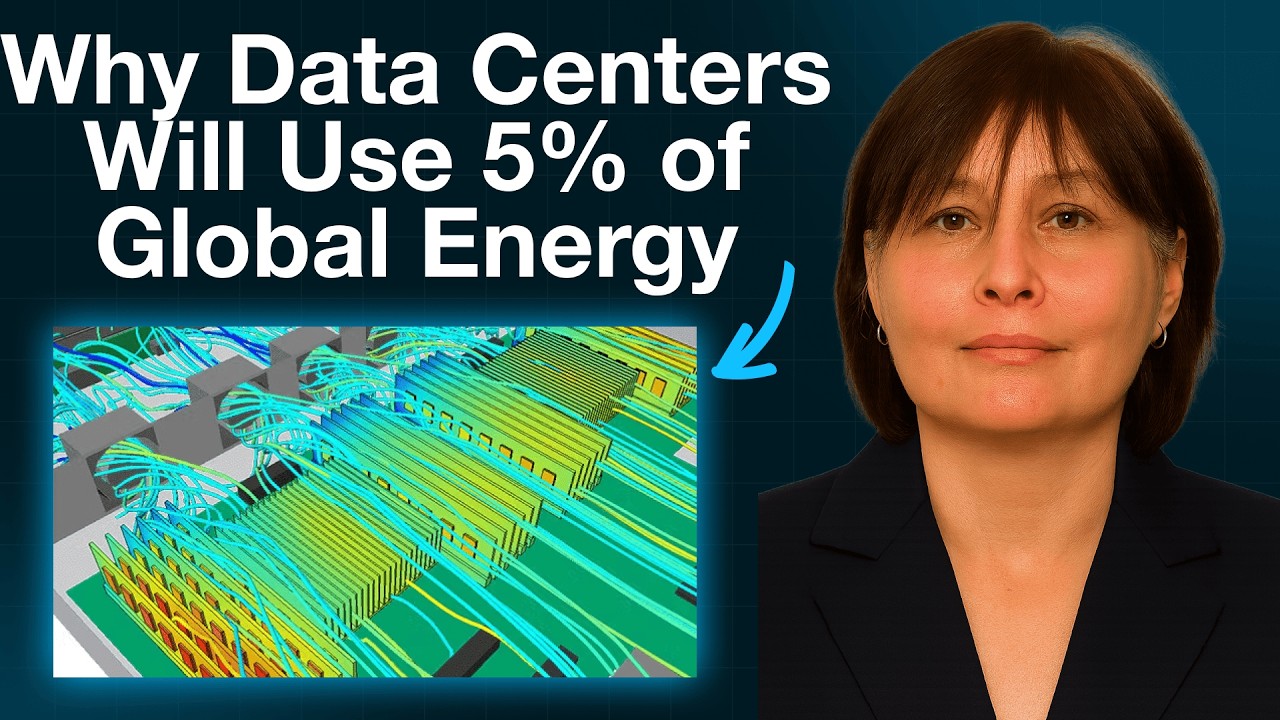
The rise of Artificial Intelligence is creating a significant, often overlooked, challenge: a massive increase in energy and water consumption from data centers. Predictions indicate that by 2030, data centers could account for 4-5% of the world’s total energy production. An AI-powered answer to a query consumes approximately ten times more energy than a traditional search, fueling this exponential growth. This energy is converted into heat, which compromises the performance and lifespan of IT equipment if not managed effectively.
The Inefficiency of Air and the Move to Liquid
Traditionally, data centers have relied on air for cooling. However, this method is fundamentally inefficient. At one point, the energy required to move the cooling air was equivalent to the energy used for data processing itself. Furthermore, conventional cooling methods consume vast quantities of clean drinking water, a scarce resource in many parts of the world.
To address these challenges, the industry is shifting towards liquid cooling, which is significantly more efficient due to the higher heat capacity of liquids compared to air. The next evolution in this space is immersion cooling, where entire server boards are submerged in a tank of dielectric (electrically non-conductive) fluid.
Debunking Misconceptions in Immersion Cooling Fluids
A common misconception is that traditional, fluor-based liquids are the superior choice for immersion cooling. While they have been used since the 1990s and are effective, they come with significant environmental downsides.
- Fluor-based liquids: These are “everlasting chemicals” known to have potentially harmful effects on the environment, atmosphere, and human health. The belief that their lower viscosity leads to better cooling is an oversimplification.
- Oils (including Plant-based): While thicker, oils possess a much higher thermal conductivity, which is crucial for heat dissipation. Simulations comparing fluor-based liquids with oils revealed a negligible difference in thermal performance.
The environmental contrast, however, is stark. Plant-based oils are a renewable resource. In soil degradation tests, soil bacteria completely break down plant-based oil within eight days, highlighting a massive advantage in sustainability.
The Role of CFD and Design Space Exploration
Computational Fluid Dynamics (CFD) is an indispensable tool for navigating the complexities of modern thermal design. Instead of building hundreds of expensive and time-consuming physical prototypes, engineers can use CFD to simulate numerous design variations and analyze the trade-offs between cooling efficiency, size, and environmental impact. This approach, rooted in the principles of Design for Six Sigma, makes design space exploration more accessible.
When setting up simulations for data center cooling, it’s crucial to use realistic conditions. This involves leveraging open-source industry information (like that from the Open Computing Group), basing geometry on real-world products (such as an Nvidia board dissipating 2,000 watts), and using fluid properties from supplier datasheets. The key performance metric is often the integrated circuit’s (IC) surface temperature, which should not exceed 85°C to protect memory components.
Engineering Principles for Effective Thermal Design
Successful thermal management goes beyond component selection. Several key principles and pitfalls are crucial to consider:
- Holistic System View: Don’t focus solely on the temperature or the pump size. A design must be evaluated within its larger context, including its environmental toll and operational requirements like 24/7 availability and concurrent maintenance.
- Start Early: Begin CFD analysis early in the design process with simplified models. You don’t need a complete CAD design to get valuable insights. A basic box model with key components and power dissipation figures can provide critical direction from the start.
- “Defend the Empty Space”: Cooling performance is often dictated by the paths available for fluid flow. This means the empty space in a layout is as important as the components themselves. Engineers must protect these flow paths from being encroached upon as the design evolves. As Wendy Luiten puts it, “it’s actually the empty space… you have to defend your empty space.”
Designing for Sustainability and Heat Reuse
A forward-thinking approach to data center design involves planning for heat reuse. By designing systems to operate with a higher fluid inlet temperature, for example 40°C (compared to the typical 20-25°C), the waste heat becomes valuable. This heat can then be repurposed for applications like heating greenhouses or domestic housing, creating a more circular and efficient energy system. This reflects a core responsibility for engineers: to innovate while ensuring the planet is kept intact for the future.