Email Spoofing with SMTP Smuggling: How the Shared Email Infrastructures Magnify this Vulnerability
SMTP smuggling is a critical vulnerability allowing email spoofing that bypasses standard authentication protocols like SPF and DMARC. This research presents a large-scale study on its prevalence, uncovering widespread issues due to shared infrastructure and incomplete patches, and introduces a novel, non-intrusive methodology for ethically testing private email services.
A critical vulnerability known as SMTP smuggling allows attackers to send spoofed emails that bypass standard authentication protocols like SPF and DMARC. This technique exploits inconsistencies in how different email servers interpret the end-of-data sequence in the SMTP protocol, enabling threat actors to impersonate trusted senders and mount sophisticated phishing attacks.
The Mechanics of an SMTP Smuggling Attack
The core of the vulnerability lies in the interpretation of the SMTP end-of-data indicator. The official RFC standard specifies \r\n.\r\n as the sequence to terminate an email message. However, to maintain compatibility with legacy systems, many real-world email server implementations are flexible and accept other variations, such as \n.\n.
An SMTP smuggling attack unfolds in two stages:
- An attacker uses a legitimate account on a sending server that is permissive (ignores the non-standard end-of-data sequence). They craft a single email that contains a second, “smuggled” email within its body.
- This email is sent to a receiving server that is vulnerable (misinterprets the non-standard sequence as a valid end-of-data indicator).
When the vulnerable receiving server processes the message, it splits the single incoming email into two separate messages. The first is a benign message from the attacker’s actual account. The second is the smuggled message, which can have any arbitrary content and a spoofed sender address, such as a CEO or system administrator.
Crucially, because the entire transaction originates from a legitimate, trusted sending server IP address, the smuggled email successfully passes SPF checks. No alerts are raised, as the communication appears to be from an authorized source.
The Amplification Effect of Centralized Infrastructure
The impact of this vulnerability is significantly amplified by the centralization of modern email infrastructure. Many organizations do not run their own email servers but instead use large providers like Microsoft or Google. This leads to a shared SPF infrastructure.
For example, the SPF record for microsoft.com includes a directive that authorizes outlook.com servers to send emails on its behalf. This creates a large “trusted circle.” An attacker can register a free outlook.com account and use it to conduct an SMTP smuggling attack to spoof high-reputation domains that use Microsoft’s services, such as openai.com or github.com, without needing an internal corporate account. This centralization means a single vulnerability in a major provider’s infrastructure can be leveraged to attack a vast number of dependent domains.
A Novel Methodology for Ethical, Large-Scale Testing
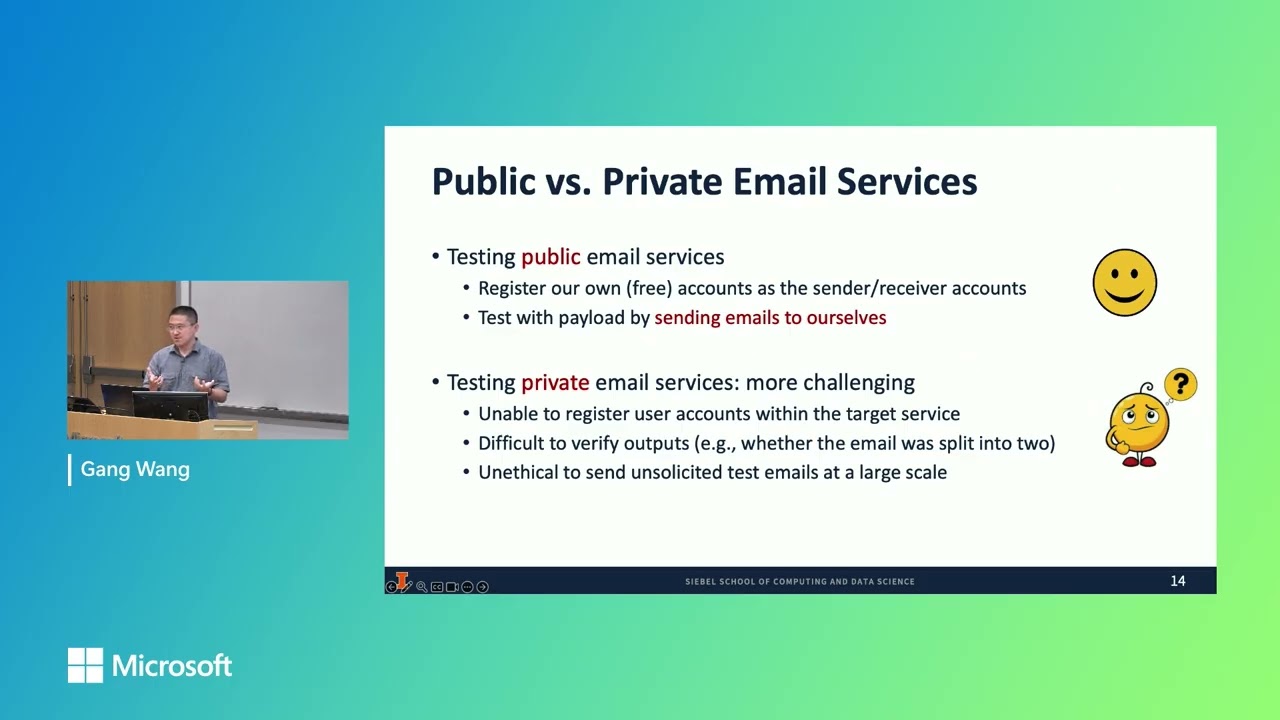
A significant contribution of this research was developing a methodology to test for these vulnerabilities at scale, particularly against private email services, in an ethical and non-intrusive manner.
- Payload Discovery: The researchers first performed fuzzing on various open-source email software to discover 13 different misinterpretable end-of-data sequences that could be used as attack payloads. This went beyond the initially disclosed vectors.
- DKIM Side Channel: To passively verify if an attack was successful (i.e., if the email was split), a DKIM signature was embedded in the smuggled portion of the email. A successful split would trigger the receiving server to perform a DNS lookup for the DKIM key on a domain controlled by the researchers, thus confirming the vulnerability without any user interaction.
- Non-Intrusive Scanning: For large-scale scanning of private domains, an innovative technique was used. A test email was crafted to contain a vulnerability report in the first part and the smuggled payload in the second. Crucially, the message was sent without the official
\r\n.\r\nend-of-data indicator.- If a server was not vulnerable, it would see an incomplete message, wait for more data, and eventually time out. The researchers would terminate the connection, and no email would be delivered.
- If a server was vulnerable, it would split the message upon seeing the non-standard indicator and deliver the first part—the vulnerability report—to the administrator. The connection would be terminated before the second part could be processed.
This method ensured that non-vulnerable systems were never bothered, while vulnerable systems received a helpful security notification.
Findings and Mitigation Strategies
The study found the vulnerability to be widespread, even a year after its initial public disclosure. 19 public email services, 1,577 private email services, five open-source email software packages, and one email gateway were found to be vulnerable. Many had implemented incomplete, ad-hoc fixes that only addressed the initially reported payloads and failed to protect against the new vectors discovered through fuzzing.
Root Cause and Solutions:
- Root Cause: The fundamental issue is that SMTP is a plaintext protocol that cannot distinguish between data and commands, combined with inconsistent server logic for handling protocol standards.
- Sending Server Fix (Recommended): The easiest and most robust fix on the sending side is to use data encoding (e.g., Base64), which is RFC-compliant. This prevents attackers from injecting character sequences that could be interpreted as commands.
- Receiving Server Fix: Receiving servers should strictly enforce the official RFC standard for the end-of-data indicator. However, this carries a risk of breaking compatibility with legitimate legacy systems.
The research underscores the fragility of IP-based authentication like SPF in a highly centralized ecosystem and suggests that signature-based protocols like DKIM offer a more robust path forward for email security.