Michael Truell: Building Cursor at 23, Taking on GitHub Copilot, and Advice to Engineering Students
Michael Truell, co-founder of Cursor, shares the journey of building an AI-first code editor that grew to $100M ARR in a year. He discusses the crucial pivot from failed startup ideas, the conviction required to compete with GitHub Copilot, and the lessons learned in product development, model strategy, and the future of programming in a world where software development will increasingly flow through models.
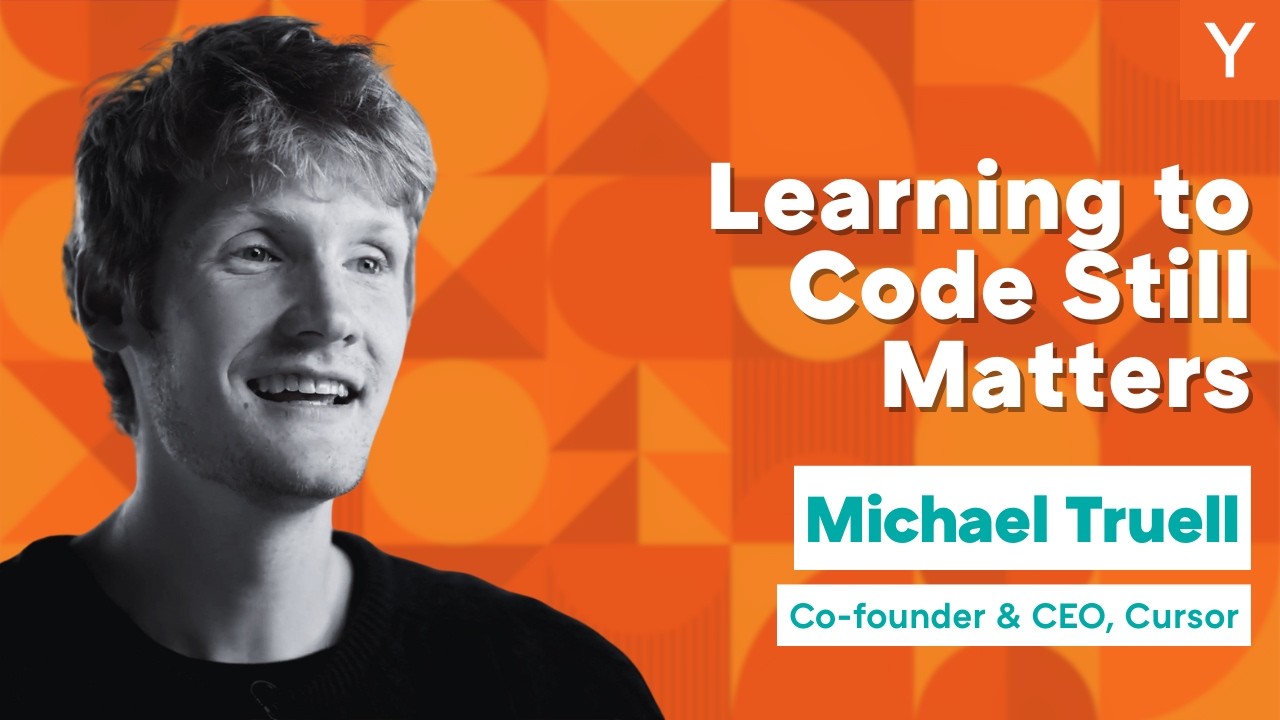
In a fireside chat at the AI Startup School, Michael Truell, co-founder of Cursor, shared his journey from early programming experiments to building one of the fastest-growing companies in AI-native development tools. His core belief is that the future of software development will entirely “flow through models,” a conviction that drove him and his co-founders to challenge established players like GitHub Copilot.
Early Forays into Programming and AI
Truell’s interest in technology began in middle school, inspired by the essays of Paul Graham. His first practical experience with coding was an attempt to build a mobile game with his brother using Objective-C. While his brother quickly gave up, Truell persisted, teaching himself the language from a book.
His interest soon shifted to AI, sparked by the idea of creating a robotic dog that could be trained with positive and negative feedback, much like a real animal. This project led him down a rabbit hole of machine learning concepts:
- Genetic Algorithms: An initial exploration into evolutionary computation.
- Neural Networks: Evolving neural networks using techniques like NEAT.
- Reinforcement Learning (RL): The eventual focus of his work.
This early work was highly practical. Due to the memory constraints of the microcontrollers they were using for their robots, Truell and his friend had to implement their own tiny neural network library from scratch. Lacking a deep understanding of calculus at the time, they fumbled their way through re-implementing core concepts, which provided an invaluable, albeit incomplete, education in ML fundamentals. This hands-on experience resulted in tangible projects, like a multi-axis robot arm that could learn to play ping-pong and a robot that could be taught to follow a line.
The “Wandering” Phase: Failed Ventures Before Cursor
Before landing on Cursor, Truell and his co-founders cycled through several ideas, a period he describes as “wandering.” Their first significant effort was a “co-pilot for mechanical engineers,” aiming to bring AI assistance to CAD software like SolidWorks. They chose the market because they believed it was “boring and sleepy and uncompetitive,” but it was a poor fit as none of them were mechanical engineers and the underlying AI technology wasn’t mature enough for the domain. The project involved immense effort in data scraping disparate CAD file formats and building custom infrastructure, but it ultimately failed to gain traction.
Simultaneously, other members of the founding team worked on a technically impressive end-to-end encrypted messaging system designed to hide metadata. However, it suffered from scalability issues and failed to find a market. After six months of intense work, all of their projects had virtually no users.
The Pivot: Taking on a Goliath
The string of failures led to a moment of desperation and clarity. The team had initially avoided the AI coding space because GitHub Copilot, already a ~$100M ARR business in 2022, seemed like an insurmountable competitor. However, their perspective shifted as they reflected on their core beliefs.
“We took a step back and realized that if we were being really consistent with our beliefs, there was going to be an opportunity for all of coding to change in the next 5 years and for all of software development to flow through models. It felt like no one working on the space at the time was really taking that seriously… they weren’t really aiming for a world where all of coding as we know it today gets automated.”
This conviction—that an entirely new paradigm for software development was emerging—gave them the motivation to build a tool that embraced this future, rather than just incrementally improving existing workflows.
Building and Launching Cursor
The first version of the Cursor editor was built from scratch in about three months. This ambitious undertaking taught them several crucial lessons:
- The Need for a Fork: They quickly learned they couldn’t replicate 12 years of VS Code’s development in a few months. Their time was better spent focusing on the novel AI features. This led to the pivotal decision to re-platform Cursor as a fork of VS Code, much like how modern browsers are built on Chromium.
- Refining the AI UX: Their initial concept was a “universal remote” where a single prompt would have the AI figure out the user’s intent. They found this was too unstructured and learned that more specific, well-defined AI features were necessary to be truly useful.
- Pragmatism in Model Strategy: Having been “burned” by the cost and effort of training custom models for their failed CAD startup, they initially built Cursor using off-the-shelf APIs. However, as the product grew throughout 2023, they realized that building their own models was a critical “product lever.” Using product data to fine-tune and serve their own models allowed them to significantly improve core features, such as next-edit prediction.
From $1M to $100M: Product-Led Wildfire Growth
After a period of slow growth in 2023, Cursor’s adoption exploded in 2024, going from approximately $1M to $100M in ARR. Truell attributes this entirely to product-led growth driven by word of mouth.
The team, which was still fewer than 10 people at the end of 2023, resisted the temptation to focus on “growth engineering.” Instead, they maintained a relentless focus on core product improvements. Every enhancement—making Cursor codebase-aware, increasing the speed and accuracy of suggestions, and enabling the AI to take more ambitious actions—directly translated into compounding growth as developers shared the tool with their peers.
The Future of Coding and Advice for Builders
Truell believes we are in a “long messy middle” of AI’s integration into software development. He doesn’t see programming disappearing soon; rather, he sees it evolving.
“For professional engineers… code is still really important and there will be this long messy middle where you will be working with the AI more and more. It will become like a colleague… You’re going to have to read the logic and review it and edit it.”
He advises that programming, like math, remains a fundamental and valuable skill to learn, not just for its direct application but for the problem-solving mindset it cultivates. His advice to young builders is to focus on two things:
- Work on projects you are genuinely interested in.
- Work with people you deeply respect.
He encourages aspiring founders to move away from “checking boxes” and instead focus on patiently building something meaningful over a long period of time.