Intelligence Isn't What You Think
Dr. Michael Timothy Bennett challenges conventional AI paradigms, arguing for a new approach inspired by the principles of living systems. He critiques the separation of software and hardware ("computational dualism"), redefines intelligence as efficient adaptation, and offers a novel theory of consciousness as a "tapestry of valence" essential for genuine intelligence.
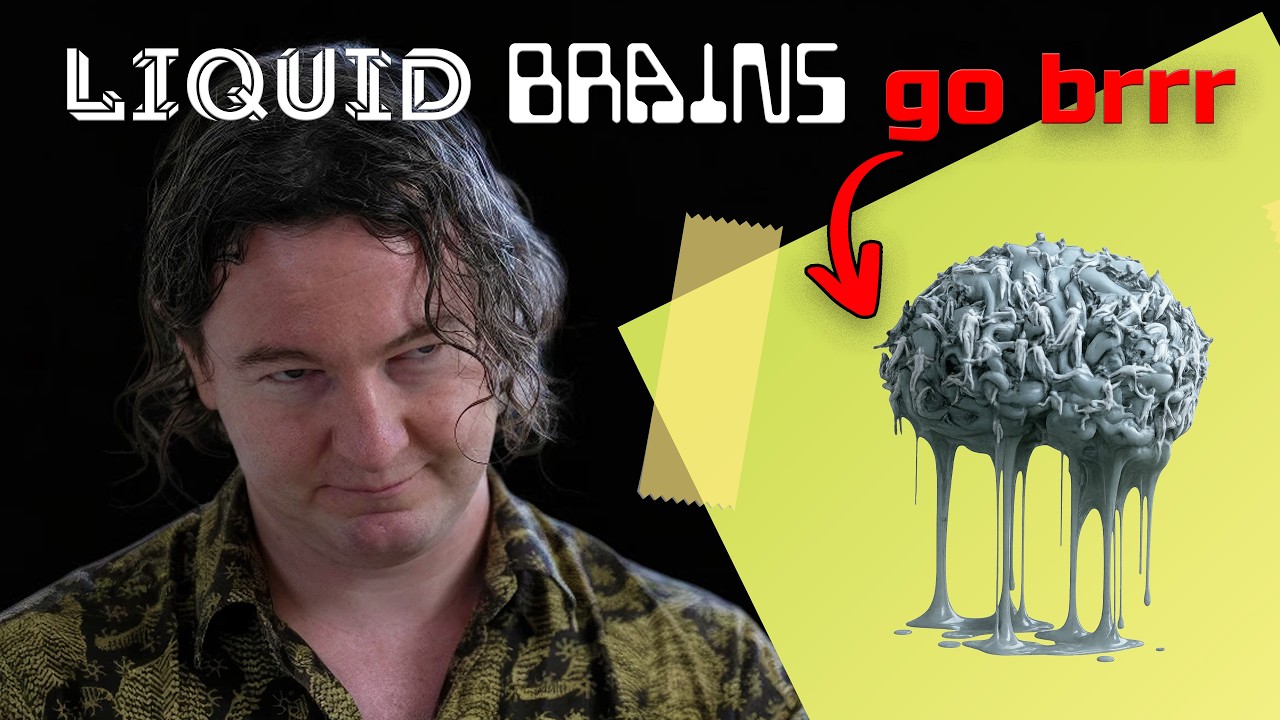
Dr. Michael Timothy Bennett begins by challenging the conventional definitions and approaches to artificial intelligence, advocating for a perspective rooted in biology and embodied cognition. He favors Pei Wang’s definition of intelligence as “adaptation with limited resources,” emphasizing efficiency in terms of energy and data, a stark contrast to the “scale maxing” approach prevalent in Silicon Valley.
Critique of Formal Models and Computational Dualism
Bennett critiques formalisms like AIXI, which are based on Solomonoff induction and Occam’s Razor (simplicity). While compelling, these models run into the problem of subjective complexity. The perceived simplicity of a model depends on the “interpreter” or the underlying language (abstraction layer) used by the agent. One can make an agent seem arbitrarily intelligent or stupid simply by changing the interpretative framework, making objective claims about performance difficult.
This leads to his central critique of modern AI, which he terms “computational dualism.” He draws a provocative analogy to Cartesian dualism, where Descartes proposed the pineal gland as the interface between the non-physical mind and the physical body.
We have just replaced the pineal gland with a touring machine.
He argues that treating intelligence as pure software, separate from its hardware and environment, is a fundamental mistake. The behavior of any software is contingent on the interpreter that executes it, all the way down to the physical laws governing the hardware. To understand intelligence, one must analyze the system as a whole, including its embodiment and environment—a concept known in cognitive science as enactive cognition. This view also aligns with the concept of mortal computation, where the physical substrate is inseparable from the computation itself, as opposed to the abstract, “immortal” nature of a theoretical Turing machine.
A Biologically-Inspired Vision for Intelligence
Bennett advocates for an AI that emulates the properties of living systems: self-organization, decentralization, and multi-scale adaptation.
- Causality and Abstraction: True intelligence requires learning a causal model of the world, starting with a representation of the self as a causal agent. An agent must be able to distinguish between its own actions causing a change and the environment causing a change. This “causal identity for self” is fundamental to subjective experience.
- The Law of the Stack: Bennett proposes a principle where the adaptability of a system’s high-level abstractions (e.g., software) is contingent on the adaptability of its lower-level abstractions (e.g., hardware). Biological systems excel because they delegate adaptation down the stack, allowing for flexibility at all levels. Computers, in contrast, are like an “inflexible bureaucracy that makes decisions only at the top.”
- Decentralization and Constraints: Drawing on the work of Michael Levin, Bennett views systems like cancer as a failure of collective intelligence, where a cell becomes informationally isolated from the whole and reverts to primitive behavior. This can happen when a system is over-constrained. Imposing too much top-down control eliminates potentially correct policies and forces components to “break off.” This suggests that AI safety should focus on designing the entire system with appropriate, minimal constraints rather than trying to rigidly align a single component.
Consciousness as a Necessary Adaptation
Bennett directly confronts the “hard problem of consciousness” by arguing that philosophical zombies—beings identical to humans but without subjective experience—are impossible in any conceivable world. He posits that consciousness is not an epiphenomenal, non-causal addition to information processing but a necessary feature of a sufficiently adaptive, intelligent system.
His theory frames subjective experience as a “tapestry of valence.” An organism is not a value-neutral processor. From the cellular level up, it is a collective of components driven by attraction and repulsion. Classifiers for objects in the world (e.g., “chair,” “television”) are not neutral representations; they are imbued with the valence of how those objects are causally relevant to the organism. Consciousness is the feeling of this multi-scale tapestry of attractions and repulsions, a state that must be realized at a single point in time. This raises questions about whether consciousness could be “smeared across time” in a simulation on a single-threaded CPU.
Ultimately, Bennett defines life itself through this lens of adaptation and complexity. Non-living things, like a rock, persist by being simple (“simping”).
Life is that which waxes [increases complexity] at the expense of simp.
Living systems actively increase their complexity and embody weaker constraints to self-repair and adapt, achieving a far greater persistence than simple objects.