29.4% ARC-AGI-2 🤯 (TOP SCORE!) - Jeremy Berman
Jeremy Berman, winner of the ARC-AGI v2 public leaderboard, discusses his novel evolutionary approach that refines natural language descriptions instead of code. He explores the idea of building AI that synthesizes new knowledge by constructing deductive "knowledge trees" rather than merely compressing data into "knowledge webs," touching on the fundamental challenges of reasoning, continual learning, and creativity in current models.
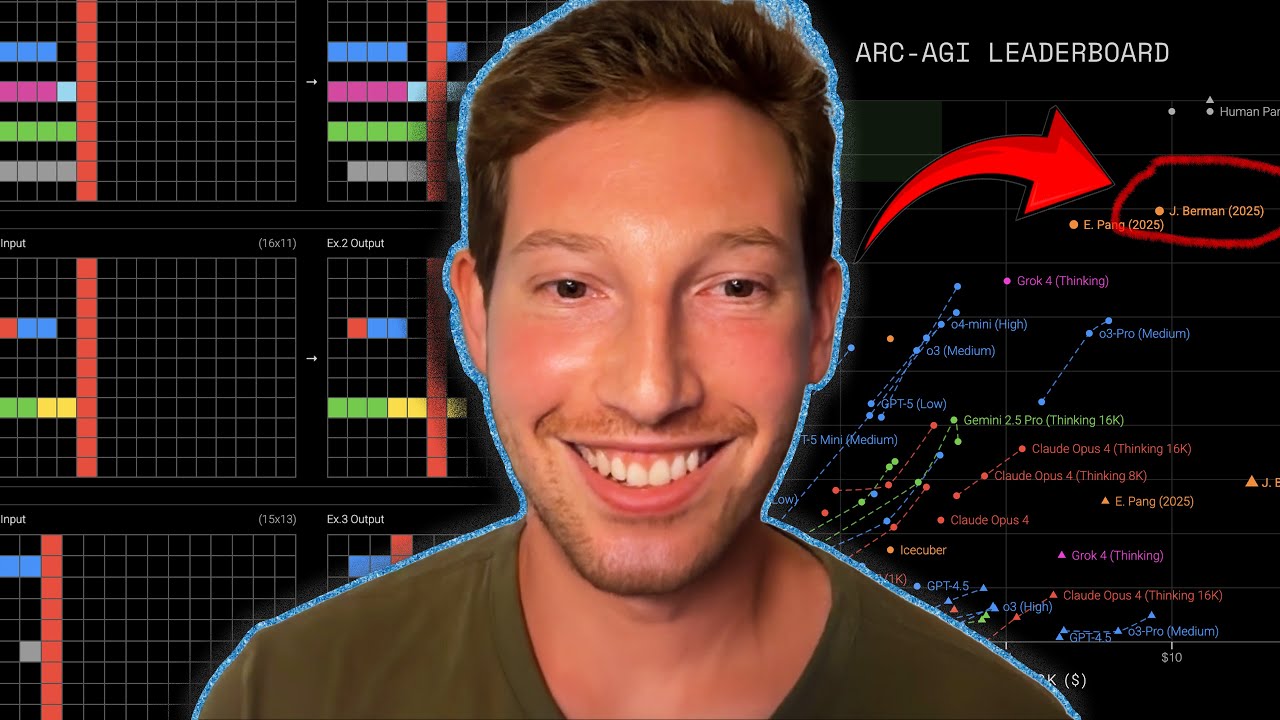
Jeremy Berman, a research scientist at Reflection AI, recently won the ARC-AGI v2 public leaderboard with an elegant evolutionary algorithm. A significant shift from his v1 solution, which evolved Python programs, his new architecture evolves natural language descriptions of algorithms. This approach propelled him to the top of the leaderboard with approximately 30% accuracy, highlighting a move towards more expressive and general problem-solving frameworks.
From Python to Natural Language: A More Expressive Approach
Berman’s initial success on ARC v1 involved generating and iteratively refining Python programs. He found that even for simple tasks, models struggled on the first attempt, but a revision loop that fed back errors significantly improved performance. Python was chosen for its deterministic nature and the ease of verifying a solution’s correctness.
However, ARC v2 introduced more compositional tasks with multiple rules, which proved difficult to express concisely in Python. Berman observed that any ARC v2 task could be described in 5-10 bullet points of plain English. This led to the core innovation of his v2 solution: switching from evolving Python code to evolving natural language descriptions.
“Really what you want is more expressive program. And so that’s why I switched from Python to English which is a much more expressive program. You can describe every single ARC v2 task in 10 bullet points of plain English, most of them in five bullet points.”
This shift came with a trade-off. While natural language is more expressive and allows the model to leverage its inductive biases more fully, it isn’t directly executable. This necessitates a “checker” agent to interpret the natural language instructions and generate the output grid for verification. Interestingly, Berman found that the checker agent needed to be a more powerful model than the instruction-creating agent to work effectively.
Knowledge Trees vs. Knowledge Webs
A central theme of the discussion is the distinction between memorized knowledge and deduced knowledge. Berman posits that pre-training treats all information as a “knowledge web”—a network of connected embeddings without a guaranteed causal structure. This is why models can feel like “stochastic parrots.” As he memorably quoted from his paper:
“A parrot that lives in a courthouse will regurgitate more correct statements than a parrot that lives in a mad house.”
True intelligence, he argues, is about compression through deduction. It involves building a “knowledge tree” from foundational axioms, where knowledge is causally and logically structured. Reasoning is the process of pruning the knowledge web and replacing it with this deductive tree. Reinforcement learning with verifiable rewards is a key process for this, as it forces the model’s internal circuits to align with the deductive, causal structure of a correct solution.
- Understanding is the possession of this knowledge tree.
- Intelligence is the efficiency with which an agent can build and expand its garden of trees.
- Reasoning is the meta-skill of building the tree, which can then be applied to learn all other skills.
Fundamental Challenges: Continual Learning and Creativity
The conversation delves into the core limitations of current AI systems, particularly catastrophic forgetting. When a model is fine-tuned on a new task, it risks losing its existing knowledge and capabilities.
“The ideal system would be we have a set of data. Our language model is bad at a certain thing. We can just give it this data and then all of a sudden it keeps all of its knowledge and then also gets really good at this new thing. We we are not there yet. And that to me is like a fundamental missing part.”
Berman suggests that future breakthroughs may involve making models more composable, perhaps by freezing expert layers or modules, creating an architecture that can learn new skills without overwriting old ones.
The final frontier discussed is creativity and invention. If reasoning is building the tree, creativity is knowing which new axioms or premises to add to grow it. Berman proposes that we need to develop an “invention circuit” in models. This could be achieved by creating training environments where known concepts (e.g., special relativity) are deliberately ablated from the pre-training data, forcing the model to re-derive them from first principles. This process would train the model not just to know facts, but to practice the skill of discovery itself.