Inside the little-known expert network quietly training every frontier AI model | Garrett Lord
Garrett Lord, CEO of Handshake, details the company's extraordinary pivot from a college career network to a dominant AI data provider. He explains how they leveraged their proprietary network of 500,000 PhDs and 3 million advanced degree holders to build a business on track to surpass $100 million ARR in its first year by providing high-quality, expert-generated data for training frontier AI models.
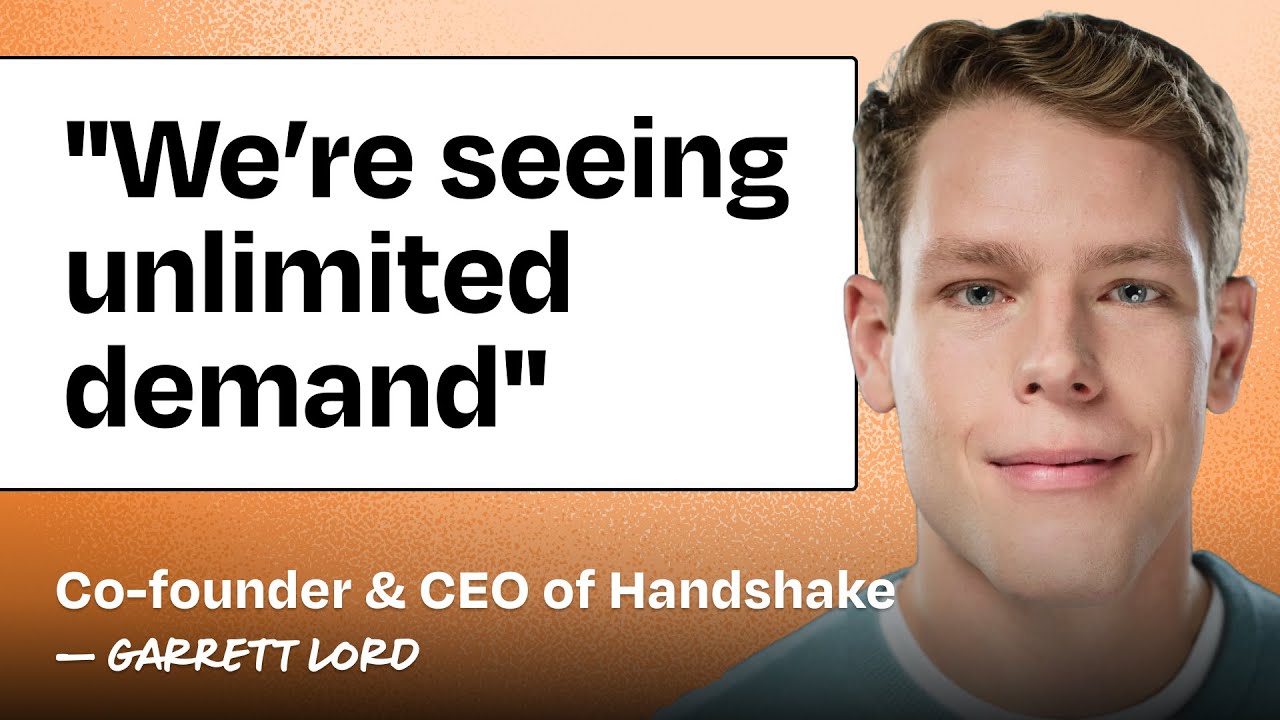
Handshake, initially a career network for students, discovered it was sitting on the world’s largest network of academic experts. This realization led to the creation of a new business line providing high-quality human data for training frontier AI models, a venture that achieved a $50 million run rate in its first four months and is on track to exceed $100 million in its first year.
The Shift from Pre-Training to Expert-Led Post-Training
The landscape of training large language models has fundamentally shifted. Initially, performance gains came from pre-training, which involved ingesting the entire corpus of written human knowledge from the internet. However, as models have essentially consumed all available online data, the gains from this approach have plateaued.
The new frontier for model improvement lies in post-training, a process of augmenting and refining the model’s capabilities in specific, high-value domains like coding, mathematics, law, and finance. This is where Handshake found its opportunity. The key insight is that as models become more sophisticated, the need has shifted from low-cost, generalist data labelers to deep domain experts. Garrett Lord notes, “The models have gotten so good that the generalists are no longer needed. What they really need is experts.”
What Experts Actually Do: Creating High-Value Data
The work performed by these experts is far more complex than simple labeling. It involves a scientific process of identifying and correcting model weaknesses.
- Breaking the Model: Experts, such as a physics PhD, use their deep knowledge to find where a model fails. This can be a failure in its reasoning steps, even if it arrives at the correct final answer, or a failure in producing the ground truth.
- Providing Ground Truth and Reasoning: When a flaw is found, the expert provides the correct answer and, more importantly, the detailed, step-by-step reasoning required to reach it. For a complex math problem, they might identify that “step six through 10 is wrong” and provide the correct procedure. This detailed reasoning is crucial for teaching the model how to “think” correctly.
- Creating Trajectory Data: To understand how humans solve real-world problems, labs require “trajectory data.” This involves experts narrating their thought process while performing a task from start to finish. The process captures everything: the screen, mouse movements, tool usage, and voiceover. This data teaches the model complex, multi-step workflows.
- Developing Rubrics for Evaluation: In non-verifiable domains like educational design, there isn’t always a single “right” answer. Here, experts develop detailed rubrics that allow a model to act as a judge, evaluating the quality of responses based on nuanced criteria, similar to how a professor grades a paper.
The output of this work is typically structured JSON data that frontier labs use to fine-tune their models. AI labs prioritize three things from their data partners: quality, volume, and speed, and Handshake’s network is uniquely positioned to deliver on all three.
Handshake’s Competitive Moat: An Engaged Expert Network
Handshake’s primary competitive advantage is its pre-existing, trusted network of 18 million students and alumni, including 500,000 PhDs and 3 million master’s students.
“The only moat in human data is access to an audience.”
This provides several structural advantages over competitors who rely on performance marketing and recruiters:
- Near-Zero Acquisition Cost: They don’t need to spend millions on ads or recruiting to find experts; they are already on the platform.
- Trust and Brand Affinity: Users already trust the Handshake brand, leading to much higher conversion and retention rates.
- Superior Experience: Handshake focuses on creating an “experts-first” platform, treating PhDs not as transactional labor but as valued members of a community, which increases engagement and data quality.
Playbook: Building a Startup Inside a Startup
To move quickly and incubate this new business, Garrett Lord adopted a “startup within a startup” model, emphasizing complete separation.
- Separate Everything: The new initiative had its own dedicated engineering, design, operations, and finance teams. They even worked in a separate part of the office.
- Founder-Led: Garrett dedicated over 80% of his own time to leading the new venture, acting as its founder.
- Distinct Culture and Ownership: The team operated with a different, more intense cadence (“leave nothing to chance”) and had a separate compensation structure tied to the new business’s success to foster a sense of ownership.
- Talent Strategy: They hired entrepreneurs and people comfortable with the ambiguity and chaos of an early-stage venture, parachuting in top talent from the core business when needed.
AI’s Role in the Future of Work
Contrary to fears of AI eliminating jobs, Garrett believes it will create “Iron Man suits” that augment human capabilities. Young, AI-native professionals will be able to accomplish tasks that previously required entire teams. This data business also serves a strategic long-term goal for Handshake: the insights gained are being used to build a fundamentally better job-matching marketplace, leveraging AI to improve outcomes for both candidates and employers.