Granite 4.0: Small AI Models, Big Efficiency
IBM's Granite 4.0 models introduce a groundbreaking hybrid architecture combining Mamba-2 and Transformer blocks with a Mixture of Experts (MoE) design. This approach enables smaller models to achieve superior performance, speed, and memory efficiency, even outperforming much larger models on key enterprise tasks while running on consumer-grade hardware.
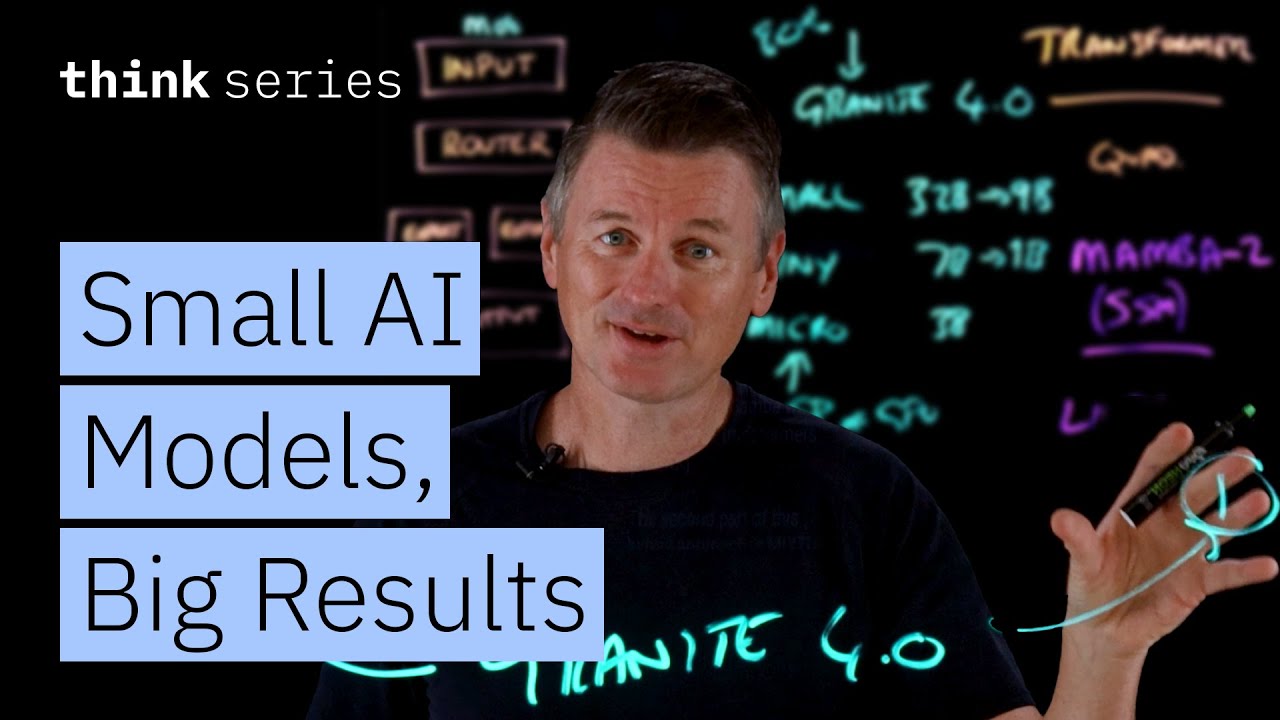
IBM’s next-generation Granite 4.0 models deliver significant improvements in performance, speed, and operational cost, not only over previous versions but also when compared to much larger models in the industry. These models are designed to be small, fast, and efficient, pushing the boundaries of what’s possible on accessible, enterprise-grade, and even consumer-grade hardware.
The Granite 4.0 Family
The Granite 4.0 family consists of several small, open-source models tailored for different use cases:
- Small: The enterprise workhorse, this is a Mixture-of-Experts (MoE) model with 32 billion total parameters (9 billion active) designed for complex workflows and multi-tool agent tasks on a single GPU.
- Tiny: Another MoE model with 7 billion total parameters (1 billion active), built for low-latency, local, and edge applications.
- Micro: A dense architecture model with 3 billion parameters, intended for lightweight local deployments. It comes in two variants: one with the new hybrid architecture and another using a traditional Transformer architecture.
Key Advantages: Efficiency and Performance
The primary theme of the Granite 4.0 series is achieving a powerful balance of speed, efficiency, and accuracy.
- Memory Efficiency: The hybrid design can reduce memory requirements by up to 80%. For instance, the Micro model requires only about 10GB of GPU memory for production workloads, whereas comparable models might need four to six times that amount.
- High Throughput: Unlike many models that slow down with increased batch sizes or context lengths, Granite 4.0’s architecture maintains high throughput, avoiding performance bottlenecks.
- Competitive Performance: The models are highly competitive within their weight class and often outperform much larger models, especially on benchmarks measuring agentic capabilities like instruction following and function calling.
A Hybrid Architectural Deep Dive
The innovation behind Granite 4.0 lies in its unique hybrid architecture, which combines the strengths of Mamba-2, Transformers, and Mixture of Experts.
Mamba-2 and Transformers: A Powerful Combination
The dominant LLM architecture, the Transformer, uses a self-attention mechanism that is powerful but computationally expensive. Its computational needs scale quadratically with the context length—doubling the context window quadruples the compute requirements.
To solve this, Granite 4.0 incorporates Mamba, a type of State Space Model (SSM). Mamba processes tokens sequentially and maintains a compressed summary of the context, updating it selectively. This allows its computational needs to scale linearly with context length, a significant efficiency gain for large context windows.
However, Transformers still excel at tasks requiring in-context learning and complex reasoning. Granite s architecture creates a hybrid system to get the best of both worlds:
The Granite 4.0 architecture is a hybrid architecture. It uses 9 Mamba blocks for every one Transformer block. Mamba kind of does the heavy lifting of capturing global context, then it lets the Transformer blocks work their magic on parsing the nuanced local details.
This results in a model that has both the efficiency of Mamba and the precision of Transformers.
Mixture of Experts (MoE)
The Tiny and Small models utilize a fine-grained MoE approach. The model is divided into specialized neural subnetworks called “experts.” A routing mechanism activates only the specific experts needed for a given token, plus a shared expert that is always active.
- The Tiny model has 62 different experts but only activates one (plus the shared one) at inference time, resulting in 1 billion active parameters out of 7 billion total.
- The Small model uses a similar strategy, with 9 billion active parameters out of 32 billion total.
This ensures that only a fraction of the model’s total parameters are used for any given task, dramatically increasing efficiency.
Unconstrained Context Length with “NoPE”
Most models use positional encoding schemes like RoPE to understand word order, but these can struggle with sequences longer than their training data. The Granite 4.0 models use NoPE (No Positional Encoding). This, combined with Mamba’s linear scaling, gives the architecture a theoretically unconstrained context length, limited only by the available hardware and memory.
This architectural approach places Granite 4.0 at the forefront of the trend toward smaller, highly efficient models that can run powerful AI workloads without requiring massive computational resources. The models are open-source and available on Hugging Face and watsonx.ai.