No Priors Ep. 135 | With Humans& Founder Eric Zelikman
Eric Zelikman, formerly of Stanford and xAI, discusses his research on AI reasoning (STaR, Q-STaR) and introduces his new venture, humans&. He argues for a paradigm shift from building AI with pure IQ to AI with EQ, focusing on long-term memory, human collaboration, and empowering users to achieve their full potential.
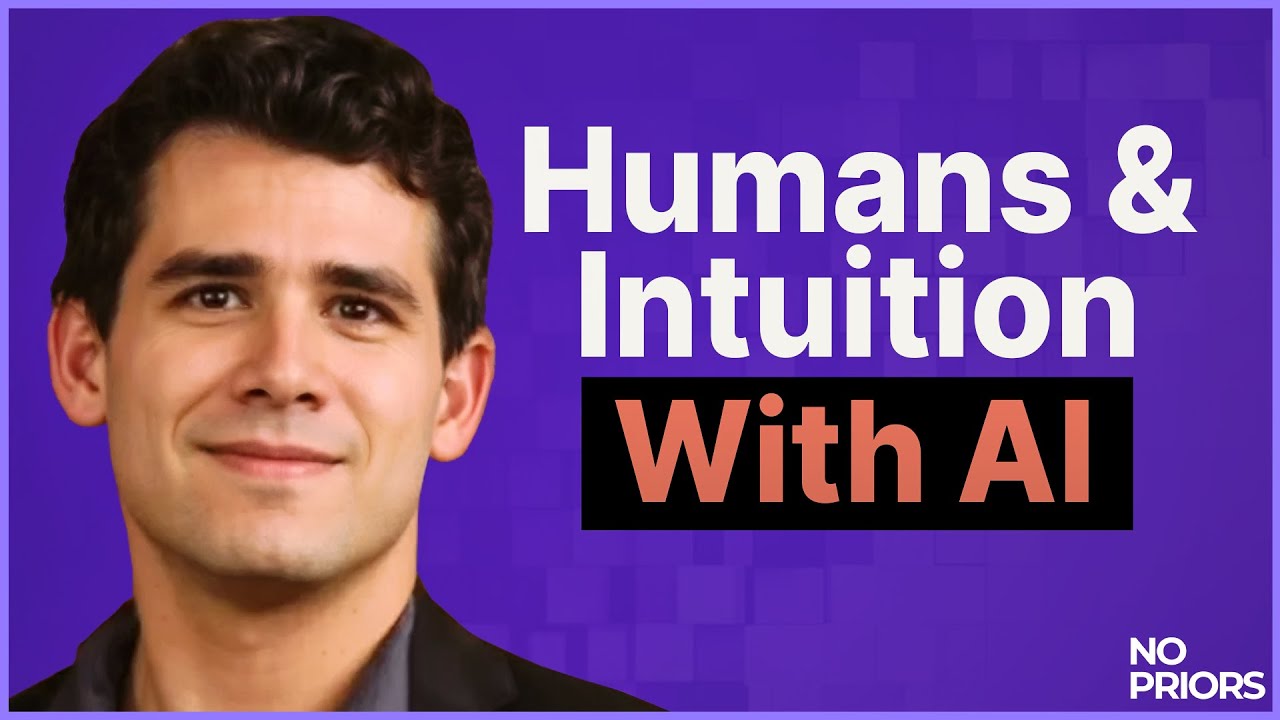
Eric Zelikman’s core motivation has been to build technology that empowers people to pursue their passions and unlock their full potential. Initially viewing automation as the direct path, he realized that truly empowering people requires a deep understanding of their goals, a significantly more complex challenge than simply automating away undesirable tasks.
From STaR to Q-STaR: Scaling Reasoning
Zelikman’s early research aimed to make language models smarter. He discussed his work on Self-Taught Reasoner (STaR), an algorithm built on a simple intuition: if a model can generate a thought process (like a Chain of Thought) that leads to a correct answer, it should be rewarded and learn from that successful reasoning trace.
- The STaR Process: The model iteratively generates solutions. If a solution is correct, the model learns from it; if not, it doesn’t. This loop allows the model to tackle progressively harder problems by learning from its successes.
- Surprising Scalability: A key finding was that STaR showed no obvious plateau in performance on tasks like n-digit arithmetic, which were considered difficult for models at the time. As the model trained for more iterations, the complexity of problems it could solve continued to increase.
- Q-STaR: This later work aimed to scale the principles of STaR to the pre-training level using web-scale data. Instead of relying on question-answer pairs, Q-STaR demonstrated that models could learn to reason more generally by trying to predict the next token in vast amounts of text. The paper introduced crucial algorithmic improvements, such as the value of the algorithm being “online” and using a baseline to help the model learn more from harder problems.
The Jagged Frontier of AI “IQ”
Today’s models possess a “jagged” intelligence. While they can solve non-trivial problems that would challenge PhD researchers, they are also easily tripped up by trick questions or assumptions that a human would spot.
- Core Limitation: The most significant gap is in emotional intelligence (EQ). Models lack a fundamental understanding of what people care about or how to help them achieve their goals.
- Context is Key: The performance of current models is highly sensitive to the context provided. Their strength lies in “closed-form” problems where an answer is easy to verify.
- Challenges in Verifiable Domains: In areas like coding, failures on sophisticated tasks can be attributed to several factors:
- The trade-off between response time and giving the model sufficient time to “think.”
- The distance between a user’s problem and the distribution of the model’s training data.
- The difficulty in verifying the correctness of complex, non-verifiable tasks.
The Missing Piece: Human-Centric AI
Zelikman argues that the industry’s focus on increasing model “IQ” and removing humans from the loop is a mistake. The prevailing metric of success—how long a model can work autonomously—creates a dynamic where users have less agency over and understanding of what is being built.
He advocates for a collaborative paradigm where humans are kept in the loop. This is not just a philosophical preference but a practical one, as it leads to:
- More efficient error correction.
- The ability to push models into out-of-distribution domains.
- Growing the “pie” of what is possible, rather than just automating and replacing existing human roles.
Introducing humans&: A New Paradigm for EQ
Zelikman’s new company, humans&, is founded on the principle of shifting the focus from IQ to EQ. He observes that despite being incredibly powerful, current models are not deeply or positively integrated into people’s lives. The primary reason is that they fundamentally do not understand people.
This failure stems from the field’s dominant training paradigm, which is:
- Task-Centric: Models are optimized for single-turn, independent tasks. Benchmarks are structured this way for easy credit assignment and quantification, which stifles progress on more complex, interactive intelligence.
- Lacking Long-Term Context: The models treat every interaction as a new game. They don’t ask clarifying questions, express uncertainty, or act proactively because they aren’t optimized to consider the long-term implications of their responses. This single-turn optimization leads to undesirable behaviors like sycophancy.
Technical Vision: Memory and Long-Term Interaction
The most fundamental capability missing from today’s models is an understanding of the long-term consequences of their actions.
“Imagine if you had a friend where you had to re-explain everything about yourself to them every time you spoke… that friendship probably would not last very long. That’s kind of what the current models are.”
A model with persistent memory and a long-term understanding of a user would be a fundamentally different product. It could proactively use context—for example, knowing about an upcoming wedding to inform a search for hotels—without the user having to “dump all of the context” in every prompt. Memory has been an underinvested feature because, in a task-centric training paradigm, it isn’t particularly useful, so models have not been developed to be good at it.
A Different Vision of Abundance
Zelikman contrasts his vision with the sci-fi trope of AI “overlords” creating a world of leisure where humans no longer produce. He believes the role of AI should not be to outsource all thinking but to empower people to achieve the “really cool things” they are passionate about. The goal is a collaborative future where AI makes everyone more effective.