Disney's AI bet: USD 1B OpenAI content deal explained
Experts Tim Hwang, Marina Danilevsky, Martin Keen, and Kush Varshney discuss Disney's partnership with OpenAI, Time Magazine's 'Architects of AI' Person of the Year, NVIDIA's Nemotron 3 model release, and the implications of Anthropic's leaked 'Soul Document' for model alignment and the future of prompting.
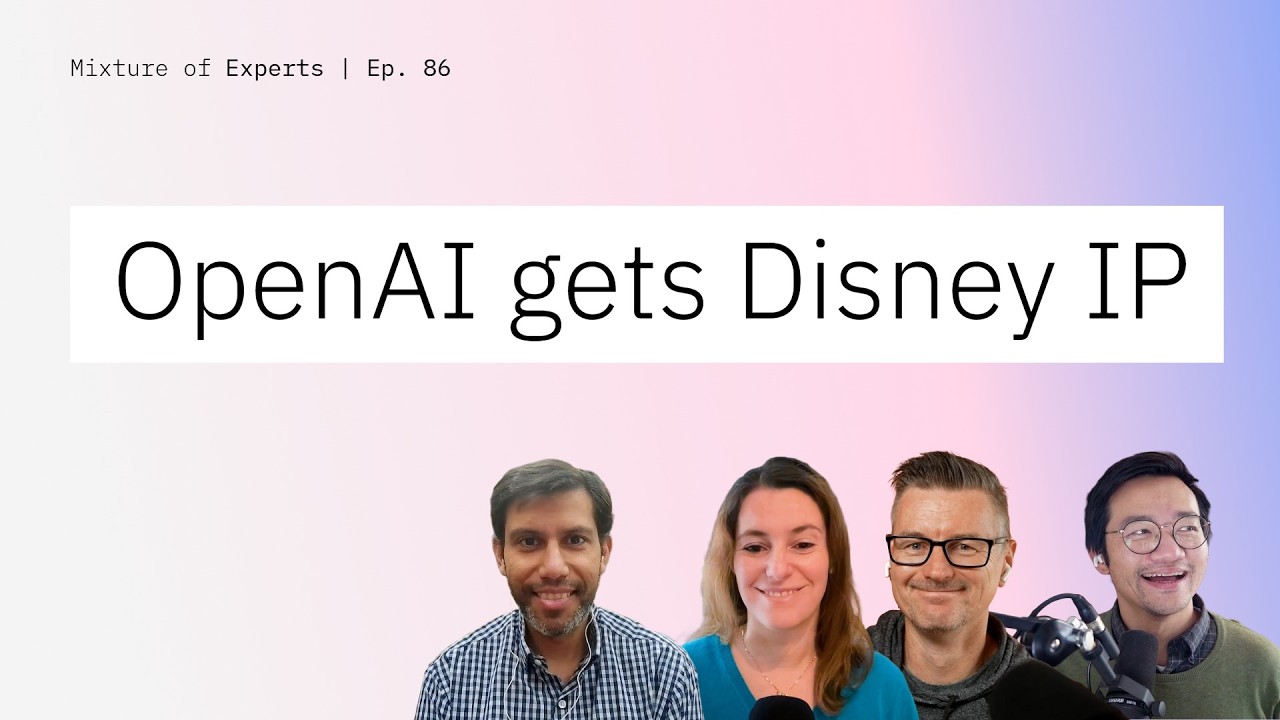
Disney’s Strategic Partnership with OpenAI
The recent three-year licensing deal, which includes Disney taking a billion-dollar equity stake in OpenAI, marks a significant shift in how intellectual property (IP) holders are engaging with generative AI. Unlike previous deals where AI companies paid for training data (e.g., Google’s deal with Reddit or OpenAI’s with the Financial Times), this arrangement is focused on the output side. Disney is paying to allow its characters and IP to be officially used within OpenAI’s generative models like Sora.
A Platform Play for Fan-Generated Content
The panel suggests Disney’s motivation is a strategic platform play to control the inevitable wave of AI-powered fan-generated content. As CEO Bob Iger noted, the goal is to “get ahead of it instead of fall prey to it.” Rather than letting fan-made shorts proliferate across social media platforms like X or Blue Sky, Disney aims to create a controlled ecosystem. By licensing their IP, they can encourage creators to use official platforms, likely integrated with services like Disney+, thereby capturing and controlling this new form of user engagement.
This move fundamentally alters the social contract of authorship. The traditional lines are blurring, and Disney is positioning itself to be a central part of this new creator economy, monetizing it through its established channels like amusement parks and merchandise while embracing the evolving nature of content creation.
Flipping the Script for IP Holders
This deal reverses the previous dynamic of litigation, where IP holders would sue AI labs for using their data for training. Now, Disney is paying to be included, creating a potential “fear of missing out” for other major IP owners. The question shifts from “Did you train on my data?” to “Why can’t my IP be generated by these models?” This could trigger a wave of similar partnerships, with content owners actively seeking to have their IP integrated into generative AI systems.
Time’s “Architects of AI”: A Reflection on the Year of Hype
Time Magazine’s choice for 2025 Person of the Year, the “Architects of AI,” is seen by the panel as a reflection of a year dominated by business, finance, and hype rather than fundamental research breakthroughs. The cover, featuring CEOs and infrastructure leaders, underscores that the “architecture” being celebrated is that of capitalism and market narrative.
The panelists argue that 2025 was the “year of AI hype,” where the conversation was driven by “cults of personality” and financial deals, while the promised leap in capabilities, such as agents replacing jobs, did not fully materialize. The focus on infrastructure spending—over $400 billion in 2025—is compared to the industrial titans of the past, with data centers positioned as the new railroads. This moment echoes Time’s 1982 “Person of the Year,” which was “The Computer,” bringing the narrative of technological mainstreaming full circle.
NVIDIA’s Nemotron 3 and the Full-Stack AI Play
NVIDIA’s release of its Nemotron 3 open-source models is analyzed as a key part of its strategy to move up the stack and solidify its dominance in the AI ecosystem. While NVIDIA leads in hardware, it hasn’t historically been a leader in foundation models. This release is a step towards changing that.
The Strategy: From Hardware to a Complete AI Stack
NVIDIA’s strategy is seen as a “full stack play.” By moving from GPUs to software layers like CUDA and now to workload management (through its acquisition of ShedMD) and foundation models, NVIDIA is aiming to become the indispensable, integrated “computer” for AI. As the quality of models becomes increasingly commoditized, the key differentiators become the levels of integration, ease of use, and the completeness of the ecosystem.
The model’s architecture—a hybrid of Transformer, Mamba (a state-space model), and Mixture of Experts (MoE)—is noted as being similar to other contemporary models like IBM’s Granite 4, indicating a convergence in architectural design. The MoE approach allows for massive models (e.g., the 500B parameter “ultra” model) that are efficient at inference, using only a fraction of their parameters for any given task.
Claude’s “Soul Document” and the Philosophy of Alignment
The leak of Anthropic’s “Soul Document” provided a unique window into the company’s approach to model alignment. This document is a long, philosophical manifesto detailing how the Claude model should behave across a wide range of scenarios.
Alignment Through Fine-Tuning vs. Prompting
Technically, the most significant aspect of the “Soul Document” is its application. Unlike a standard system prompt, these principles are used during the fine-tuning process. This method embeds the desired behaviors and values more deeply into the model’s parameters, reinforcing them consistently rather than applying them only at inference time. This contrasts with more common reinforcement learning techniques that focus on optimizing discrete question-and-answer pairs without a broader philosophical framework.
This approach involves trade-offs:
- Evaluation: It becomes more difficult to quantitatively evaluate the model’s performance when the goal is alignment with broad, narrative principles rather than clear-cut right or wrong answers.
- Modularity: Kush Varshney points out that baking a specific personality—like a “brilliant friend”—so deeply into the model makes it less flexible for enterprise use cases that may require different, more neutral personas.
Despite the cynicism one might have for a document containing lines like, “It generally believes it might be building one of the most transformative and potentially dangerous technologies in human history yet presses forward anyway,” the panel agrees that it has a tangible impact. Claude is widely considered one of the most pleasant and coherent models to interact with, suggesting that this philosophical, literary approach to alignment contributes to a higher-quality user experience. This signals a potential shift from fragile, prompt-based control towards more robust, fine-tuning-based methods for instilling desired behaviors in AI systems.