The Day AI Solves My Puzzles Is The Day I Worry (Prof. Cristopher Moore)
Professor Cristopher Moore of the Santa Fe Institute discusses the surprising effectiveness of AI, arguing it stems from the rich, non-random structure of the real world. He explores the limits of current models, the nature of intelligence as creative problem-solving and abstraction, the importance of grounding and shared reality, and the profound implications of computational irreducibility and the need for algorithmic transparency in high-stakes applications.
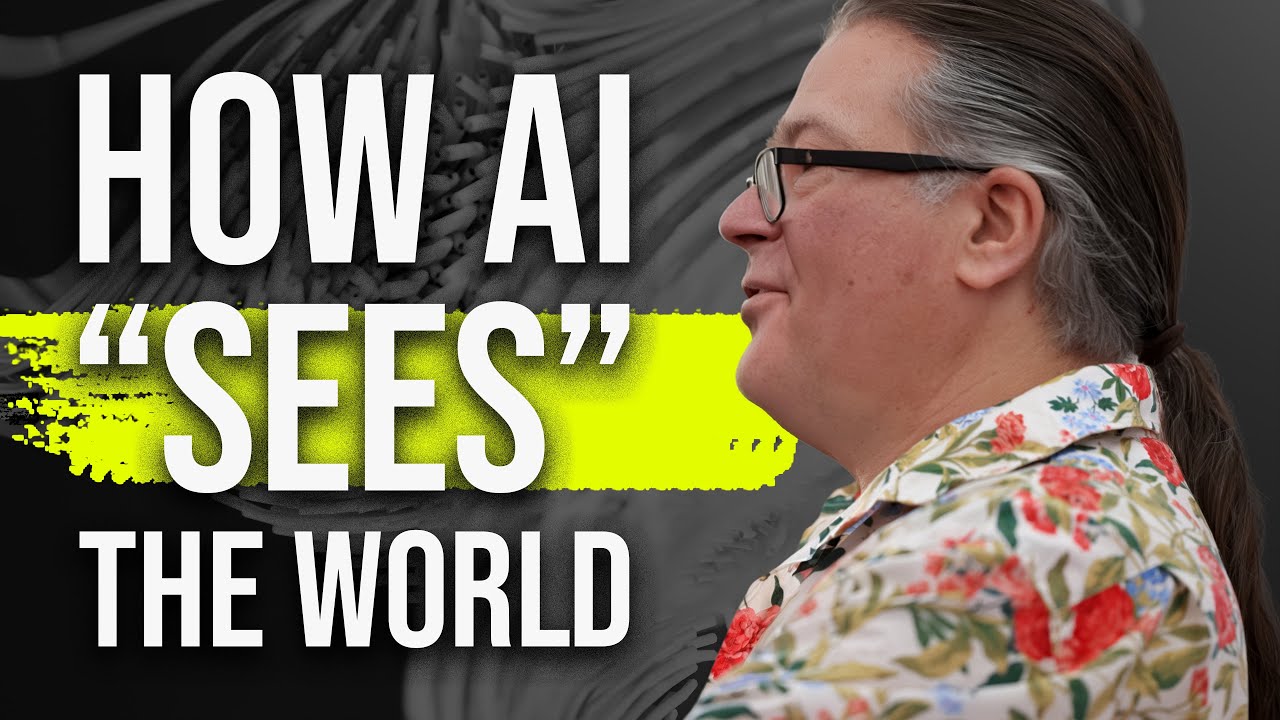
Cristopher Moore, a self-described “frog” in the world of science, prefers diving deep into concrete problems over taking a high-level “bird’s-eye view”. This perspective informs his analysis of artificial intelligence, computational theory, and the nature of intelligence itself.
The Structure of the World and the Success of AI
The surprising effectiveness of large models like transformers stems not from a magical architecture, but from the nature of the data they are trained on. Real-world data is neither completely random nor adversarially designed to be difficult. Instead, it is filled with rich structure, patterns, and hierarchies. Moore argues: “the real world presents us with examples of these problems where there is so much rich structure to sink your teeth into.”
Any sufficiently rich architecture can learn to exploit this structure. We will likely look back and realize that what truly matters is that “the world is structured and any architecture which is capable of capturing some of that structure is going to do well at prediction.” This contrasts with theoretical work in computer science and statistical physics, which often proves hardness based on worst-case adversarial examples or purely random data models. While concepts like phase transitions—sharp shifts in problem difficulty based on signal-to-noise ratios, analogous to a magnet losing its field at a critical temperature—are powerful for understanding random problems, they don’t capture the full picture of real-world AI performance.
Intelligence as Creative Problem-Solving
Despite their success, current models falter on tasks requiring novel reasoning and abstraction, such as modern Sudoku variants with complex, layered rules. These puzzles, designed by humans for humans, require insights and the creation of new logical constraints on the fly, a process current AI struggles with. Moore notes that the ability of AI to absorb rules and perform intelligent search “hasn’t happened yet.”
This highlights a deeper aspect of intelligence: the ability to transform hard problems into simpler ones. It’s about inventing heuristics and new forms of “partial knowledge” to navigate a problem space. Humans fluidly switch their approach, asking “which piece can fit here?” and then “where can this piece go?” This process of formalization and mathematization is a crucial, creative step that often constitutes 90% of the work in scientific modeling. True intelligence involves inventing the variables and constraints to address a problem, not just solving a pre-defined one.
Grounding, Meaning, and Shared Reality
A significant limitation of current language models is their lack of grounding in the physical world. When asked to summarize a nuanced essay, a model might regress to the mean, producing a “lowest common denominator” summary based on common arguments about the topic, completely missing the author’s unique, subtle point. This indicates a failure to grasp meaning beyond statistical correlation.
Moore, a self-professed Platonist, believes in a shared, objective reality of abstract concepts. When two people visualize a cube, they perceive the same object with 8 corners and 12 edges. This shared perception allows for meaningful agreement and correction. He suggests that once AI systems can utilize multimodal “workspaces”—to doodle, run code, and manipulate virtual objects—they will move closer to this kind of grounded understanding.
Computation, Universality, and Irreducibility
The conversation delves into the fundamental nature of computation and its relationship to intelligence.
-
Computational Irreducibility: Drawing on Stephen Wolfram’s work, Moore discusses systems where there are no analytical shortcuts to predict a future state. To know the outcome, “you have to do the work” of simulating every intervening step. While our only method for proving a system is irreducible is to build a universal computer out of it (as was done for Rule 110), many natural systems appear chaotic and irreducible without offering the controlled “particles” needed to construct a computer.
-
Turing Completeness and Recursion: The idea that intelligence requires Turing completeness is nuanced. Moore points out that humans are finite-state machines. Our power comes from being “tool using and tool making” entities. We extend our cognitive workspace with paper, pencils, and computers, giving us access to recursion. The key is not having a built-in stack, but the ability to recognize the need for one and build it. The truly profound intelligent act is the “jump” to a higher level of abstraction, where an infinite pattern is captured by a finite description. He finds the specific architecture of the Turing machine less central than the unifying principle of universality it represents, which is also found in lambda calculus and partial recursive functions.
-
The Computational Lens: Moore is agnostic about whether the universe is fundamentally computational (“pan-computationalism”). He prefers to see computation as a powerful “lens” for understanding systems by focusing on the storage, transmission, and transformation of information. However, it’s not the only lens; a thermodynamic or metabolic lens might be more appropriate for understanding the origin of life, for instance. He is inclined to believe the Physical Church-Turing thesis is true—that the universe is ultimately simulatable by a finite computer and does not contain “real infinities.”
Algorithmic Justice and Transparency
In high-stakes domains, the inscrutability of AI models is a critical problem. Moore argues for a standard of transparency, which is stronger than mere explainability or interpretability.
When an AI system’s decision affects a person’s fundamental rights—such as in the criminal justice system—we must be able to inspect its workings. The justice system values procedural fairness (the right to confront one’s accuser, contest evidence) over pure accuracy. An opaque, proprietary algorithm violates these principles. Moore states, “I don’t think we should be using opaque proprietary tools to make decisions that affect people’s fundamental human rights.” While a black box might be acceptable for movie recommendations, it is not for determining guilt or innocence, where the ability to look under the hood and challenge the process is paramount.