The Moonshot Podcast Deep Dive: Andrew Ng on Deep Learning and Google Brain
Andrew Ng, founder of Google Brain and DeepLearning.AI, discusses the history of neural networks and the foundational ideas that led to modern AI breakthroughs. He covers the controversial early bets on scale and general-purpose algorithms, the technical innovations behind Transformers, and the future democratizing effect of artificial intelligence.
The creation and success of Google Brain were driven by two core, and at the time, controversial hypotheses. The first was that scale matters. Around 2010, the prevailing academic view favored inventing novel algorithms over simply building bigger neural networks. Despite advice from senior figures that focusing on scale was not a good career move, the data generated by my students at Stanford showed a clear, undeniable trend: for every model we tried, performance improved as the model size increased. This data provided the confidence to pursue scale relentlessly.
The second core idea was the “one learning algorithm” hypothesis. Inspired by neuro-rewiring experiments in the brain, where one part of the brain tissue can learn a new function (e.g., learning to “see” after previously learning to “hear”), the question was whether we needed thousands of hand-engineered algorithms for different tasks. The hypothesis was that a single, general-purpose learning algorithm could, if fed different data (text, images, audio), learn to process each type effectively. This was heresy at the time in a field dominated by specialized models, but it has since become the foundation of modern AI.
The Early Days: Pushing Against the Current
In the early 2010s, neural networks were largely out of favor in the AI community, having been in the “wilderness” for a long time. The path to publishing in top conferences was through clever mathematical proofs, not demonstrating the power of scaled-up systems. This focus on scale was seen as lacking intellectual rigor. For researchers who had spent decades meticulously tweaking specific algorithms, the idea that a large model fed with massive amounts of data could outperform their work was emotionally wrenching.
The Google Brain project began at X after Sebastian Thrun, who deserves immense credit for its inception, encouraged me to pitch the idea of using Google’s massive compute infrastructure to Larry Page. The partnership with Jeff Dean was crucial; he brought the deep computer systems expertise, while I brought the machine learning perspective. This combination allowed us to effectively leverage Google’s infrastructure to scale our algorithms.
Technical Innovations and Breakthroughs
Hardware and Architecture
Initially, we were slower to embrace GPUs, partly because Google’s CPU infrastructure was so brilliant and there were concerns about creating a heterogeneous and hard-to-manage compute environment. However, the need for parallel computation was undeniable.
This philosophy of designing for parallel hardware was a core, if sometimes underappreciated, aspect of the Transformer paper. Before Transformers, models for tasks like translation tried to ingest and memorize an entire sentence before generating the output. The Transformer’s key innovation was the attention mechanism, which allowed the model to focus on specific, relevant parts of the input sentence as it generated the output. Crucially, the entire architecture was designed so that every step was highly parallelizable, making it a perfect fit for GPUs and TPUs. This design choice was what unlocked its ability to scale and become the foundation for today’s large models.
The “Cat Video” Paper
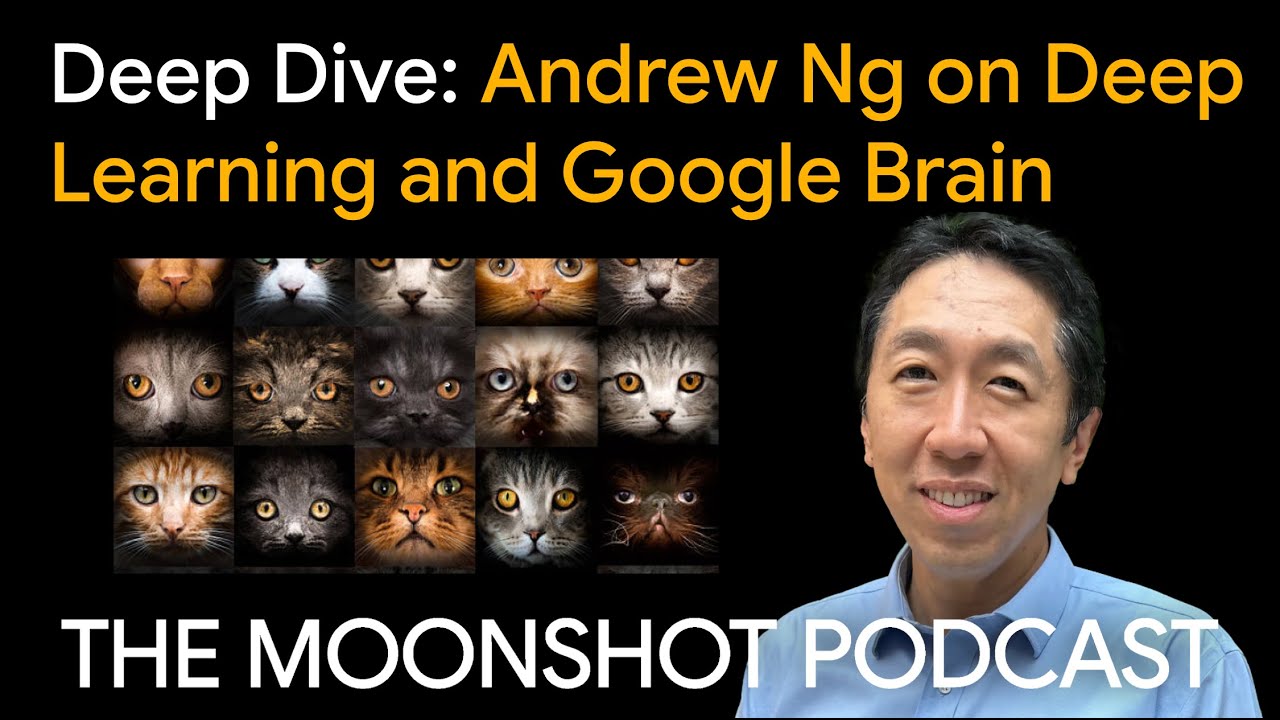
Google Brain’s “coming out moment” was the 2012 paper demonstrating unsupervised learning. We built what was likely the largest neural network in the world at the time and trained it by showing it unlabeled frames from YouTube videos. One day, my student Quoc Le showed me that a neuron in the network had learned to respond specifically to images of cats. The algorithm had, on its own and without any human labels, discovered the concept of a “cat.” This was a massive breakthrough, proving that models could learn meaningful features from the world’s vast stores of unlabeled data.
From Research to Real-World Application
To prove our value, we collaborated with teams across Google. Our early successes included:
- Speech Recognition: We worked with the speech team to improve the accuracy of voice search, which was still maturing.
- Google Street View: A significant early win was using computer vision to read house numbers from Street View imagery. This had a major business impact by dramatically improving the geocoding accuracy of addresses in Google Maps.
- YouTube: We also applied our work to help with content tagging and moderation filtering.
The Future of AI: Democratization and the Workforce
AI’s most profound impact will be its democratizing effect. Today, high-level intelligence—from a specialist doctor to a personal tutor—is one of the most expensive resources in the world. While there isn’t a clear path to making human intelligence cheap, there is a path to making artificial intelligence cheap. In the future, every person could have an “army of smart, well-informed staff” to act as health advisors, tutors, and more, which will lift up a great number of people.
This will also reshape the nature of work. The relevant dynamic is not that “AI will replace people,” but that “people that use AI will replace people that don’t.” Just as knowing how to use a search engine is a baseline skill for knowledge workers today, the ability to effectively use AI will become a non-negotiable requirement for most roles in the future.