AGI progress, surprising breakthroughs, and the road ahead — the OpenAI Podcast Ep. 5
OpenAI's Chief Scientist Jakub Pachocki and researcher Szymon Sidor discuss the rapid progress towards AGI, focusing on the shift from traditional benchmarks to real-world capabilities like automating scientific discovery. They share insights into recent breakthroughs in mathematical and programmatic reasoning, highlighted by successes in competitions like the International Math Olympiad (IMO), and explore what's next for scaling and long-horizon problem-solving.
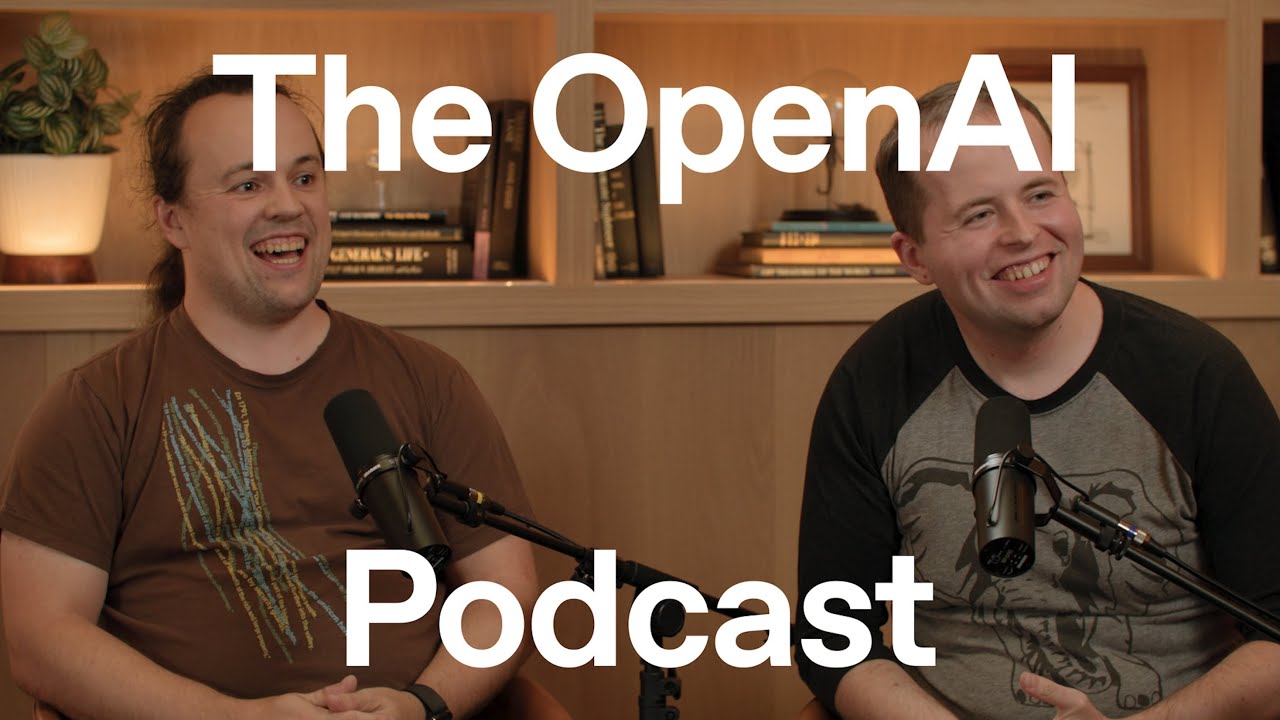
The definition of Artificial General Intelligence (AGI) has evolved from an abstract concept to a set of more concrete, albeit distinct, capabilities. While milestones like achieving natural conversation have been met, the focus is shifting from pointwise measures to real-world impact. The most meaningful application of AGI is seen as the automation of scientific discovery and the production of new technology, a process traditionally associated with human ingenuity. This involves creating a general intelligence that can generate ideas to fundamentally change our understanding of the world, with promising early results in complex fields like medicine.
The Shifting Landscape of AI Evaluation
The last decade has seen an astounding pace of progress. Ten years ago, deep learning models for NLP struggled with basic sentiment analysis, failing on simple negations like “this movie is not bad.” Today, models can compete at the highest levels of programming and mathematics competitions. This insider’s perspective contrasts sharply with external analyses that might suggest AI’s economic impact is small or that progress is slowing down.
This rapid advancement has led to significant challenges with traditional evaluation methods:
- Benchmark Saturation: Models are reaching human-level performance on many standardized benchmarks, making it difficult to measure further progress. Some benchmarks even contain flawed data, making a perfect score impossible.
- Over-specialization: It’s now possible to train models that are disproportionately good at specific tasks, like mathematics, without a corresponding increase in general intelligence. A high score on a math benchmark is no longer as representative of a model’s overall capability.
- From Test-Taking to Utility: The focus must shift from a model’s ability to score well on a test to its real-world utility and its capacity for discovering novel insights.
Reasoning, Competitions, and Long-Horizon Problems
To better gauge progress in reasoning, OpenAI has turned to human-level competitions that require deep, creative thinking over extended periods, not just knowledge recall.
International Math Olympiad (IMO)
The IMO was long considered a key milestone on the path to AGI. Success in this competition demonstrates a superior mathematical reasoning ability that could be applied to disrupt any domain that can be mathematically modeled.
“It is of course like in a limited domain of of math, but it really is about like fairly creative thinking, not about applying a formula.”
Notably, the model that achieved a gold-medal level performance did so purely through reasoning, without using external tools like a calculator. It was also able to correctly identify when it was not making progress on a problem, a fascinating step in self-awareness. This was particularly evident with the notoriously difficult “problem six,” which both OpenAI’s and Google DeepMind’s models identified as unsolvable while perfecting the other five problems.
AtCoder and 10-Hour Problem Solving
Another significant achievement occurred in the AtCoder competition in Japan, which features a single, complex, long-horizon heuristic problem to be solved over 10 hours. This format tests a different kind of intelligence than short-form contests, requiring sustained focus and diverse optimization strategies. OpenAI’s model secured second place, competing directly against top human competitors, demonstrating its capability in prolonged, focused problem-solving.
The Next Breakthroughs: Scaling and Persistence
The recent, surprising leaps in reasoning capabilities were the result of intense, dedicated research. Internally, the initial success of these reasoning models was a shocking moment that prompted serious questions about organizational readiness for an incredibly fast pace of progress.
Looking forward, two key areas are critical for the next wave of breakthroughs:
- Compounding Scaling: The original scaling paradigm of pre-training is not obsolete; it will compound with new advances in reasoning.
- Long-Horizon Reasoning and Persistence: The next frontier is enabling models to work on a focused problem for a very long time, using vastly more compute than is feasible for a single user query. The amount of computation one might dedicate to solving a major medical research question is incomparably larger than that for a chat response. Developing this model persistence is a clear next step.
For the end-user, AGI will likely manifest as an automated “company” of highly capable researchers and engineers that radically accelerates the pace of technological progress. Interfaces will also become more persistent and human-like, strengthening our ability to form attachments and interact with them.
Advice for the Next Generation
When asked what to tell high school students today, the advice was unequivocal:
“You should absolutely learn to code. one skill that that is at premium and will continue being at premium is to have like really structured intellect that can like break complicated problems into pieces and you know like that might not be programming in the future but programming is a fine way to acquire that skill.”
The skill is not about the specific language but about developing a structured, analytical mind. This is complemented by the encouragement to think big, question perceived constraints, and believe in the ability to make a meaningful, positive change in the world.