Aleph: The AI Platform for Modern Finance
Co-founders Albert Gozzi and Santiago Perez De Rosso of Aleph discuss their journey building an AI-native FP&A platform. They share insights on their first-principles approach of meeting finance teams in spreadsheets, achieving rapid time-to-value, and the early challenges of building a horizontal product. The conversation covers their YC experience, scaling to a $29M Series B, and their vision for the future of finance powered by pragmatic, accuracy-focused AI.
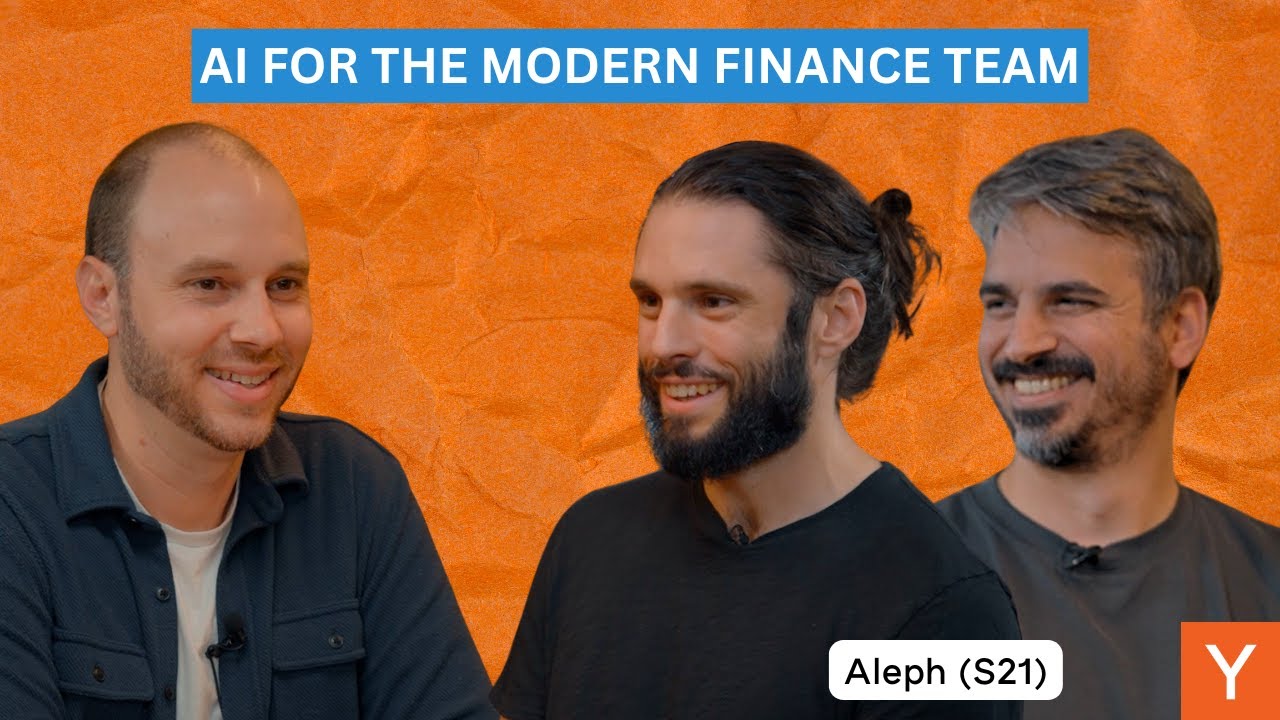
Aleph is pioneering an AI-native Financial Planning & Analysis (FP&A) platform, built on the foundational principle of meeting finance professionals in their native environment: spreadsheets. The core mission is to centralize all the information a finance team needs and provide them with intelligent tools to drive analysis and decision-making, directly within the spreadsheet ecosystem they live and breathe.
Rethinking FP&A from First Principles
The co-founders identified critical flaws in the legacy FP&A market. Traditional tools often require implementation times of three to six months, delaying value realization for customers. Aleph’s approach counters this with a focus on immediate impact.
“It doesn’t make sense for a tool like Aleph to take 6 months to implement. But that’s the standard today in the market… we are, you know, first time to value within a day or less, maybe sometimes even hours, and then we’re fully implemented in like one, two weeks.”
This rapid time-to-value is a key differentiator, resonating with fast-growing companies like Zapier, Turo, and Harvey. The second core principle is empowering finance teams within their existing workflows. Instead of forcing users onto a new, rigid platform, Aleph integrates into spreadsheets, which co-founder Santiago Perez De Rosso calls “the best no-code tool ever.” This combination of a familiar interface with a powerful, centralized data backend has proven to be a winning formula.
The Founder’s Journey and Early Traction
The company’s vision is a direct result of the founders’ complementary backgrounds. CEO Albert Gozzi experienced the pains of FP&A firsthand as a management consultant, a member of P&G’s finance team, and later as the COO/CFO of a startup. CTO Santiago Perez De Rosso brought a deep technical background from Google and a PhD in computer science, with research focused on no-code development tools.
Their journey through Y Combinator in 2021 was a period of rapid acceleration. They secured their first customer just one day before their follow-up YC interview, a testament to the extensive customer research—over 150 calls—conducted even before the company was fully formed. This deep empathy for the customer’s problem meant the core product vision has remained remarkably consistent, avoiding major pivots.
In the early days, the team embraced the “do things that don’t scale” mantra to build trust, which is paramount when handling sensitive financial data.
- Prioritizing Security: Aleph became SOC 2 certified when it was just a three-person company with less than $100k in the bank, signaling a non-negotiable commitment to security.
- Hands-on Customer Success: The early customer success team acted as a human extension of the product, manually reviewing numbers with clients and ensuring reports were accurate and timely. This dedication to ensuring the customer’s success, even if it required manual workarounds, was crucial for building initial trust and momentum.
Building a Pragmatic, AI-Native Platform
While the vision for Aleph was established in a pre-GPT world, AI is now central to its future. The founders view AI pragmatically—as a means to an end, not a feature to be “slapped onto a workflow.” The focus is on building curated, intelligent workflows that significantly enhance the productivity of finance teams.
A key technical challenge is ensuring accuracy, which is non-negotiable in finance.
“In the space in which we operate like accuracy matters a lot so we need to spend a lot of time you know making sure that the that everything we put out there works works well.”
Having built the foundational “plumbing” of the product (integrations, permissions, security), the team is now focused on leveraging AI to build more advanced, value-added features. The goal is to move beyond simple automation and fundamentally change how finance teams operate, plan, and forecast.
Lessons on Growth and Focus
Reflecting on their journey from YC to a $29 million Series B, the founders shared key lessons:
- Perseverance is Key: A core YC learning was to “never give up.” The ability to move on from a lost customer to the next opportunity without losing momentum is critical.
- Focus Inward: Startups are more likely to fail from internal issues than external competition. The founders advise against getting distracted by competitors, emphasizing that focusing on talking to customers and adding value is what compounds over the long term.
- Personal Evolution: As the company scales, a founder’s role must evolve. The focus shifts from individual contribution (coding, building a spreadsheet) to amplifying the team’s impact through setting direction, fostering alignment, and solving more abstract problems.