No Priors Ep. 129 | With U.S. Under Secretary of State (E) Designate Jacob Helberg
Jacob Helberg, Under Secretary of State designate, discusses how AI will act as a productivity engine to reindustrialize America, the geopolitical race for AI dominance in the "superintelligence century," and the critical need for nuclear energy to power this transformation.
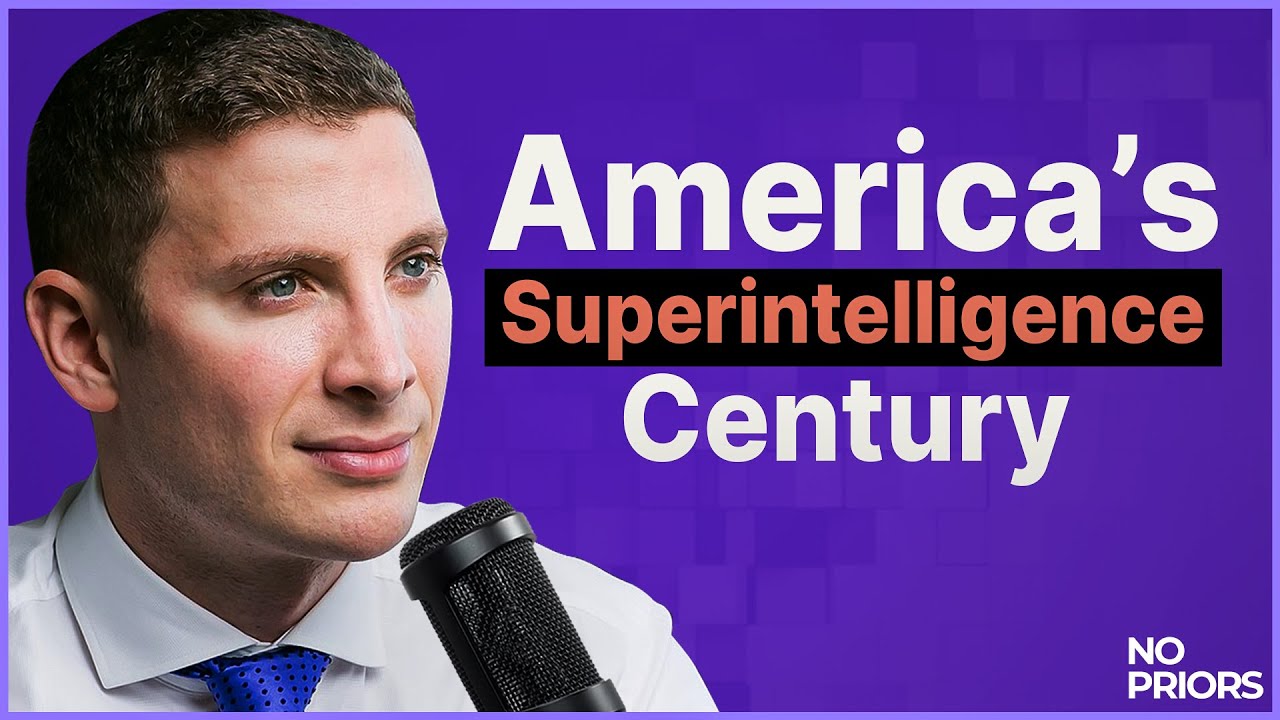
Jacob Helberg presents a vision where Artificial Intelligence serves as the primary catalyst for a new era of American economic growth, productivity, and reindustrialization. Far from being a job-killer, AI is framed as a technology that will give workers “superpowers,” massively increasing their output and enabling the United States to overcome the labor cost advantages of developing nations.
Securing the Supply Chain and Reigniting Manufacturing
A core tenet of Helberg’s agenda is securing America’s brittle supply chains to reduce over-reliance on geopolitical rivals. The U.S. currently depends on China for refining 90% of critical minerals and on Taiwan for advanced semiconductors. This exposure represents a significant economic and national security vulnerability.
The strategy to counter this involves two main thrusts:
- Reshoring and Friend-Shoring: Forging new partnerships with allied nations and bringing critical manufacturing back to the U.S.
- Countering Monopolistic Practices: China’s strategy of flooding the market to sink prices and drive Western refineries out of business can be countered with strategic government action. The DoD’s deal with MP Materials for rare earth magnet production serves as a blueprint: establishing an “anchor buyer” and a price floor to guarantee stability for domestic producers.
This shift is already visible in leading economic indicators. The U.S. is moving from a consumption-driven economy to a high-investment one, with private CapEx investment exceeding 2% of GDP and projected to double. Key areas for this capital expenditure include AI infrastructure, energy, raw industrials, and defense.
AI as the Engine for a New Industrial Revolution
Helberg challenges the long-held economic theory that mature economies must inevitably evolve into service-based economies. He argues that AI provides a historic opportunity to “violate that narrative.”
“The people who say that we can’t re-industrialize because China has a bigger population or, you know, our people are more expensive, I think are totally missing the plot… I’m a believer that AI will far from replacing humans altogether will actually give humans superpowers.”
The historical precedent for this is the first industrial revolution, where technology allowed Britain, a small country, to achieve a per capita industrial output over 50 times that of China. Similarly, AI-driven productivity gains can erode the competitive advantages of cheap labor. This is explained by Jevons’ paradox: when a technology massively increases efficiency, the demand for the underlying resource (in this case, human labor) actually increases because the relative cost goes down. Companies will choose to increase their total output with their newly augmented workforce rather than reduce headcount, leading to a world that “is just going to produce a lot more stuff.”
The “Superintelligence Century” and Geopolitical Shifts
The defining feature of the 21st century will not be the rise of China, but the “rise of superintelligence.” This paradigm shift is creating a new global landscape with several key features:
- A Second Great Divergence: Economies that are first-movers in integrating AI will reap massive productivity benefits and leapfrog the rest of the world.
- Collapse of the Cheap Labor Advantage: The economic model for many developing nations will be fundamentally disrupted.
- Europe’s Economic Decline: Europe is falling behind after missing major technology waves and is now further hindering itself with restrictive policies like the EU’s AI Act.
- The Rise of the Middle East: Tech-forward nations like the UAE and Israel are emerging as unexpected economic powerhouses, with GDP per capita figures surpassing those of some European countries.
- A US-China AI Race: The two nations are locked in an aggressive competition to control the foundational “scaffolding of the AI architecture for the world,” from hardware to models and applications.
The Critical Need for Energy Abundance
Powering this AI-driven, reindustrialized economy requires a massive expansion of the U.S. energy supply. Data centers alone may require the nation to double its electricity production. Helberg identifies nuclear energy as the best path forward to achieve this.
The primary obstacles for nuclear have been immense capital expenditure and long, unpredictable construction timelines, often derailed by regulatory red tape and protests, which cause financing costs to compound. The solution lies in policy certainty. The administration can play a crucial role by:
- Compressing the Regulatory Window: Creating a predictable and efficient permitting process.
- Encouraging Strategic Investment: Signaling that the U.S. government (specifically, CFIUS) will welcome foreign investment from trusted partners, such as those in the Middle East, to capitalize these large-scale nuclear projects.
The ultimate vision is a new American economy characterized by high investment, rising productivity, a healthier balance of manufacturing and services, and a potential GDP growth band of 3-5%, up from the 1-3% of recent decades. This requires a “builder-friendly administration” focused on removing roadblocks through deregulation and empowering innovators.