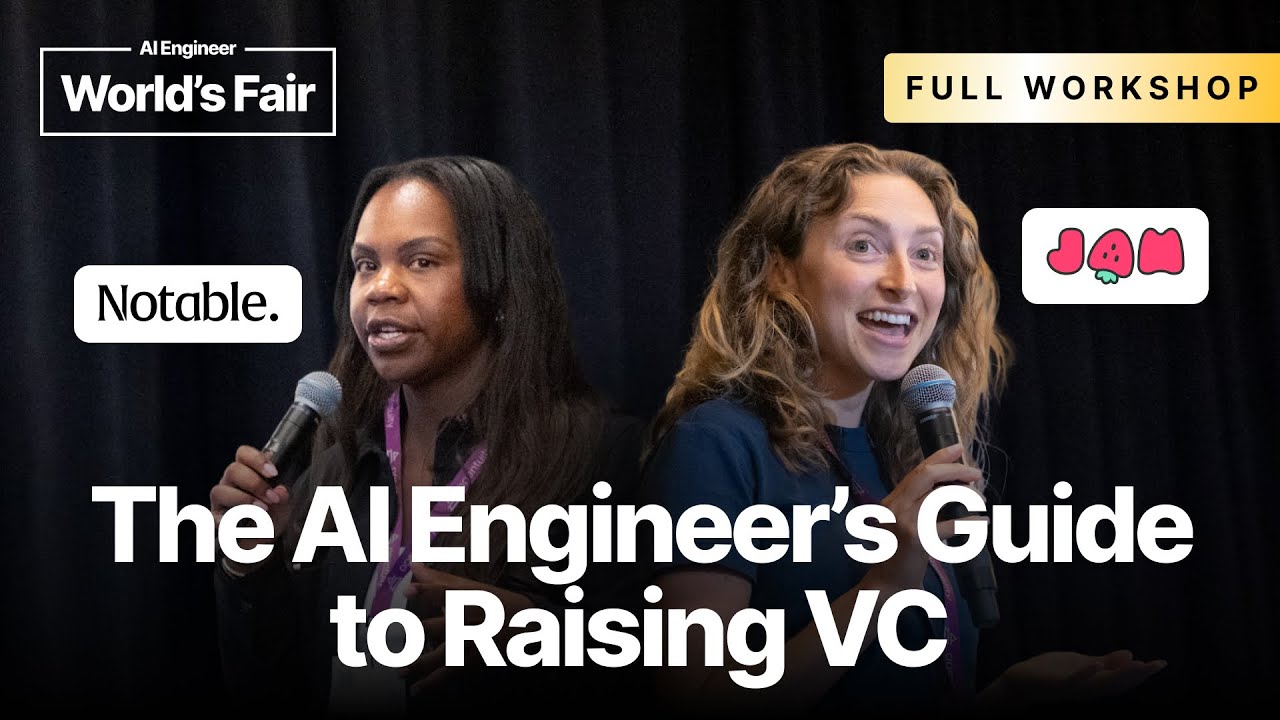
The AI Engineer’s Guide to Raising VC — Dani Grant (Jam), Chelcie Taylor (Notable)
VCs Dani Grant and Chelcie Taylor provide a tactical playbook for AI engineers on raising their first round of funding. They cover when to raise, how to write effective cold emails, what to focus on in a pitch (vision over tech), how to answer key questions about competitors and go-to-market, and the dynamics of a successful investor meeting.
For early-stage companies, particularly at the pre-seed and seed stages, the most critical elements for fundraising are the founder, the team, and the vision—not a finished product or existing revenue. Investors are betting on a founder’s unique insight into a market and their ability to build a team and execute on a grand vision. The product pitched today is understood to be a starting point that will likely evolve significantly over time.
When to Raise: Dispelling the Myths
A common misconception is that a company needs revenue or even a fully-built product to raise venture capital. This is not the case for pre-seed and seed funds. These investors are well-versed in backing founders pre-revenue and pre-product.
-
Potential Over Progress: It can be easier to raise when the company is still in the “potential” phase. An early prototype or even just a compelling vision allows investors to imagine the upside without being anchored to an early, unpolished MVP. As founder Dani Grant noted, “it was a lot easier for us to raise our round when everything is potential.”
-
Founder Conviction: While you don’t need a product, you do need conviction. Leaving a full-time job is a powerful signal of this conviction. While some firms may invest in founders who are still employed, taking the leap demonstrates a full commitment that de-risks the investment from a VC’s psychological perspective.
-
Co-Founders: While there are unique cases of solo founders, having a co-founder is standard and generally preferred by VCs.
Getting the First Meeting
While warm introductions are ideal, they aren’t available to everyone. Cold outreach can work if done correctly. VCs are salespeople trying to “sell money” to great entrepreneurs, so they are incentivized to find deals wherever they can.
The Art of the Compelling Cold Email
The job of the email is not to sell the entire company but simply to compel a response. Keep it short and create intrigue.
Effective cold emails often share these traits:
- Show You’ve Done Research: Reference a specific blog post, tweet, or topic the VC has publicly discussed. This shows you are thoughtful and not just mass-emailing. An example that led to an investment was as simple as:
"Hey, loved your post. You might find the one I did a while back on this topic interesting. Would love to hear what you think."It didn’t even mention the startup. - Have a Specific, Tangible Ask: Instead of a vague “I’d love to chat,” ask for specific feedback. For example:
"I'd love your take on our go-to-market"or"Any pointers to other investors in the consumer space?"This helps the VC immediately understand the purpose of the meeting. - Build a Relationship First: The “ask for advice, get money; ask for money, get advice” principle holds true. Engage with an investor’s content and ideas early on. Frame the initial outreach as a desire to share ideas with a fellow thinker in the space. This builds a relationship before you are formally “running a process.”
Mastering the Pitch Meeting
The pitch meeting is a performance where you are selling your vision. For a technical audience like AI engineers, the biggest mistake is over-focusing on the technology.
“Why You, Why Now?”
This is the core question you must answer. Investors are looking for founders with a unique, non-traditional insight into a market, customer, or product. Ground your pitch in the core problem you’ve identified and explain what led you to your unique approach.
From Feature to Billion-Dollar Company
Investors need to see the path from your current idea to a massive, fund-returning outcome. A common question is, “Why is this a company and not a feature?”
- Be prepared to articulate the grand vision. A successful framing is: “This is the first feature of our future product.” Then, explain what that future product looks like and how you get there.
- Signal future revenue potential by mentioning conversations with potential design partners or customers, even if they are just interviews. You can say, “Based on conversations with X potential buyers, we have a hypothesis that ACVs could be in this range.”
The Dynamics of a Successful Pitch
- Give a Good Meeting: The meeting should be an engaging, bidirectional conversation, not a monologue. Laughter and a clear focus are good signs.
- Don’t Over-Answer: VCs often ask questions to see how you think, not just what you know. Instead of launching into a 10-minute explanation, provide a concise answer and open the door for a deeper dive: “We’ve thought about it a couple of ways. Most likely we’ll do X, but I’m happy to go into more detail.”
- It’s Okay to Not Know: A founder who can say, “I could make up an answer for you right now, but I want to be thoughtful about it,” demonstrates maturity and trustworthiness. This is often more impressive than a fabricated, on-the-fly answer.
- Practice on Lower-Stakes VCs: Schedule your first few pitches with funds you are less excited about. Use them to get your reps in, refine your story, and anticipate questions so you are fully prepared for your top-choice investors.
Answering Key Questions
Be prepared to discuss these core areas:
- Problem & Solution: What is the core problem and your vision for the solution?
- Customer (ICP): Who is your Ideal Customer Profile? It’s okay to have a few hypotheses that you plan to test.
- Revenue & Monetization: What is your hypothesis for the business model (e.g., usage-based, seat-based, PLG)? Reference similar companies and be ready to discuss why you’ve chosen a certain path.
- Team: Who are the first key hires? How will you attract top talent? Mentioning your network is a powerful signal.
- Competitors: Never say you have no competitors. Acknowledge the landscape and show how you are different. Use it as an opportunity to gather intelligence by asking the VC, “You’ve likely met with others in this space. Why did you pass on them?” This turns the question into a valuable dialogue.
Wrapping Up and Next Steps
- Always Ask for Next Steps: If the VC doesn’t offer them, prompt them: “What does your process look like from here?”
- The Pitch Deck is a “Leave-Behind”: Don’t present a slide deck in the first meeting, as it can turn a conversation into a dry presentation. The purpose of the pitch deck is to be a compelling “brochure” that the VC you met with can use to sell your company to their partners internally. Have it ready to send immediately after the meeting.