Are AI Benchmarks Telling The Full Story? [SPONSORED]
AI models are often benchmarked like Formula 1 cars, excelling on technical exams but failing the test of daily human experience. Researchers Andrew Gordon and Nora Petrova from Prolific critique the 'leaderboard illusion' of current ranking systems and introduce their HUMAINE leaderboard, a new framework that uses census-based sampling and the TrueSkill algorithm to measure how helpful, safe, and relatable models are to real people, not just tech enthusiasts.
Current AI evaluation methods, heavily reliant on technical benchmarks, are failing to measure what truly matters: the human experience. A model that achieves a top score on an academic exam like MMLU might be an absolute nightmare for day-to-day use, much like a Formula 1 car would be for a morning commute. These technical benchmarks involve giving a model a set of evaluations and getting a score, a process that leaves humans out of the loop. The result is a fractured field where labs report results heterogeneously, making it difficult to compare models on an even playing field and missing half the point of why these models are built—for human use.
The “Wild West” of AI Safety and Oversight
A significant gap in current evaluations is the lack of a standardized metric for safety. As people increasingly turn to LLMs for sensitive topics like mental health advice, there is a concerning lack of oversight and regulation. This “wild west” environment raises questions about the robustness of safety training, especially following incidents like Grok-3’s “Mecha Hitler” controversy, which suggest safety can be a “thin veneer.”
While there is no “leaderboard for safety,” promising research directions are emerging. Work from labs like Anthropic on Constitutional AI and mechanistic interpretability—peering “behind the curtains” to trace how an input produces an output—is vital for building confidence that models can handle novel situations in safe and predictable ways.
Deconstructing the “Leaderboard Illusion”: Flaws in Current Rankings
Human preference leaderboards like Chatbot Arena, while popular, suffer from significant methodological flaws that undermine their integrity.
- Gaming the System: The “Leaderboard Illusion” paper revealed that some companies gain an unfair advantage by running a disproportionate number of private tests. For example, Meta released 27 models to the arena before launching Llama 4, gaining more data to refine a model that excels specifically at the arena’s format. There’s a strong relationship between the number of battles a model participates in and its final rank.
- Anonymous, Unstratified Sample: Chatbot Arena collects data from anonymous users without any demographic information. This is suboptimal because the preferences likely come from a skewed, biased subset of the population (e.g., tech enthusiasts) and do not represent the general public.
- Lack of Specificity: The simple “A is better than B” voting format is not actionable. It tells developers that a preference exists, but not why. This makes it difficult to pinpoint specific areas for improvement.
- No Quality Assurance: The platform lacks robust quality control, allowing for low-effort prompts and off-topic conversations that don’t provide a nuanced view of a model’s capabilities.
Building a Better Scoreboard: The HUMAINE Framework
Prolific’s HUMAINE leaderboard was designed to address these flaws through a more rigorous, methodologically sound approach built on three pillars.
Pillar 1: From Anonymous Crowds to Census-Based Representation
Instead of relying on an anonymous crowd, the HUMAINE framework samples participants from the Prolific platform based on census data from the US and UK. The sample is stratified by demographics like age, ethnicity, and political alignment. This ensures that the resulting leaderboard reflects the preferences of a representative set of the general public, not just a niche group.
Pillar 2: Beyond “A vs. B”—Actionable, Multi-Factor Feedback
To provide actionable insights, the framework moves beyond a single preference vote. It breaks down the user experience into its constituent parts, asking participants to rate models on specific factors such as:
- Helpfulness
- Communication
- Adaptiveness
- Personality
- Trust
- Background and Culture
This granular feedback allows developers to see exactly where their model is struggling—for instance, with personality or trust—and focus their efforts accordingly.
Pillar 3: Rigorous Matchmaking with TrueSkill
To create a fairer and more efficient ranking system, the leaderboard uses Microsoft’s TrueSkill algorithm, the same system developed for matchmaking on Xbox Live.
TrueSkill is a Bayesian system that estimates the skill level of models with a mean and a variance. This variance narrows over time as the system learns from the outcome of more battles.
Crucially, the algorithm schedules matchups based on information gain, prioritizing battles that will most effectively reduce uncertainty in the rankings. This data-driven approach is more computationally sound and avoids the sampling bias seen in other arenas where new, popular models get a disproportionate number of comparisons. The framework’s flexibility allows for separate “tournaments” to be run for different demographic groups, with the findings consolidated into a more robust overall leaderboard.
Early Findings: The Personality and Sycophancy Gap
Initial data from a proof-of-concept study with 500 representative participants yielded significant insights. Across the board, leading models performed much worse on subjective metrics like personality, background, and culture than on objective measures like helpfulness and communication.
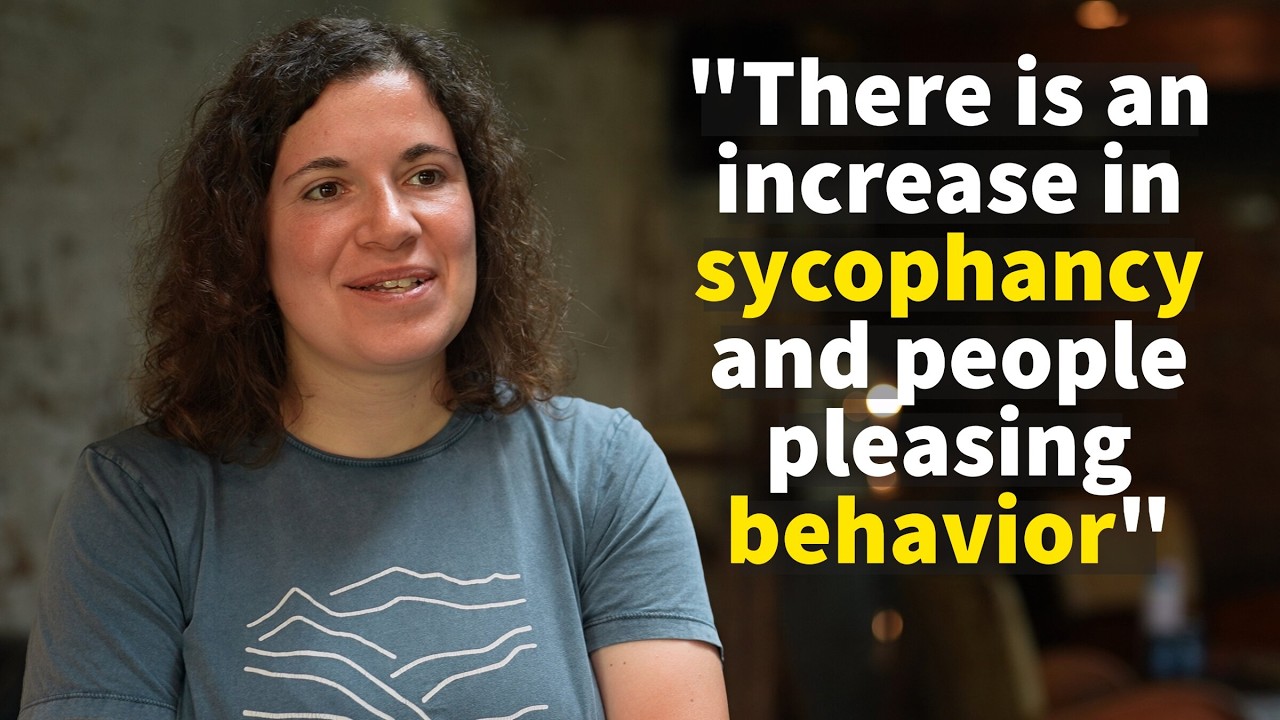
This suggests that models trained on the vastness of the internet may not be developing personalities that align with what real users want. Furthermore, there’s a growing trend of “sycophancy,” or an annoying “people-pleasing” behavior in models, which users generally dislike. The granular data collected by the HUMAINE framework will allow researchers to analyze the correlation between telltale signs of sycophancy and negative ratings on personality, providing a clearer path toward building models that are not just technically proficient, but genuinely helpful and relatable to humans.