The Common Thread of All Technology: Monitoring the Situation, Ep.1
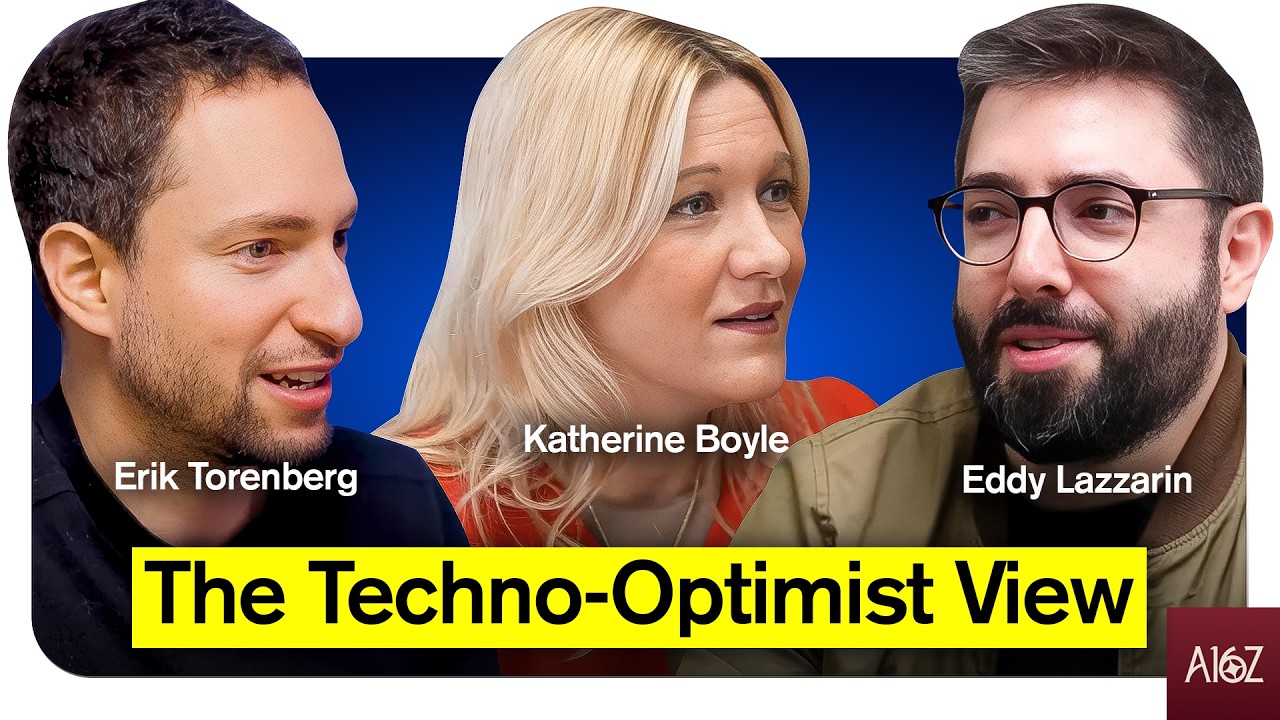
In the first episode of "Monitoring the Situation", a16z's Erik Torenberg, Katherine Boyle, and guest Eddie Lazzarin discuss the firm's coherent vision, linking American Dynamism, gaming, and crypto through the lens of Marc Andreessen’s Techno-Optimist Manifesto. They explore the philosophical alignment between crypto and American values, the impact of AI on parenting and healthcare, new education models, and how fragmented internet subcultures are shaping mainstream discourse.
The Unifying Thesis of a16z
The perceived silos between a16z’s investment areas—such as American Dynamism, consumer, games, and crypto—are misleading. There is a deep, underlying continuity in technological development that connects these seemingly disparate fields. The journey of Palmer Luckey, from a gaming-obsessed teenager building VR headsets in his parent’s motorhome to founding Oculus and later Anduril, a major defense technology company, serves as a prime example. This illustrates Chris Dixon’s thesis that “everything great starts looking like a toy.” Technologies developed in gaming, like GPUs, are now foundational to AI data centers, demonstrating how innovations in one area can be reapplied to solve critical problems elsewhere.
This interconnectedness is best captured by Marc Andreessen’s Techno-Optimist Manifesto, which serves as the coherent thesis for all technological building. It frames the founder’s journey as a universal story arc, regardless of the sector. The challenges and triumphs of building are shared across all domains, from atoms to bits. This perspective refutes the idea of infighting between categories, suggesting instead that all of tech should be aligned on the fundamental hero’s journey of innovation.
American Dynamism Meets Crypto
A common question is how to reconcile the goals of American Dynamism—strengthening American institutions—with crypto, which is sometimes viewed as a hedge against the state. The connection lies in their shared underlying values. Crypto is fundamentally a “freedom-promoting technology,” aligning with core American ideals like property rights, free capital flow, and individual ownership.
Rather than being replacements, the state and crypto can be complementary systems for enacting these values.
- A Venue for Experimentation: Crypto provides a transparent, open-source environment to experiment with new models of ownership and capital formation without granting asymmetric power to any single entity outside the state. This allows for rapid innovation in a way that is legible and can inform state-level policy.
- Philosophical Alignment: The founders drawn to American Dynamism and crypto often share a similar philosophical profile. They are motivated by solving America’s biggest generational problems and are often influenced by canonical texts like The Sovereign Individual. Many early investors in foundational American Dynamism companies like SpaceX and Palantir were also early proponents of crypto’s core ideas.
- Decentralization and Federalism: Crypto’s focus on decentralization mirrors the American political philosophy of federalism—the idea that distributed power is a cornerstone of a resilient system. The crypto ethos is described as a “uniquely American cultural phenomenon,” much like the concept of the “founder” and the “startup” itself.
The Internet as Doctor: AI, Healthcare, and the Wisdom of Crowds
A new generation of parents is approaching medicine with a different epistemic standard, driven by the internet and AI. This isn’t just skepticism of experts, but a demand for more information and a higher standard of evidence.
- AI as a Medical Co-pilot: People are now using tools like ChatGPT to analyze their own medical diagnostics and lab reports, bringing a wealth of data-driven questions to their doctors. This creates a more collaborative and informed patient-doctor relationship, moving beyond the traditional top-down model.
- Incentives and Diagnosis: There’s a growing awareness of the systemic incentives that can lead to over-diagnosis. The discussion highlights the staggering rise in ADHD diagnoses, particularly among boys (nearly one in four 17-year-olds). This trend is fueled by incentives for both parents (extra time on tests, more resources) and schools (more state funding for special needs students). This creates a system where disagreeing with a diagnosis requires being “a very disagreeable, sadly principled mother.”
Rethinking Education for the 21st Century
The conversation touches on the evolving landscape of education, highlighting three emerging branches: the traditional system, alternative schools like Alpha School, and the nascent world of AI tutors.
- Personalized Learning at Scale: The core innovation is the ability to provide an “infinite treadmill” of learning, allowing children to go to arbitrary depths on subjects they are passionate about. A child obsessed with garbage disposals can now access hundreds of YouTube videos, diagrams, and tutorials—a level of specialized knowledge unimaginable a generation ago.
- The Power of Niche Interests: Allowing a child to become an expert in a niche topic, like how a garbage disposal works, primes them to understand adjacent concepts like mechanical and hydraulic systems. This compounding nature of knowledge is a powerful learning accelerator.
- Customized Curriculums: Models like Alpha School customize lesson plans around a child’s interests. For a kid obsessed with basketball, math can be taught through the lens of salary caps and statistical player analysis, making the subject relevant and engaging.
Internet Culture, Fragmentation, and the Social Graph
The internet has not dissolved into a single mainstream culture but has instead fostered countless fragmented, mutually unintelligible subcultures. The reaction to the assassination of Charlie Kirk highlighted this gap, where mainstream observers struggled to understand the memes and references of the shooter’s online world (e.g., Discord, gamer culture), which were immediately legible to those inside it.
In this fragmented landscape, different platforms serve different functions. While Instagram can be an echo chamber, X (formerly Twitter) has emerged as a unique “translation layer” and public arena.
- X as the Arena: Despite issues with misinformation, the ground truth on major events often emerges on X first due to its open graph, the norm of public correction via quote tweets, and its user base of journalists and power users.
- Developing a Theory of Mind: Engaging on X, particularly with pseudo-anonymous accounts, forces users to develop a “theory of mind” for people they would otherwise never encounter. It provides a raw, unfiltered feedback loop on ideas, revealing how different segments of the population will perceive a statement. This makes it a powerful, if sometimes brutal, tool for understanding the full spectrum of public opinion.