2025 is the Year of Evals! Just like 2024, and 2023, and … — John Dickerson, CEO Mozilla AI
A deep dive into why 2025 is poised to be the 'Year of Evals' for AI. The speaker argues that a confluence of factors—the C-suite's post-ChatGPT awakening, budget dynamics, and the rise of autonomous agentic systems—has finally made AI evaluation a critical, top-of-mind issue for enterprise leaders.
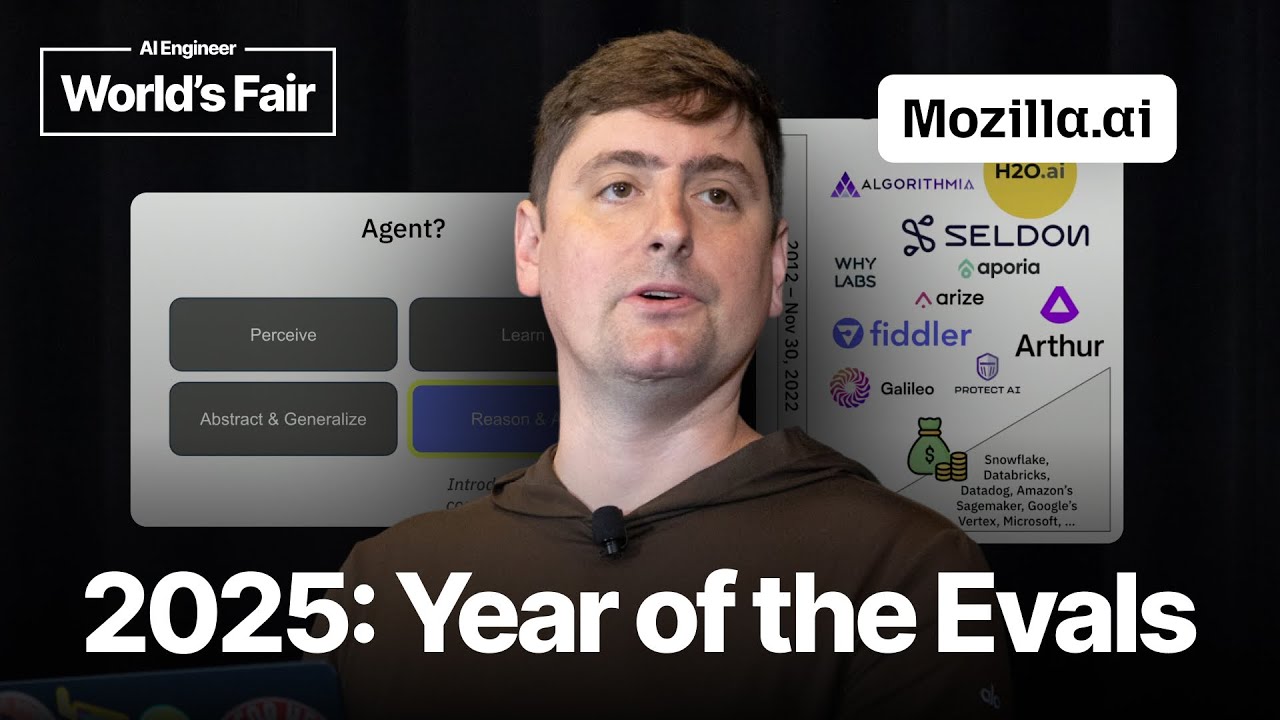
For years, the promise that a CEO would be fired over a preventable AI incident went unfulfilled, and the push for robust AI/ML evaluation remained a niche concern. While practitioners understood its importance, the C-suite remained unconvinced. Now, a perfect storm of technological and economic shifts has set the stage for 2025 to finally become the “Year of Evals.”
The Pre-ChatGPT Era: A Hard Sell
Before late 2022, AI/ML monitoring was a known concept, but it struggled to gain executive traction for several reasons:
- Obscured Impact: Models typically produced numerical outputs that were fed into larger, more complex systems. This “erased the top of mind need to think about what’s coming out of the model itself,” at least for decision-makers outside of the direct technical teams.
- Weak Link to Business KPIs: The connection between a specific model’s performance and downstream business metrics like revenue gained or dollars saved was tenuous. This made it difficult to sell evaluation tools beyond the CIO’s office, as the ROI wasn’t immediately clear to CEOs or CFOs.
- “Lip Service” on ROI: While executives talked about the potential of AI, the actual investment was often “comically small.” For instance, a major financial institution like JPMC spent only $100 million on AI/ML in its consumer division over a five-year period leading up to 2022.
The Tipping Point: A Confluence of Three Factors
Three critical events occurred concurrently to elevate the importance of AI evaluation:
- The ChatGPT Moment (November 2022): The launch of ChatGPT was a watershed moment. For the first time, non-technical executives—CEOs, CFOs, CISOs—could interact directly with a powerful AI through a simple UI and be “wowed by it.” AI was no longer an abstract concept but a tangible, powerful technology.
- The Macroeconomic Freeze: Just as enterprise budgets for 2023 were being set, fears of an impending recession led to widespread IT budget freezes. However, a loophole existed for “a specific pet project where a small amount of budget could be applied.” Because the C-suite was now captivated by AI, that pet project became GenAI.
- The Rise of Agentic Systems: The technological evolution is now moving beyond models that provide input to systems that “are now acting for humans, acting for teams.” These agents, which can reason and take autonomous actions, introduce a new level of complexity and, more importantly, a new level of risk.
The Enterprise Adoption Lifecycle
This confluence of events created a clear adoption path within enterprises:
- 2023: The Year of GenAI Science Projects: With budgets frozen, the only new money available was funneled into GenAI experiments and proofs-of-concept.
- 2024: The Year of Production: Those science projects began moving into production, primarily as internal applications like chatbots or hiring tools. This shift forced executives to ask critical questions about ROI, governance, risk, and compliance. To provide a “quantitative estimate of risk,” one must perform evaluation.
- 2025: The Year of Scale and Autonomy: Usage is now scaling rapidly, and the C-suite is comfortable allocating large, real budgets to AI. This scaling is happening just as the technology is shifting towards autonomous agents, making evaluation an unavoidable necessity.
The C-Suite is Finally Aligned
The need for evaluation is no longer confined to the CIO’s office. The entire C-suite is now engaged:
- CEO: Understands the technology’s capabilities and must report on it to the board and shareholders.
- CFO: Cares about the bottom line and needs quantitative evaluation data to measure impact and plan budgets.
- CISO: Views AI as a significant security risk (e.g., hallucinations, prompt injection) and an opportunity. CISOs are often “more scrappy and willing to try out tools,” making them a key entry point for evaluation and guardrail products.
- CTO/CIO: Require numerical data and standards to make informed technical decisions.
The Future of Evaluation
The conversation is now shifting in two key directions:
- Multi-Agent Systems Monitoring: The industry recognizes that evaluation can’t be limited to a single model. The focus must be on monitoring the entire system of interacting agents to understand emergent behaviors and risks.
- The Role of Human Expertise: For high-stakes applications like financial analysis, domain expertise is critical. The current solution involves “expensive human validation in lockstep with the multi-agent system.” This process is costly but creates invaluable, proprietary data and environments that become a competitive moat.
- LLMs as Judges: The “LLM as a judge” paradigm is widely used as a “poor man’s version of a human doing the judging” because it helps solve the dataset creation bottleneck. However, practitioners must be cautious, as these models have known biases (e.g., towards conciseness) and their outputs must be validated against human judgment.