Tokenless

Interactive discovery

Explore the topic map

Follow the connections between themes, people, and ideas across the Tokenless archive in an interactive topic modeling map.

Machine Learning

View All
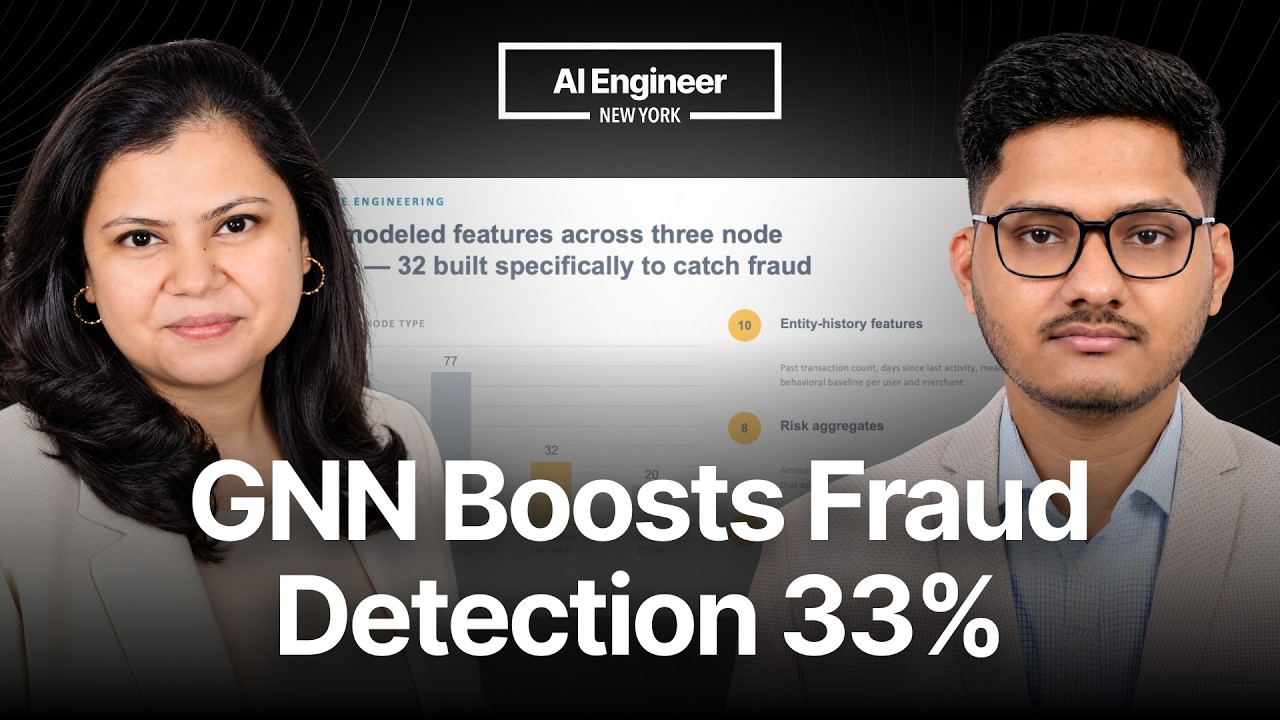
Judge a Transaction by the Company It Keeps — Somya Rai & MD Sharique, EXL

Judge a Transaction by the Company It Keeps — Somya Rai & MD Sharique, EXL

EXL developed an advanced fraud detection system that augments XGBoost with Graph Neural Network (GNN) embeddings. Traditional tabular models struggle to capture fraud signals residing in transaction neighborhoods. The system's innovative design includes meticulous sampling strategies, disjoint monthly graph construction for leakage control, and a GraphSAGE architecture that aggregates mean, max, and standard deviation of neighbor features to detect subtle fraud patterns. Emphasizing explainability for regulatory compliance and analyst trust, it also features a highly optimized serving architecture achieving 3ms P99 latency, pivoting to edge prediction to reduce cache footprint from 60GB to 2-3GB. This led to a 27-33% relative lift in true positive rates and a projected $65 million incremental fraud capture.

From 15% to 90% GPU Utilization: Fix the Data Pipeline, Not the Model

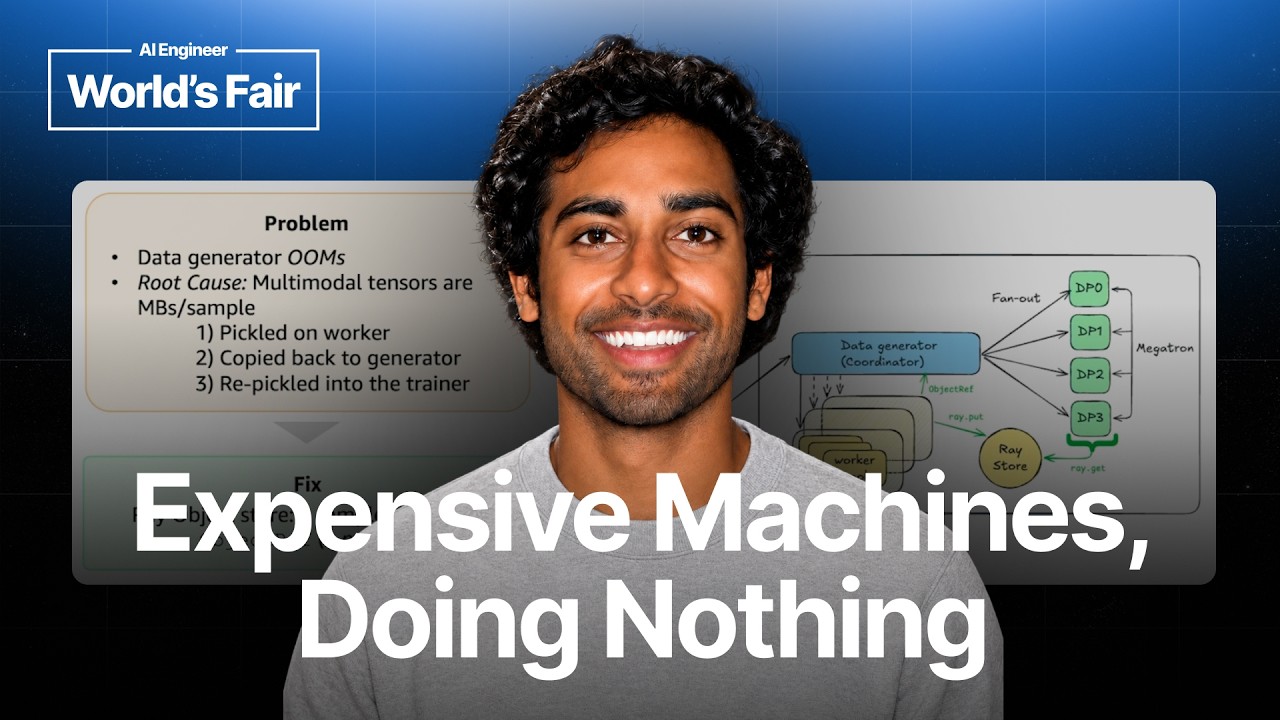
From 15% to 90% GPU Utilization: Fix the Data Pipeline, Not the Model

Tarun Sunkaraneni from Amazon AGI shows how a multimodal SFT pipeline that spent about 85% of its time waiting on data was brought to roughly 90% GPU utilization. He walks through concurrency with asyncio and Ray actors, prefetching, zero-copy transfer via Ray's object store, and a network-card bottleneck that appears only at scale, and argues that the hardest part of training throughput is often keeping GPUs fed rather than optimizing the model.

Small Models, Big Results: Training a Finance Agent for Under $500 — Charles Dickens, Snorkel AI

Small Models, Big Results: Training a Finance Agent for Under $500 — Charles Dickens, Snorkel AI

Snorkel AI and UC Berkeley's Sky Computing Lab show that a 4B Qwen3 model, trained with reinforcement learning for under $500 using the rLLM framework, beats its 235B sibling on expert-validated financial question answering built from SEC 10-K filings. The talk covers the FinQA dataset construction and verification, common failure modes of frontier models, transfer to multi-table and general tool-use tasks, and ablations showing that simple data and binary rewards outperform more elaborate setups, since the real bottleneck is disciplined tool use rather than reasoning depth.

Artificial Intelligence

View All
Bringing Continual Learning to Every Company: Trajectory’s Ronak Malde

Bringing Continual Learning to Every Company: Trajectory’s Ronak Malde

Ronak Malde, co-founder of Trajectory, argues that agents need to learn continuously from real-world experience instead of relying on offline batch updates. He covers how training custom models has become accessible to companies, two research directions (Group Size-1 GRPO and a meta-grader for reward propagation), the Harvey and Rogo results, the distinction between continual learning and recursive self-improvement, and a vision of product builders as gardeners who shape products that grow on their own.

Why Waiting for the Next AI Model Can Pay Off - John Stecher, Blackstone & Scott Worland, Norm AI

Why Waiting for the Next AI Model Can Pay Off - John Stecher, Blackstone & Scott Worland, Norm AI

Blackstone CTO John Stecher and Norm AI CTO Scott Worland discuss how to build AI agent systems that remain useful as models improve. They cover why data strategy and straight-through processing come first, how to weigh ROI against waiting for a better model, how evals anchor financial-services work, and why Norm rebuilt its platform after a large hand-labeled eval set exposed the cost of over-engineered code.

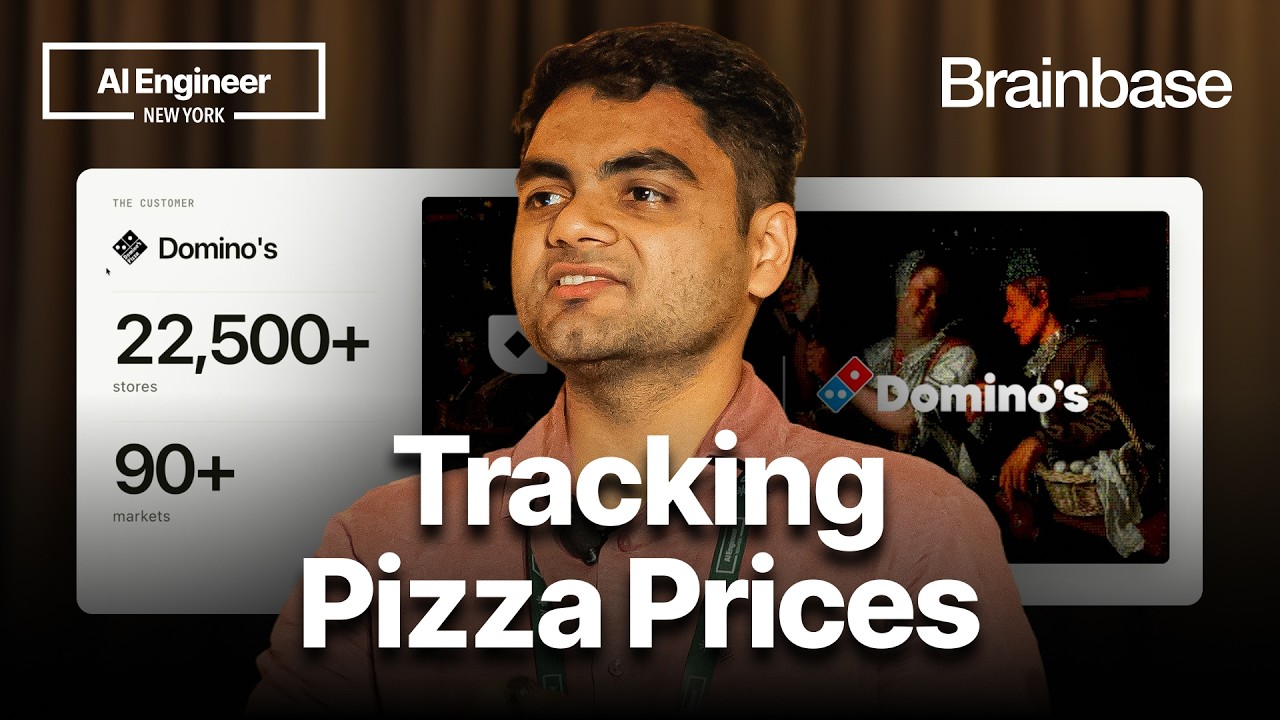
How We Took an AI Agent From 41% to 97% Accurate - Milind Sunil Shah, Brainbase Labs

How We Took an AI Agent From 41% to 97% Accurate - Milind Sunil Shah, Brainbase Labs

Milind Sunil Shah of Brainbase Labs presents a six-step framework for improving back-office agents, illustrated with a Domino's project that tracks competitor pizza prices across websites and delivery apps. Accuracy rose from 41% to 97%, cost per source fell from $2 to $1, and run time dropped from 129 to 71 minutes, all through instructions, skills, and playbooks rather than a new model. The talk covers kickoff, ontology, benchmarks and evals, a narrow first agent, iteration, and handing off the full loop.

Technology

View All
What iPhone Packaging Reveals About the Robotics Opportunity

What iPhone Packaging Reveals About the Robotics Opportunity

Tutor Intelligence CEO Josh Gruenstein explains why robotics is a systems problem spanning AI, hardware, manufacturing, and customers, and how deploying robots into real factories and warehouses, with human tutors as backup, generates the data that makes them more capable. The discussion covers the company's own robot designs, its focus on small and mid-sized businesses, the economics of flexible robotic labor, and the implications for American manufacturing and supply chains.

Why Founders Are Betting Big on Factories, Mines, and Energy

Why Founders Are Betting Big on Factories, Mines, and Energy

Erin Price-Wright and Connor Love unpack the AD50 and the rebuilding of America's industrial base, covering how defense demand is financing manufacturing capacity for commercial markets, how AI is reshaping factory economics, how a new generation of founders applies lessons from SpaceX, Tesla, Anduril, and Palantir to mining, energy, and manufacturing, and why private capital is now willing to fund physical infrastructure before government demand is guaranteed.

Mark Cuban’s Plan to Make Healthcare Affordable

Mark Cuban’s Plan to Make Healthcare Affordable

Mark Cuban and Julie Yoo discuss how transparency, direct contracting, and AI could reshape healthcare economics, from Cost Plus Drugs and modular pod manufacturing to personalized medicine, the future of physicians, and advice for founders who want to use AI to learn rather than to stop thinking.


Recent Post

AI doesn't work the way you think it does

AI doesn't work the way you think it does

Today's AI, despite its impressive capabilities, may be an "impostor" with a messy, unstructured internal understanding—a "spaghetti" representation. This summary explores an alternative, open-ended approach to building AI that fosters a deep, modular, and truly intelligent foundation, moving beyond brute-force optimization to embrace serendipitous discovery and "evolvability."

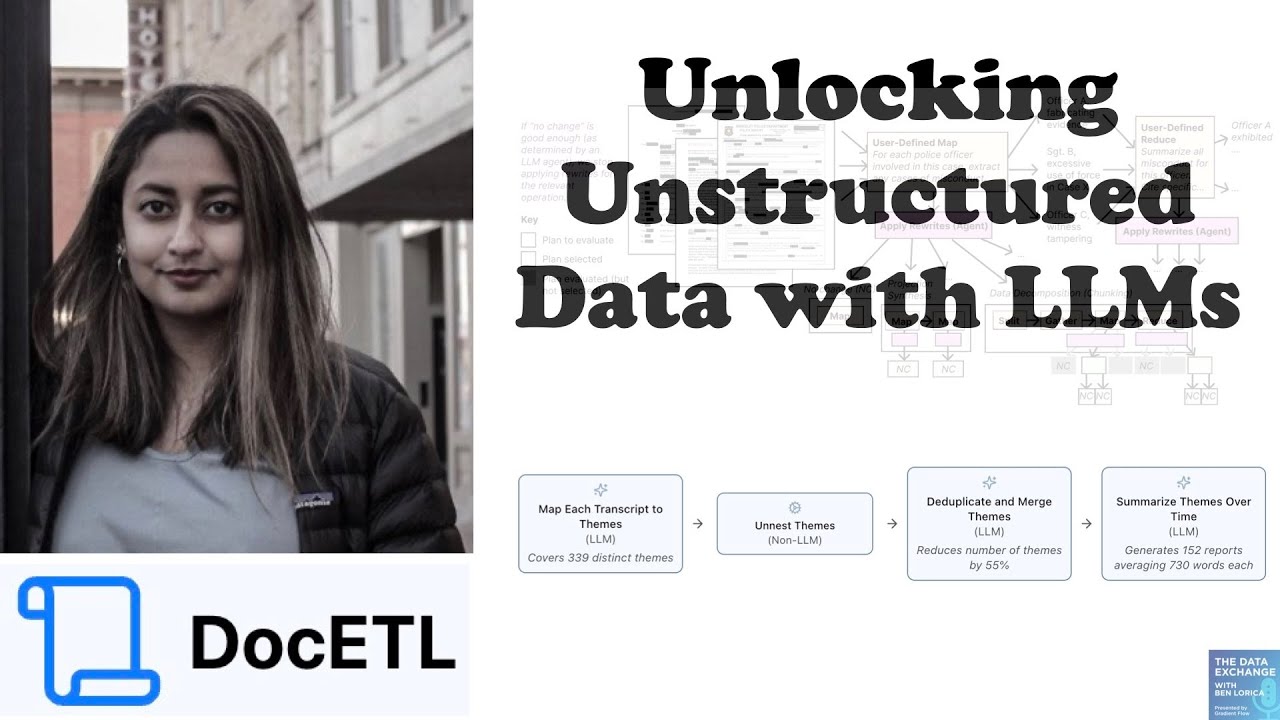
Unlocking Unstructured Data with LLMs

Unlocking Unstructured Data with LLMs

Shreya Shankar of UC Berkeley discusses DocETL, a MapReduce-style framework that leverages LLMs to extract, analyze, and structure insights from unstructured enterprise data. The conversation covers practical architecture patterns, the role of non-determinism, strategies for model selection (including fine-tuning and multi-LLM pipelines), and the importance of user experience in this emerging field.

No Priors Ep. 121 | With Chai Discovery Co-Founders Jack Dent and Joshua Meier

No Priors Ep. 121 | With Chai Discovery Co-Founders Jack Dent and Joshua Meier

Chai Discovery's co-founders discuss Chai 2, their new generative AI platform for antibody design. It achieves a nearly 20% hit rate from just 20 computational attempts, a 100-fold improvement over previous methods, signaling a shift from drug discovery to drug engineering.

Moonshot Podcast Deep Dive: Sebastian Thrun on Waymo’s Early Days

Moonshot Podcast Deep Dive: Sebastian Thrun on Waymo’s Early Days

Sebastian Thrun, co-founder of Google's Moonshot Factory, recounts the early days of X and the Waymo self-driving car project. He shares insights into the unique management philosophy that fostered radical innovation, the ethical responsibilities of technologists, and his optimistic vision for the future of AI.

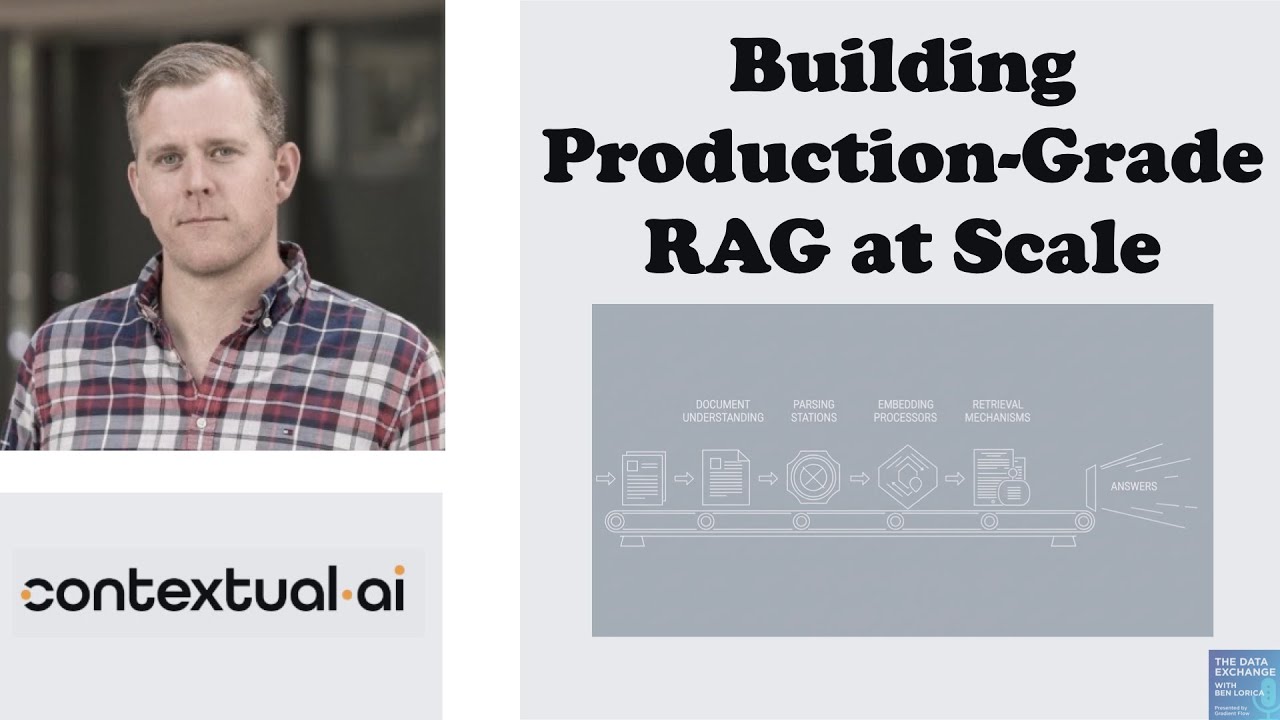
Building Production-Grade RAG at Scale

Building Production-Grade RAG at Scale

Douwe Kiela, CEO of Contextual AI, explains the evolution from basic RAG to "RAG 2.0", an end-to-end, trainable system. He argues that this system-level approach, which integrates optimized document parsing, retrieval, reranking, and grounded models, is superior to relying on massive context windows alone and is a fundamental tool for next-generation AI agents.

No Priors Ep. 120 | With Google DeepMind’s Pushmeet Kohli and Matej Balog

No Priors Ep. 120 | With Google DeepMind’s Pushmeet Kohli and Matej Balog

Push Kohli and Máté Balog from Google DeepMind discuss AlphaDev, an AI agent that uses large language models and evolutionary search to discover novel, more efficient algorithms for fundamental computer science problems, marking a significant step in AI's ability to generate creative and practical solutions.

Stay In The Loop! Subscribe to Our Newsletter.

Get updates straight to your inbox. No spam, just useful content.