Tokenless

Interactive discovery

Explore the topic map

Follow the connections between themes, people, and ideas across the Tokenless archive in an interactive topic modeling map.

Machine Learning

View All
Judge a Transaction by the Company It Keeps — Somya Rai & MD Sharique, EXL

Judge a Transaction by the Company It Keeps — Somya Rai & MD Sharique, EXL

EXL developed an advanced fraud detection system that augments XGBoost with Graph Neural Network (GNN) embeddings. Traditional tabular models struggle to capture fraud signals residing in transaction neighborhoods. The system's innovative design includes meticulous sampling strategies, disjoint monthly graph construction for leakage control, and a GraphSAGE architecture that aggregates mean, max, and standard deviation of neighbor features to detect subtle fraud patterns. Emphasizing explainability for regulatory compliance and analyst trust, it also features a highly optimized serving architecture achieving 3ms P99 latency, pivoting to edge prediction to reduce cache footprint from 60GB to 2-3GB. This led to a 27-33% relative lift in true positive rates and a projected $65 million incremental fraud capture.
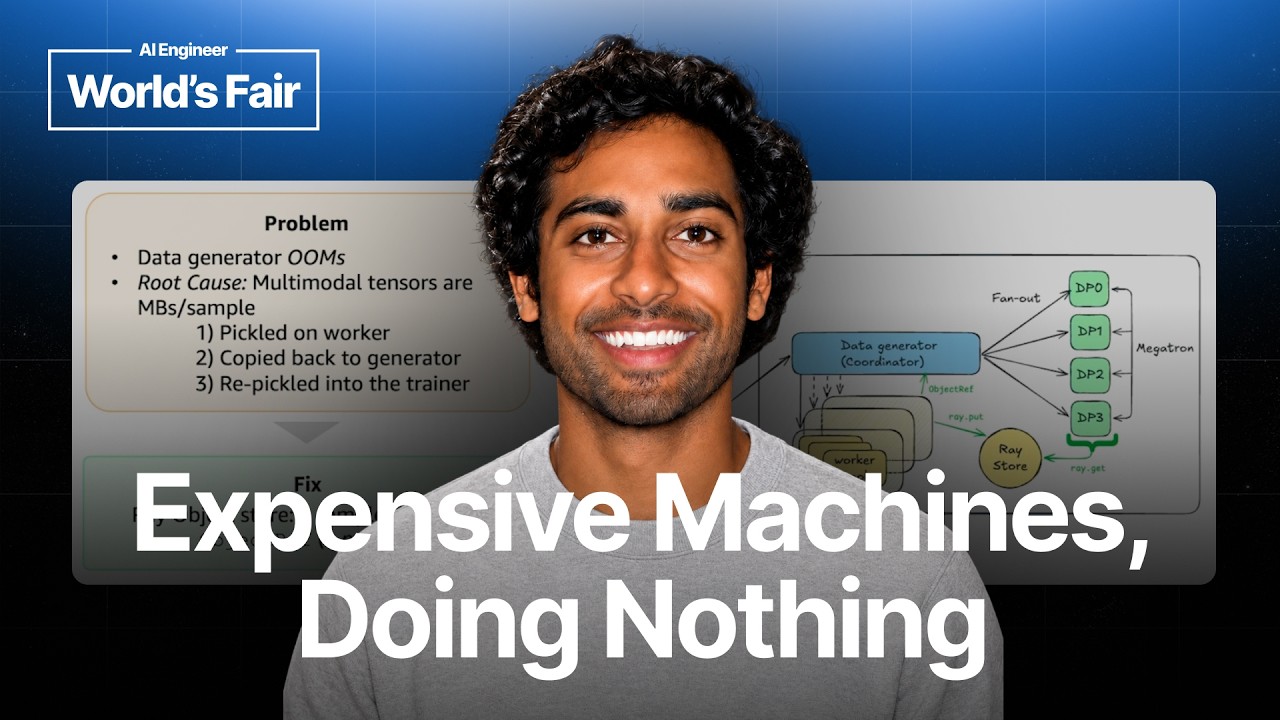

From 15% to 90% GPU Utilization: Fix the Data Pipeline, Not the Model

From 15% to 90% GPU Utilization: Fix the Data Pipeline, Not the Model

Tarun Sunkaraneni from Amazon AGI shows how a multimodal SFT pipeline that spent about 85% of its time waiting on data was brought to roughly 90% GPU utilization. He walks through concurrency with asyncio and Ray actors, prefetching, zero-copy transfer via Ray's object store, and a network-card bottleneck that appears only at scale, and argues that the hardest part of training throughput is often keeping GPUs fed rather than optimizing the model.

Small Models, Big Results: Training a Finance Agent for Under $500 — Charles Dickens, Snorkel AI

Small Models, Big Results: Training a Finance Agent for Under $500 — Charles Dickens, Snorkel AI

Snorkel AI and UC Berkeley's Sky Computing Lab show that a 4B Qwen3 model, trained with reinforcement learning for under $500 using the rLLM framework, beats its 235B sibling on expert-validated financial question answering built from SEC 10-K filings. The talk covers the FinQA dataset construction and verification, common failure modes of frontier models, transfer to multi-table and general tool-use tasks, and ablations showing that simple data and binary rewards outperform more elaborate setups, since the real bottleneck is disciplined tool use rather than reasoning depth.

Artificial Intelligence

View All
Our Smaller Model Beat Opus on Finance Tasks - Alexander Shevchenko, Ramp

Our Smaller Model Beat Opus on Finance Tasks - Alexander Shevchenko, Ramp

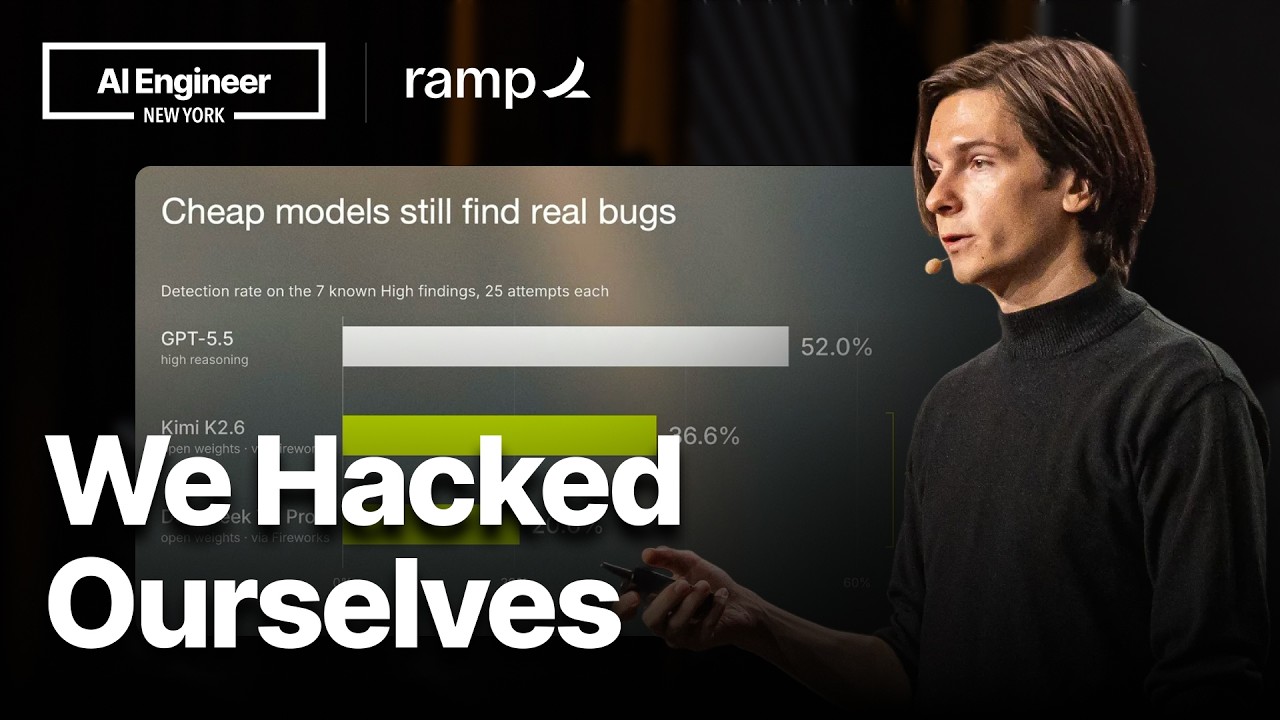
Alexander Shevchenko of Ramp Labs explains why an application company keeps running applied research rather than waiting for the next frontier model, and walks through three projects in production: a post-trained Qwen 3.5 specialist for financial question answering at Haiku-level latency, KV cache cartridges that prepare agents with far more context ahead of time, and a 10,000-agent swarm that pen-tested Ramp and found seven high-severity vulnerabilities using cheaper open-weight models.

AI Labs Will Trap You or Replace You - Dillon Rolnick, Nous Research

AI Labs Will Trap You or Replace You - Dillon Rolnick, Nous Research

Nous Research CEO Dillon Rolnick argues that as AI models commoditize, frontier labs will try to recoup their enormous investments by locking businesses into their platforms or competing directly in lucrative sectors like finance. He contends that proprietary software moats are disappearing, that agents behave more like operating systems than chatbots, and that companies should build on open foundations they own, such as Hermes Agent, so they can swap models and inherit new capabilities.

Robots Will Be Trained on Video Games - Pim de Witte, General Intuition

Robots Will Be Trained on Video Games - Pim de Witte, General Intuition

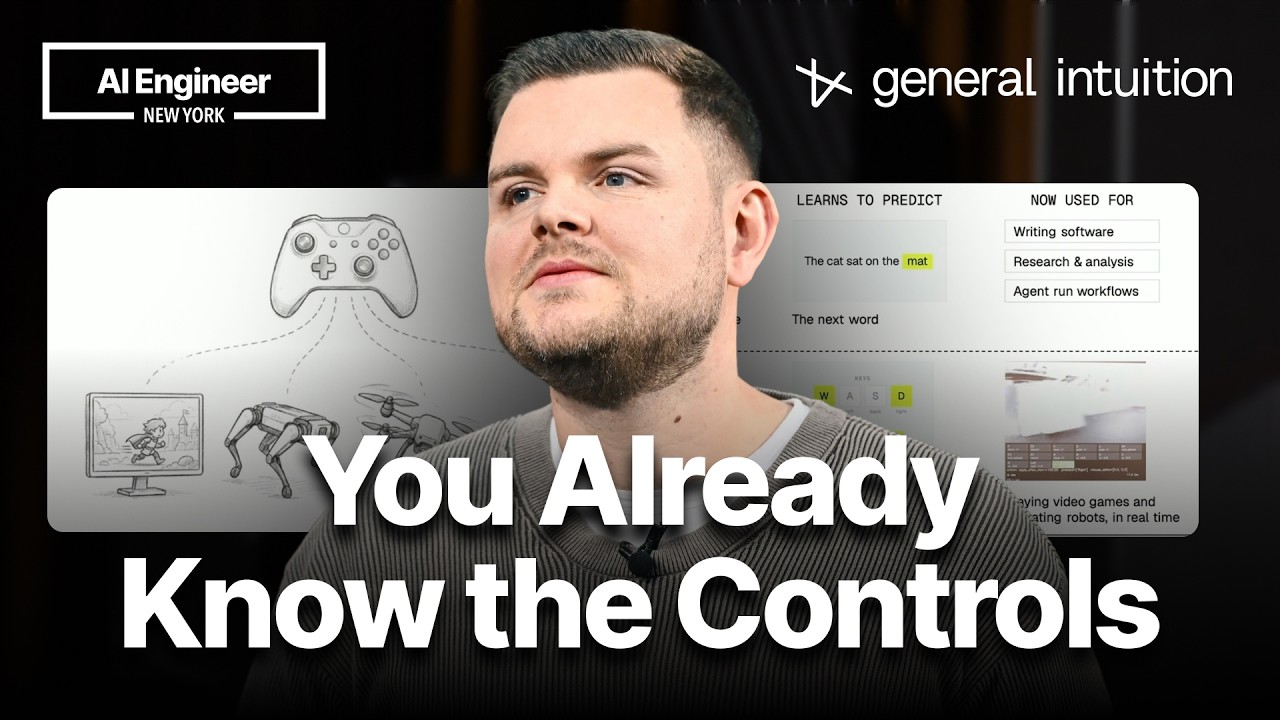
Pim de Witte of General Intuition argues that models acting in space and time should be built differently from turn-based LLMs. Their continuous frames-in, actions-out model is trained on Medal game recordings, since game controllers already drive most robots, and it can play games and control more than ten robot types. The talk covers world models, action density, applications such as accessibility and UX, the difference from JEPA, and upcoming early access and hackathons.

Technology

View All
What iPhone Packaging Reveals About the Robotics Opportunity

What iPhone Packaging Reveals About the Robotics Opportunity

Tutor Intelligence CEO Josh Gruenstein explains why robotics is a systems problem spanning AI, hardware, manufacturing, and customers, and how deploying robots into real factories and warehouses, with human tutors as backup, generates the data that makes them more capable. The discussion covers the company's own robot designs, its focus on small and mid-sized businesses, the economics of flexible robotic labor, and the implications for American manufacturing and supply chains.

Why Founders Are Betting Big on Factories, Mines, and Energy

Why Founders Are Betting Big on Factories, Mines, and Energy

Erin Price-Wright and Connor Love unpack the AD50 and the rebuilding of America's industrial base, covering how defense demand is financing manufacturing capacity for commercial markets, how AI is reshaping factory economics, how a new generation of founders applies lessons from SpaceX, Tesla, Anduril, and Palantir to mining, energy, and manufacturing, and why private capital is now willing to fund physical infrastructure before government demand is guaranteed.

Mark Cuban’s Plan to Make Healthcare Affordable

Mark Cuban’s Plan to Make Healthcare Affordable

Mark Cuban and Julie Yoo discuss how transparency, direct contracting, and AI could reshape healthcare economics, from Cost Plus Drugs and modular pod manufacturing to personalized medicine, the future of physicians, and advice for founders who want to use AI to learn rather than to stop thinking.


Recent Post

What is Agent Observability?

What is Agent Observability?

Lior Gavish, CTO and co-founder of Monte Carlo Data, discusses the critical transition from data observability to agent observability. He covers the widespread adoption of AI agents in data teams, the new challenges they introduce for monitoring, and why traditional tools fall short in providing the necessary insights into agent performance, security, and governance.

Context Engineering Our Way to Long-Horizon Agents: LangChain’s Harrison Chase

Context Engineering Our Way to Long-Horizon Agents: LangChain’s Harrison Chase

Harrison Chase, co-founder of LangChain, explains the evolution of AI agents from early, rigid scaffolding to modern, flexible "harnesses." He argues that "context engineering"—managing what an LLM sees—is the key to building effective long-horizon agents. Chase also explores how agent development differs from traditional software, highlighting the critical role of traces as the new source of truth and memory systems that enable agents to improve themselves over time.

SW Design, Architecture & Clarity at Scale • Sam Newman, Jacqui Read & Simon Rohrer • GOTO 2025

SW Design, Architecture & Clarity at Scale • Sam Newman, Jacqui Read & Simon Rohrer • GOTO 2025

A panel discussion with Sam Newman, Jacqui Read, and Simon Rohrer exploring the intersection of software design and architecture. The conversation delves into the critical role of communication, the practical application of Architecture Decision Records (ADRs), strategies for bridging the gap between architects and developers, and modern approaches to standardization through platform engineering and creating agile enterprise architectures.

Most cybersecurity training doesn’t work. Can we change that?

Most cybersecurity training doesn’t work. Can we change that?

In an era where AI accelerates the speed, scale, and polish of cyberattacks like phishing and deepfakes, the human element remains the most critical variable. This discussion explores why traditional 'checkbox' training fails and how immersive, stress-inducing simulations like the cyber range are essential for building the muscle memory, confidence, and decision-making skills needed for effective incident response.

"We Made a Dream Machine That Runs on Your Gaming PC"

"We Made a Dream Machine That Runs on Your Gaming PC"

Shahbuland Matiana and Andrew Lapp from Overworld Labs introduce Waypoint 1, a 2 billion-parameter open-source world simulation model designed to run on consumer hardware at 60 FPS. They discuss its novel architecture, which combines a causal language model with an image diffusion model to denoise frames in real-time based on user prompts and controller inputs, emphasizing low-latency interaction and the importance of local execution for user privacy.

What a $42B Software Co. Really Spends on AI Tools | Mike Cannon-Brookes

What a $42B Software Co. Really Spends on AI Tools | Mike Cannon-Brookes

Atlassian Co-Founder & CEO Mike Cannon-Brookes shares insights from a massive internal study of over 10,000 engineers using AI coding tools. He discusses the true measures of developer productivity, the future of developer roles, and why human-AI collaboration, powered by organizational context, is the key to the future.

Stay In The Loop! Subscribe to Our Newsletter.

Get updates straight to your inbox. No spam, just useful content.