Tokenless

Interactive discovery

Explore the topic map

Follow the connections between themes, people, and ideas across the Tokenless archive in an interactive topic modeling map.

Machine Learning

View All
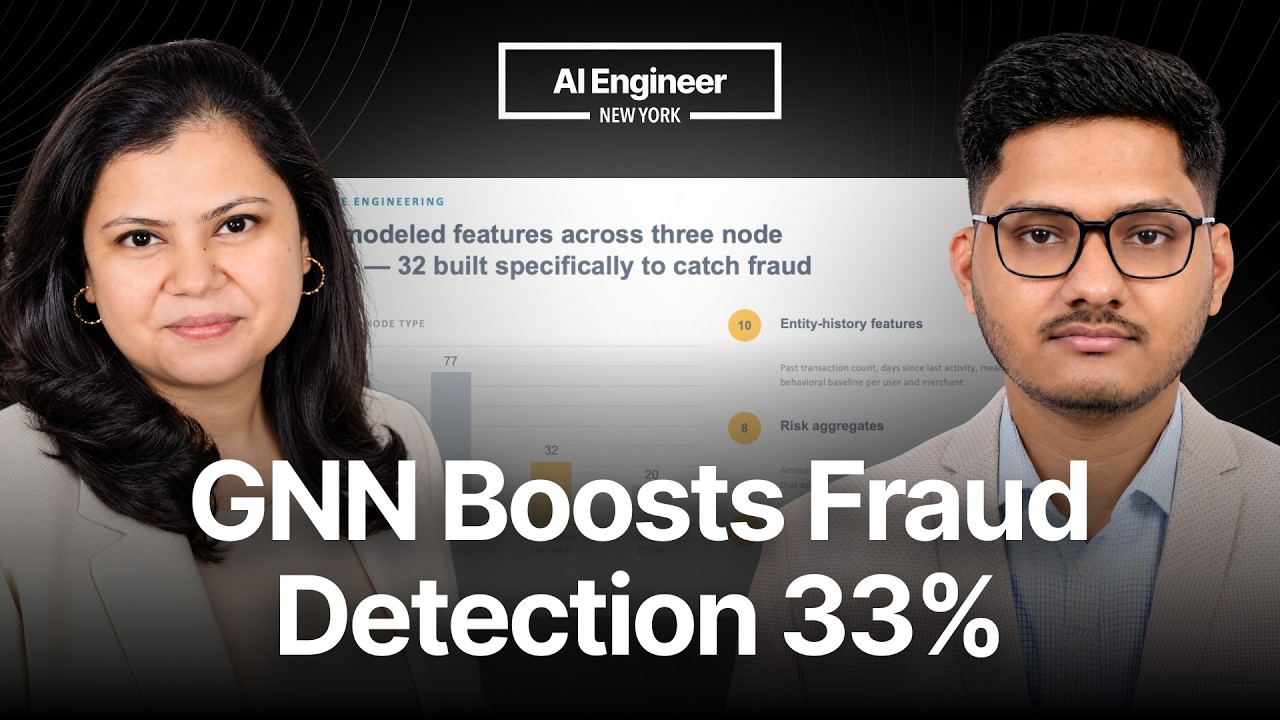
Judge a Transaction by the Company It Keeps — Somya Rai & MD Sharique, EXL

Judge a Transaction by the Company It Keeps — Somya Rai & MD Sharique, EXL

EXL developed an advanced fraud detection system that augments XGBoost with Graph Neural Network (GNN) embeddings. Traditional tabular models struggle to capture fraud signals residing in transaction neighborhoods. The system's innovative design includes meticulous sampling strategies, disjoint monthly graph construction for leakage control, and a GraphSAGE architecture that aggregates mean, max, and standard deviation of neighbor features to detect subtle fraud patterns. Emphasizing explainability for regulatory compliance and analyst trust, it also features a highly optimized serving architecture achieving 3ms P99 latency, pivoting to edge prediction to reduce cache footprint from 60GB to 2-3GB. This led to a 27-33% relative lift in true positive rates and a projected $65 million incremental fraud capture.
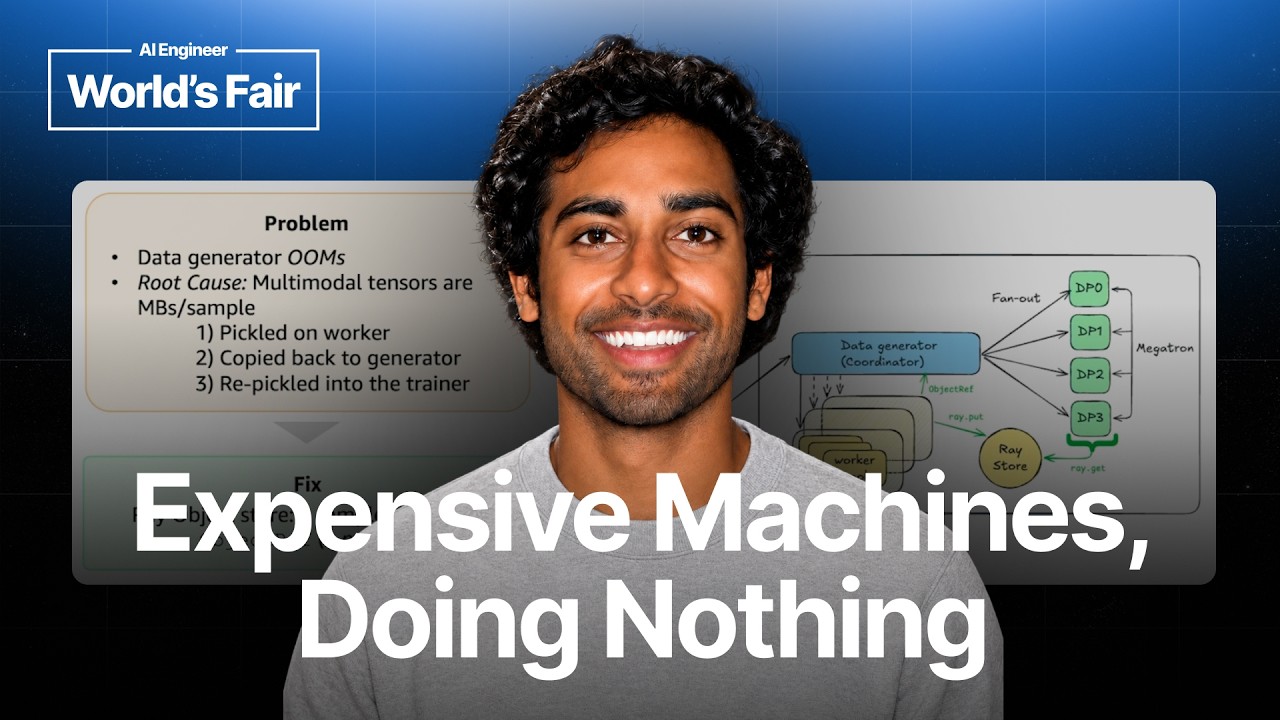

From 15% to 90% GPU Utilization: Fix the Data Pipeline, Not the Model

From 15% to 90% GPU Utilization: Fix the Data Pipeline, Not the Model

Tarun Sunkaraneni from Amazon AGI shows how a multimodal SFT pipeline that spent about 85% of its time waiting on data was brought to roughly 90% GPU utilization. He walks through concurrency with asyncio and Ray actors, prefetching, zero-copy transfer via Ray's object store, and a network-card bottleneck that appears only at scale, and argues that the hardest part of training throughput is often keeping GPUs fed rather than optimizing the model.

Small Models, Big Results: Training a Finance Agent for Under $500 — Charles Dickens, Snorkel AI

Small Models, Big Results: Training a Finance Agent for Under $500 — Charles Dickens, Snorkel AI

Snorkel AI and UC Berkeley's Sky Computing Lab show that a 4B Qwen3 model, trained with reinforcement learning for under $500 using the rLLM framework, beats its 235B sibling on expert-validated financial question answering built from SEC 10-K filings. The talk covers the FinQA dataset construction and verification, common failure modes of frontier models, transfer to multi-table and general tool-use tasks, and ablations showing that simple data and binary rewards outperform more elaborate setups, since the real bottleneck is disciplined tool use rather than reasoning depth.

Artificial Intelligence

View All
The Right Model for Each Coding Task

The Right Model for Each Coding Task

Weave co-founders Adam Cohen and Andrew Churchill explain how their engineering analytics platform evolved from measuring human productivity to optimizing coding agents. The conversation covers Weave Router, which automatically selects the best model for each coding task, cost per output as a better measure than raw token spend, an AI coach for engineers, and the design of autonomous software factories with automated validation.

The New AI Agents That Shop, Plan, and Gossip

The New AI Agents That Shop, Plan, and Gossip

David Pawlan, creator of Assistant Benchmark, joins Anish Acharya and Josh Elman to take stock of an agent landscape that changes almost weekly. Drawing on tests of more than 140 assistants and a survey of AI power users, they explore why trust is the dominant fear, how fences and permissions might make agents safe, and where privacy, embarrassment, and judgment fit in. The conversation then moves to multiplayer and gossipy agents, agent-to-agent networks that could spark serendipity, and the possibility that the most valuable agents will do more than save time, becoming a kind of secret superpower.

AI-Friendly Code: The Missing Link for Speed with Quality • Adam Tornhill • GOTO Copenhagen 2026

AI-Friendly Code: The Missing Link for Speed with Quality • Adam Tornhill • GOTO Copenhagen 2026

Adam Tornhill explores why AI agents produce fast early gains that often erode under growing code complexity, and how the Code Health metric, safeguarding loops, and codebase-specific refactoring can keep agentic development sustainable at scale, including a 300,000-line legacy case study.

Technology

View All
What iPhone Packaging Reveals About the Robotics Opportunity

What iPhone Packaging Reveals About the Robotics Opportunity

Tutor Intelligence CEO Josh Gruenstein explains why robotics is a systems problem spanning AI, hardware, manufacturing, and customers, and how deploying robots into real factories and warehouses, with human tutors as backup, generates the data that makes them more capable. The discussion covers the company's own robot designs, its focus on small and mid-sized businesses, the economics of flexible robotic labor, and the implications for American manufacturing and supply chains.

Why Founders Are Betting Big on Factories, Mines, and Energy

Why Founders Are Betting Big on Factories, Mines, and Energy

Erin Price-Wright and Connor Love unpack the AD50 and the rebuilding of America's industrial base, covering how defense demand is financing manufacturing capacity for commercial markets, how AI is reshaping factory economics, how a new generation of founders applies lessons from SpaceX, Tesla, Anduril, and Palantir to mining, energy, and manufacturing, and why private capital is now willing to fund physical infrastructure before government demand is guaranteed.

Mark Cuban’s Plan to Make Healthcare Affordable

Mark Cuban’s Plan to Make Healthcare Affordable

Mark Cuban and Julie Yoo discuss how transparency, direct contracting, and AI could reshape healthcare economics, from Cost Plus Drugs and modular pod manufacturing to personalized medicine, the future of physicians, and advice for founders who want to use AI to learn rather than to stop thinking.


Recent Post

Why NVIDIA builds their own open models | Nemotron w/ Bryan Catanzaro

Why NVIDIA builds their own open models | Nemotron w/ Bryan Catanzaro

Bryan Catanzaro, NVIDIA's VP of Applied Deep Learning Research, explains the business rationale behind developing open models like Nemotron. The strategy is twofold: to drive internal systems R&D for future hardware and to support the broader AI ecosystem, which in turn expands NVIDIA's market.

The Forest & The Desert Are Parallel Universes • Kent Beck • GOTO 2025

The Forest & The Desert Are Parallel Universes • Kent Beck • GOTO 2025

Kent Beck introduces the 'Forest vs. Desert' metaphor to describe two parallel universes of software development. He contrasts the 'Forest' mindset, based on abundance, trust, and collaboration (akin to Extreme Programming), with the 'Desert' mindset, rooted in scarcity, control, and pressure. Beck argues that while the Desert is internally consistent and can be profitable, it settles for 'crumbs', whereas the Forest aims to realize the full potential value of software—the 'whole cake'.

What cybersecurity pros need to know about OpenClaw and Moltbook

What cybersecurity pros need to know about OpenClaw and Moltbook

This podcast explores the security implications of emerging AI technologies, focusing on locally run AI agents like OpenClaw as a new attack surface. Panelists discuss the dangers of misconfigured agents, the challenge of AI-generated 'slop' overwhelming bug bounty programs, major changes to NIST's National Vulnerability Database (NVD), and the rise of imperfect, 'vibe-coded' malware.

Quarkus in Action • Martin Stefanko, Jan Martiska & Holly Cummins

Quarkus in Action • Martin Stefanko, Jan Martiska & Holly Cummins

Authors Martin Štefanko and Jan Martiška discuss their book "Quarkus in Action," detailing the framework's powerful developer experience, the trade-offs between JVM and native compilation, and its cloud-native capabilities. They explore the book's structure, which guides readers through building a complex microservices application to showcase over 29 different extensions, from REST and gRPC to reactive messaging and cloud deployment.

What’s the Future of Vertical SaaS in an AGI World? Jamie Cuffe, CEO of Pace

What’s the Future of Vertical SaaS in an AGI World? Jamie Cuffe, CEO of Pace

Jamie Cuffe, founder of Pace, discusses how AI agents are replacing traditional Business Process Outsourcers (BPOs) in the insurance industry, achieving 50-75% cost savings. He details his strategy of using forward-deployed engineers to build trust and ensure success in mission-critical workflows, transforming a low-margin services industry into a high-margin, AI-native business.

Reinforcement Learning for Agents — with Amazon AGI Labs’ Antje Barth

Reinforcement Learning for Agents — with Amazon AGI Labs’ Antje Barth

Antje Barth from Amazon's AGI Labs discusses Nova Act, a new service for building reliable AI agents. She explores how they achieve over 90% reliability using reinforcement learning in 'web gyms', the shift towards 'normcore' agents for practical automation, and the future of AI as a digital co-worker.

Stay In The Loop! Subscribe to Our Newsletter.

Get updates straight to your inbox. No spam, just useful content.