Computer science

Security and Privacy in the Underserved Majority World: Practices, Challenges, and Opportunities

Security and Privacy in the Underserved Majority World: Practices, Challenges, and Opportunities

Collins Munyendo presents studies from Kenya and across the majority world showing how economic pressure, shared computing resources, social dynamics, and language barriers challenge Western-centric security and privacy designs, and proposes privacy-by-design redesigns and privacy-enhancing technologies for data sharing developed with local communities.
Assisted Algorithms

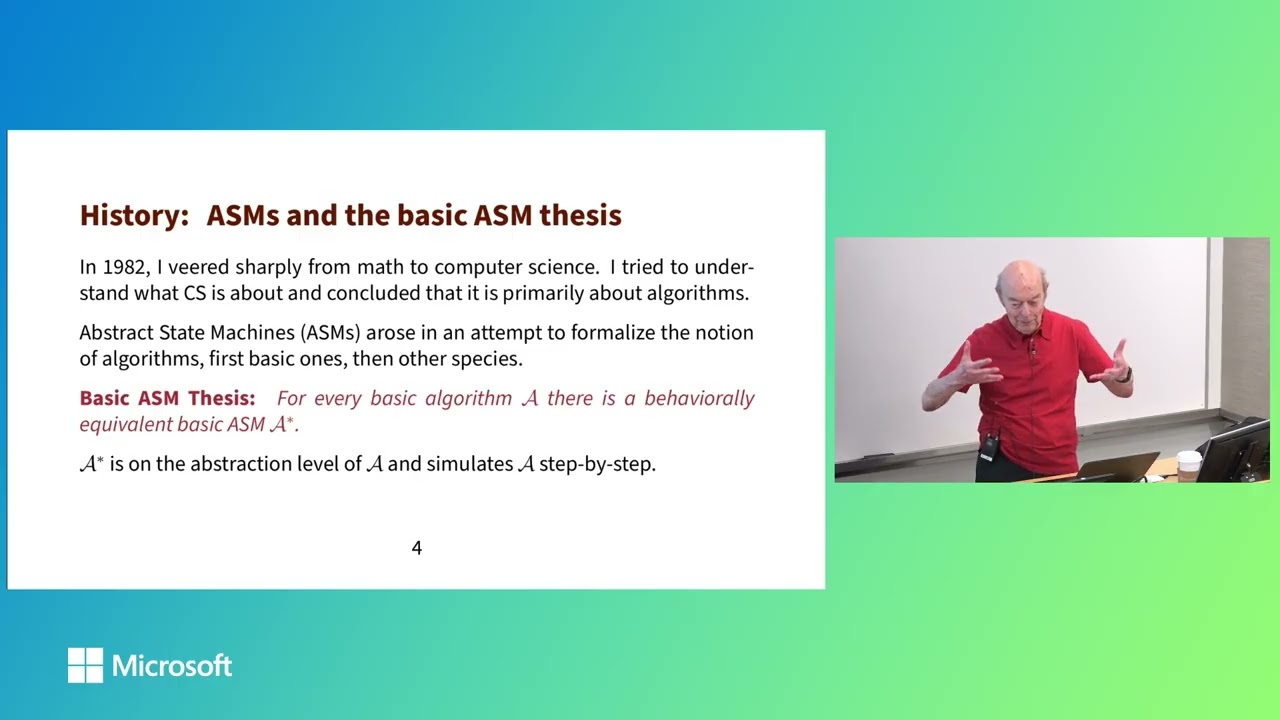
Assisted Algorithms

Yuri Gurevich argues that algorithms are inherently deterministic and that probabilistic and quantum algorithms work by delegating non-algorithmic steps such as coin flips and quantum measurements to external oracles or assistants. He presents a theory of assisted algorithms with revised abstract state machine postulates, using a primality test and Grover's search as running examples.

Aegon: Self-Auditable Key Transparency

Aegon: Self-Auditable Key Transparency

This talk presents Aegon, a self-auditable key transparency scheme designed for global-scale encrypted messaging. It builds on Iron Dict's polynomial commitment approach to remove per-epoch global work, shards the dictionary for horizontal scaling, and uses proof caching to bound storage. The result is constant-size audit proofs that a lightweight client can verify itself over an entire history, rather than relying on external auditors.

Ash Framework: Declarative Elixir Web Apps • Rebecca Le, Zach Daniel & C. Alexander • GOTO 2026

Ash Framework: Declarative Elixir Web Apps • Rebecca Le, Zach Daniel & C. Alexander • GOTO 2026

Rebecca Le and Zach Daniel, co-authors of the Ash Framework book, discuss how their Tunez-based guide was built to introduce concepts in the order a real project needs them, how writing it forced the addition of generator-based testing to Ash, and why Ash's extensibility, Cinder's rapid development, and AI-assisted onboarding make its steep but flattening learning curve worthwhile.

Quota Isn't Enough: Topology Aware Scheduling on Modern GPU Clusters

Quota Isn't Enough: Topology Aware Scheduling on Modern GPU Clusters

A deep dive into why rack-scale NVL72 GPU hardware makes topology a scheduling requirement, and how Kueue's Topology Aware Scheduling (TAS) brings NVLink domains, rack boundaries, and PodSet slices into Kubernetes admission. Covers preferred vs. required placement, the performance cliff between NVLink and InfiniBand, and production lessons on sticky scheduling, quota debugging, fragmentation, node hot swaps, and the upstream path toward configurable preemption.

What If We Stopped Using GPUs? | YC Paper Club

What If We Stopped Using GPUs? | YC Paper Club

A session on alternative compute covering the argument for abandoning backpropagation in favor of zero-order optimization and sharded training, optical computing that performs diffusion-style image generation with propagating light, the state of neuromorphic computing in 2026, and how cultured human neurons learned to play Doom through reinforcement learning.