Ai

Claude for Long-Horizon Tasks — Lance Martin, Anthropic

Claude for Long-Horizon Tasks — Lance Martin, Anthropic

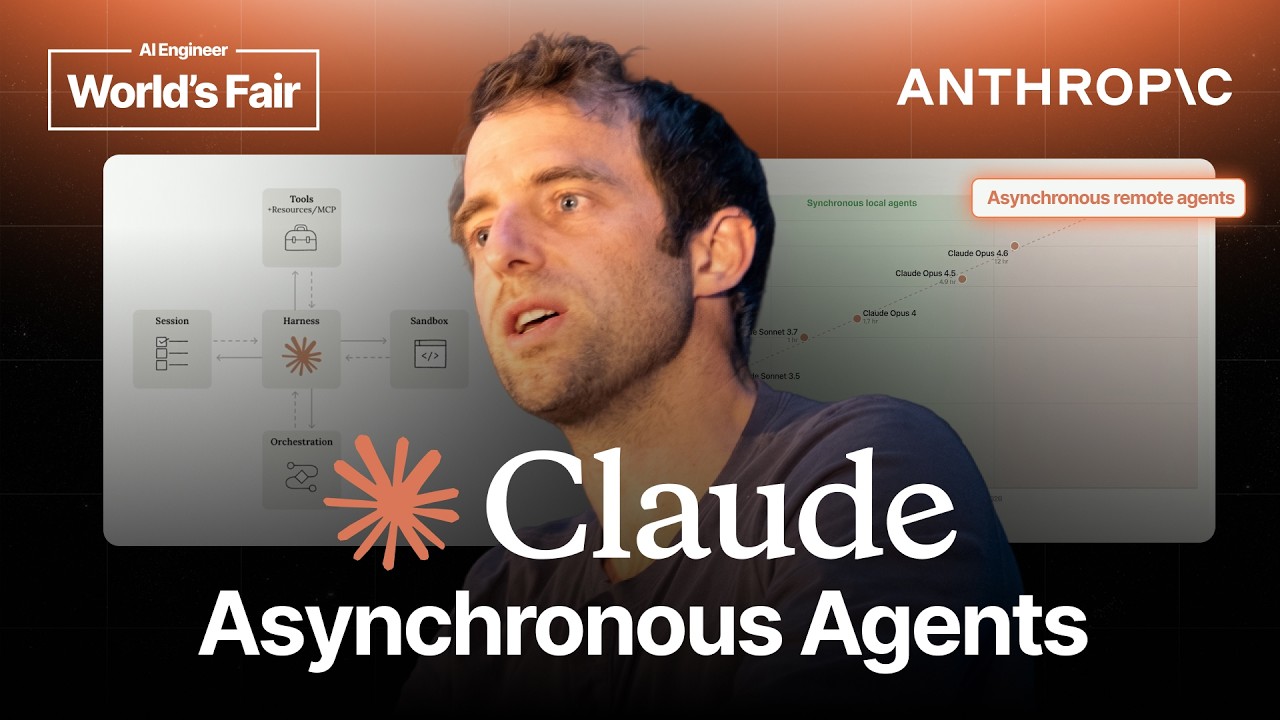
Lance Martin from Anthropic shares insights into building reliable and secure long-horizon agents with Claude. He details architectural principles like decoupling the 'brain' from the 'hands' for reliability and security, implementing independent verifiers for self-correction, and developing advanced self-learning memory systems akin to human memory's in-band writing and offline 'dreaming' consolidation. The talk concludes with a vision for evolving agent harnesses towards organizational-level, proactive, and multiplayer capabilities.
Open Models: Kimi K3, Qwen 3.8, Xi's WAIC Speech, Distillation, The Open-Closed Gap, and What's Next

Open Models: Kimi K3, Qwen 3.8, Xi's WAIC Speech, Distillation, The Open-Closed Gap, and What's Next

Nathan Lambert and Florian Brand discuss the accelerating open model landscape, focusing on the surge in Chinese models like Kimi K3 and GLM 5.2. They explore the reasons behind China's progress, the evolving US ecosystem, the cybersecurity implications of open-source bans, and debunk common misconceptions about distillation, particularly challenging Ben Thompson's recent claims. The episode concludes with predictions and a frontier model tier list.

GPT-Red: Can AI read teams stop prompt injections?

GPT-Red: Can AI read teams stop prompt injections?

This podcast explores AI's impact on cybersecurity, discussing OpenAI's GPT-Red for automated red-teaming against prompt injections, the open-source ScamBuster that uses AI to bait scammers for threat intelligence, and Bruce Schneier's insights on the widening gap between skill and ability in the AI era and its ethical implications for the field.

Better Agent Auth — Bereket Habtemeskel & Paola Estefania, Better Auth

Better Agent Auth — Bereket Habtemeskel & Paola Estefania, Better Auth

The Agent Auth protocol introduces a novel approach to securing AI agents by treating them as distinct principals with their own identities, moving away from sharing user credentials. It defines a system for agent discovery, fine-grained capability-based authorization, and comprehensive traceability, enabling users to grant specific authority to agents and revoke it granularly. This paradigm shift offers enhanced security, accountability, and control over autonomous operations.

Causal Models Need Causal Data - Xaira’s X-Cell model (Bo Wang & Ci Chu)

Causal Models Need Causal Data - Xaira’s X-Cell model (Bo Wang & Ci Chu)

Bo Wang and Ci Chu of Xaira Therapeutics introduce X-Cell, a 4.9-billion-parameter diffusion language model designed to predict cellular responses to genetic perturbations. Trained on PISCES, the largest genome-wide CRISPRi Perturb-seq dataset (25.6 million single cells across 16 contexts), X-Cell overcomes limitations of previous observational models. The discussion highlights the critical role of high-quality, causal data, X-Cell's architecture advantages, and its demonstrated ability to generalize to unseen cell types and primary cells, marking a significant step towards truly predictive virtual cell models in drug discovery.

2026 State of AI Engineering — Barr Yaron, Amplify Partners

2026 State of AI Engineering — Barr Yaron, Amplify Partners

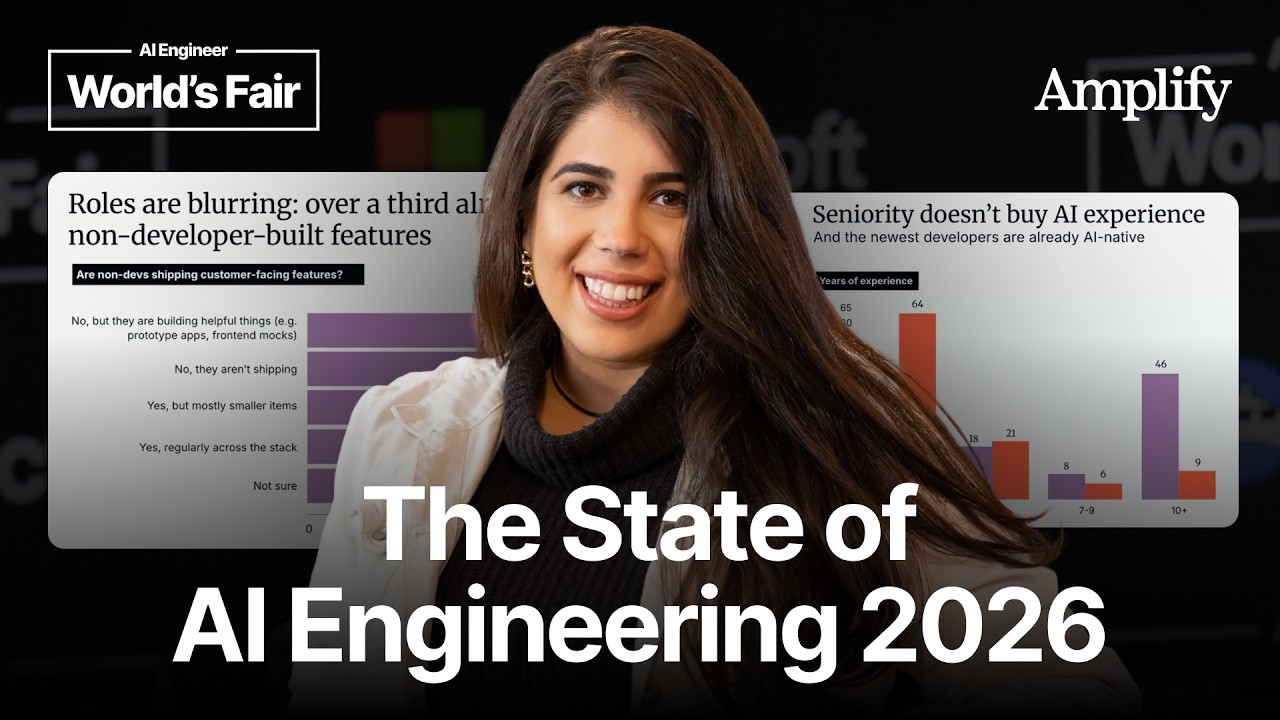
Barr Yaron's 2026 AI engineering survey reveals key trends: audio and image generation are rapidly gaining traction, while cost is now a primary engineering constraint. Agents are evolving to take actions within systems, but control mechanisms remain primitive. Evaluation (eval) is still the top infrastructure challenge. AI positively impacts job satisfaction and experimentation but also raises concerns about technical skill erosion and non-developers shipping code, fundamentally changing engineering culture. Predictions include a likely AGI declaration within five years and a shift away from Transformers as state-of-the-art.