Ai

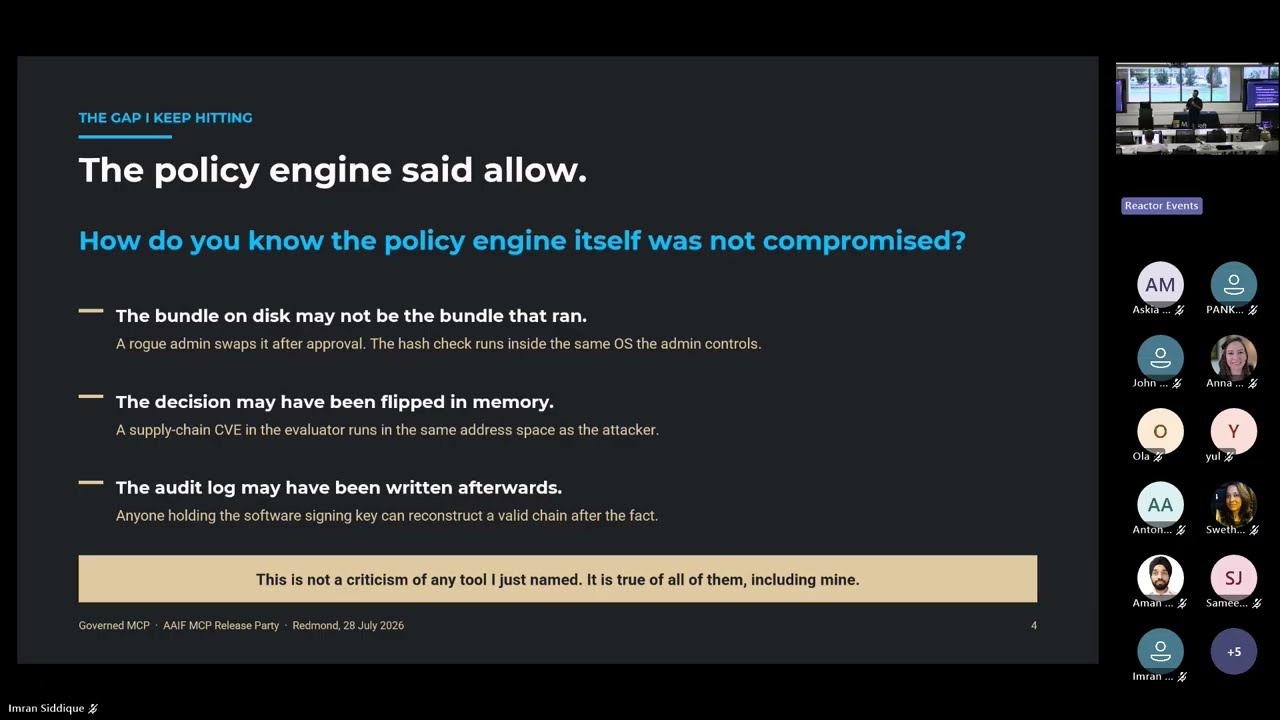
Policy Enforcement and Tamper-Evident Audit Chains | ​Imran Siddique | MCP Release Party - Seattle

Policy Enforcement and Tamper-Evident Audit Chains | ​Imran Siddique | MCP Release Party - Seattle

Imran Siddique introduces cMCP, an open-source gateway that enhances Modular Control Plane (MCP) servers with policy enforcement and tamper-evident audit trails. It achieves this by running Cedar policy evaluation within Trusted Execution Environments (TEEs), ensuring that agent actions are governed securely and verifiably. The talk delves into the concept of "beyond governance" towards verifiable AI, the 'trace' standard for auditable logging, and the importance of confidential computing for regulated industries.

How to Kill the Code Review — Ankit Jain, Aviator

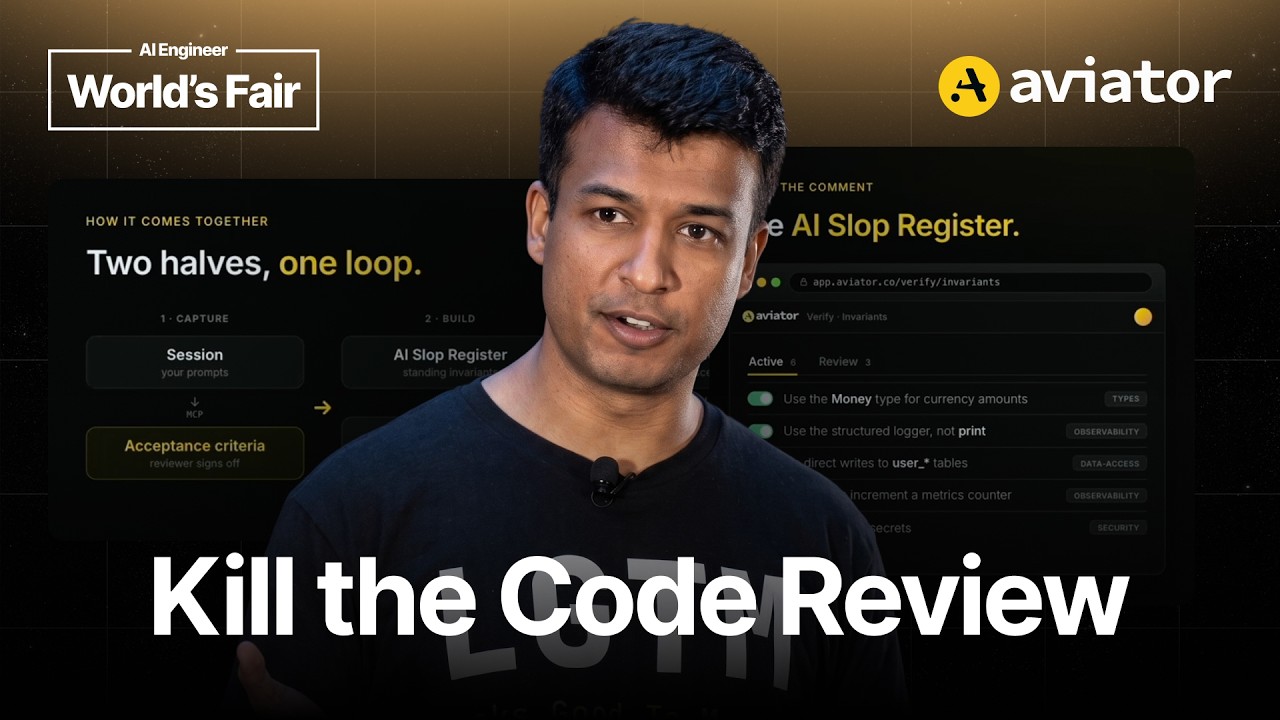
How to Kill the Code Review — Ankit Jain, Aviator

Ankit Jain argues that traditional line-by-line code review is defunct, with AI reviewing code that humans no longer read. He asserts that code review's vital, often overlooked, purpose is 'alignment'—knowledge sharing, mentorship, and architectural feedback—which current AI-driven workflows fail to capture. His proposal involves capturing user-AI interaction prompts as acceptance criteria, generating test plans with an 'AI Slop Registry' (codified recurring review comments), and verifying changes against live previews. The new review surface becomes the 'intent and evidence' rather than the code diff, preserving collaboration and ensuring semantic accuracy.

Security Firewall for Agents — Ryan Dahl, Deno

Security Firewall for Agents — Ryan Dahl, Deno

Deno addresses the critical security challenge of AI agents with production write access by introducing Claw Patrol. This MIT-licensed proxy operates below the HTTP layer, deep inspecting all agent communications (including non-HTTP protocols), enforcing granular HCL-based rules, and handling credential injection. It allows for human or LLM approval workflows, ensuring robust, external security against prompt injection and malicious actions, as agents are fundamentally considered untrusted software.

Context Engineering in 2026 — Louis-François Bouchard, Omar Solano & Samridhi Vaid, Towards AI

Context Engineering in 2026 — Louis-François Bouchard, Omar Solano & Samridhi Vaid, Towards AI

Experiments with an AI tutor reveal that not compacting context often outperforms summarization, leading to better recall, lower cost, and faster responses, primarily due to LLM API prompt caching. Compaction invalidates the cache, making it unexpectedly expensive. While cloud environments benefit from full history, local hardware limits necessitate compaction, highlighting the need to prioritize actual constraints over default compaction strategies.

Inside Stripe's AI Strategy with Will Gaybrick

Inside Stripe's AI Strategy with Will Gaybrick

Stripe's President of Product & Business, Will Gaybrick, discusses how AI is transforming Stripe from a payments company into a multi-product financial infrastructure platform. He highlights AI's role in boosting product development velocity through internal tools like "Stripe Minions," which generate thousands of pull requests weekly, enabling a "build everything" philosophy rather than cost-cutting. The conversation also explores the future of "agentic commerce," the potential return of micropayments enabled by stablecoins, and how Stripe empowers internal "founder-like agency" while maintaining high product quality in an increasingly AI-driven software landscape.

Reading Group July 2026 - Loop Engineering

Reading Group July 2026 - Loop Engineering

This session provides an in-depth exploration of Loop Engineering, a paradigm shift from manual AI prompting to designing autonomous systems that orchestrate AI agents. Speakers share practical experiences, from building production-grade platforms with automated code generation and adversarial AI reviews to experimental loop structures and foundational infrastructure layers. Key discussions address challenges like managing token costs, preventing agent chaos, and implementing robust verification mechanisms for industrializing software development.