Ai

AI Hackers Are Faster Than Your Pen Test — Eli Cohen, Snyk

AI Hackers Are Faster Than Your Pen Test — Eli Cohen, Snyk

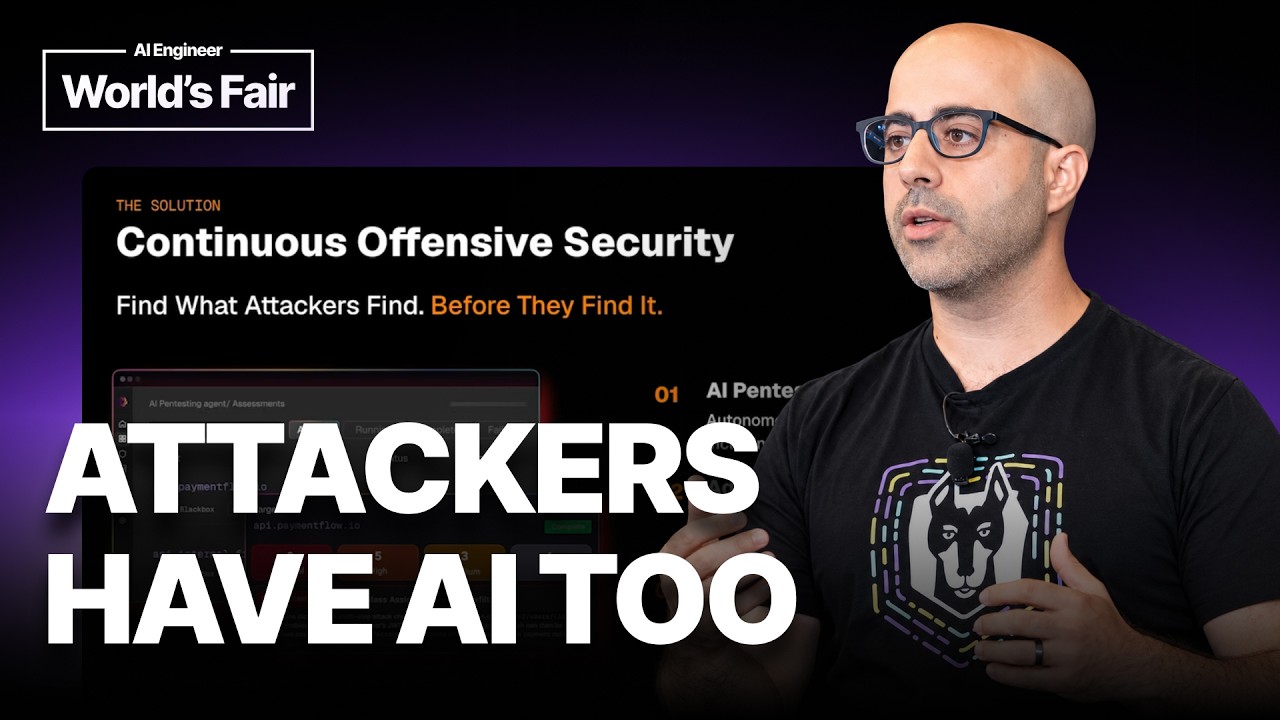
Eli Cohen of Snyk argues that AI-generated code and AI-powered attackers have broken the traditional security model. He calls for continuous offensive security built on AI pentesting on every code change, agent red teaming, and a multi-agent system that validates exploits. He compares SAST, DAST, and human pentesting, and closes with four questions to ask any AI pentesting vendor.
Stop Overpaying for Intelligence | DevDay 2026

Stop Overpaying for Intelligence | DevDay 2026

A practical session on cutting AI costs without sacrificing quality. The speakers argue for measuring cost per completed task rather than per-token list prices, show how to right-size models with accuracy-versus-cost Pareto analysis, and walk through four levers: prompt caching, programmatic tool calling, reasoning effort, and batch or flex processing. Customer case studies from Perplexity, Notion, Clio, and Blitzy ground the advice.

Higgsfield - Building Agents That Provision Their Own Compute | DevDay 2026

Higgsfield - Building Agents That Provision Their Own Compute | DevDay 2026

Alex Mashrabov, CEO of Higgsfield, explains how agentic systems choose among models and provision their own GPU infrastructure to deliver consistent, multi-step creative media. He covers the trade-offs between speed, controllability, and dedicated deployment, and shares the 10-hour AI-generated live stream as an example of what becomes possible for small teams.

Stack Overflow - From Idea to Product | DevDay 2026

Stack Overflow - From Idea to Product | DevDay 2026

A VP of Product at Stack Overflow explains how a small team used OpenAI Codex to build two very different products: the enterprise knowledge intelligence layer Stack Internal and the experimental agent-first platform Stack Overflow for Agents. The discussion covers how to tune guardrails to product risk, how archetypes simplify multi-source enterprise ingestion, and how a community built for humans can be extended so agents both consume and contribute knowledge.

The Software Factory: From Bug Report to Production Code — Davis Palmie, Factory

The Software Factory: From Bug Report to Production Code — Davis Palmie, Factory

Davis Palmie of Factory explains the software factory, a system of agents that turns bug reports and user feedback into production code. He covers leadership concerns about cost, model choice, engineering roles, and org structure, argues that coding was never the bottleneck, and lays out principles for a factory: model agnosticism, sovereign deployment, and SDLC-wide integration. He also describes eight pillars of agent readiness, starting with narrow use cases like incident triage, and closes with why outcome metrics should replace token counts.

Why AI Agents Should Have Their Own Sandbox — Philipp Schmid, Google DeepMind

Why AI Agents Should Have Their Own Sandbox — Philipp Schmid, Google DeepMind

Philipp Schmid of Google DeepMind introduces the Gemini Interactions API, a unified interface for models and agents with server-side state and long-running jobs. He then shows managed cloud sandboxes for Antigravity agents that persist, can be shared, and automatically pick up skills and AGENTS.md files, closing with a live AI talk radio demo built from a single prompt.