Ai

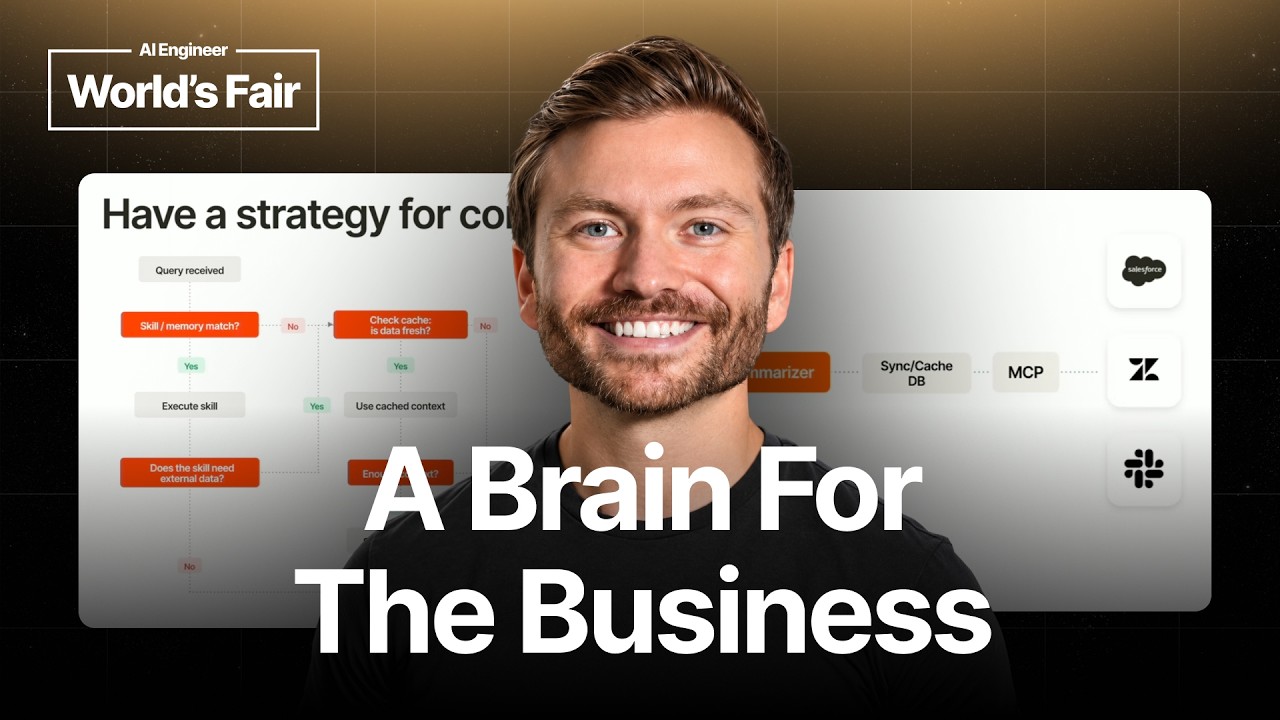
Why Your Company Needs a Context Graph (and How to Build It) — Gil Feig, Merge

Why Your Company Needs a Context Graph (and How to Build It) — Gil Feig, Merge

Gil Feig, co-founder and CTO of Merge, explains why agents need a company-wide context graph rather than a few MCP connections. Using the question of which customers were upset last week, he shows why live API lookups fail across large datasets and why synced local copies, routing, summarization, skills, memory, and traceable provenance are needed to build a reliable company brain.
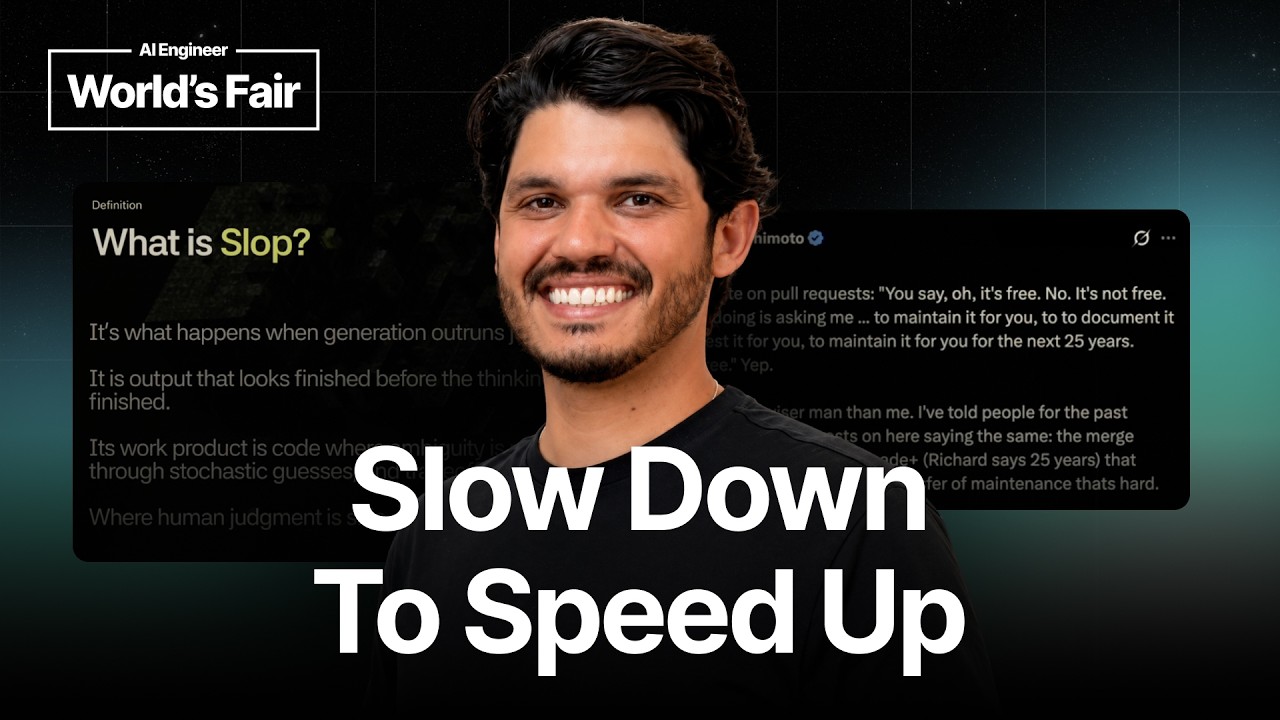
Generation Is Cheap, Review Is Expensive: How to Stop Shipping AI Slop — Gabriel Martinez, G2i

Generation Is Cheap, Review Is Expensive: How to Stop Shipping AI Slop — Gabriel Martinez, G2i

Gabriel Martinez of G2i argues that slop is not AI-written code but work that looks finished before the thinking behind it is done. He connects it to missing judgment, code as a liability, misaligned incentives that reward merging speed over review, oversized PRs and documents that push understanding onto reviewers, and the case for conventions, diagrams as review surfaces, and small changes. He closes by explaining why G2i built ORC to keep humans in control of agent-generated work.

How MasterClass Builds Multi-Agent AI That Learners Can Trust

How MasterClass Builds Multi-Agent AI That Learners Can Trust

MasterClass engineers Mandar and Priya explain how they built NCX, a multi-agent AI tutoring system, and the CoreWeave-based tracing, MCP server, and AgentOps loop that keeps it reliable and self-improving in production.

Beam: The Great American Open Model with ReflectionAI Co-Founder and CEO Misha Laskin

Beam: The Great American Open Model with ReflectionAI Co-Founder and CEO Misha Laskin

Misha Laskin, co-founder and CEO of Reflection AI, discusses building frontier open-weight models, the launch of the 500B-parameter Beam reasoning model, the economics of renting versus owning intelligence, and why he believes open models will capture most token demand. The conversation covers RL-driven scaling efficiency, Chinese open model ecosystems and their geopolitical implications, and the safety case for openness, including cybersecurity as a lens for defense and offense. He closes with optimism about AI-accelerated science and the evolving research workforce.

High-Performance Engineering: Forward Deployed at Aston Martin F1

High-Performance Engineering: Forward Deployed at Aston Martin F1

A session on CoreWeave's forward deployed engineering partnership with the Aston Martin Aramco F1 Team, covering why Formula 1 is an unforgiving environment for AI, and three projects: a unified data platform for aerodynamic and telemetry data, Delta to Map, a small transformer model that reduces the gap between wind tunnel predictions and track measurements, and Radio Insights, a fine-tuned speech-to-text and agentic system that makes sense of 40 live radio channels. The discussion extracts lessons applicable to any team moving AI from experiment to production under fixed deadlines.

Beyond Faster Simulation: Hitting NASA's 2030 CFD Benchmark and the Infrastructure for Physics AI

Beyond Faster Simulation: Hitting NASA's 2030 CFD Benchmark and the Infrastructure for Physics AI

nTop and CoreWeave completed 10,000 LES CFD simulations in about 32 hours, meeting NASA's 2030 CFD Vision goal four years early. The approach combines signed distance field geometry, which cannot break under parametric variation, with a GPU-native Lattice Boltzmann solver that removes the meshing step entirely. The talk also covers the 14 TB dataset generated and the path toward physics AI surrogates trained in implicit latent space.