Synthetic data

The Next Frontier of AI Is Spatial Intelligence | Fei-Fei Li on a16z

The Next Frontier of AI Is Spatial Intelligence | Fei-Fei Li on a16z

Fei-Fei Li and Yunzhu Li discuss World Labs' acquisition of SceniX, focusing on building "spatial intelligence" and "large world models" to enable robots to understand and interact with the physical world. They elaborate on SceniX's "real-to-sim-to-real" pipeline, emphasizing how simulation, coupled with generative models like Marble, addresses the data bottleneck in robotics by providing consistent, scalable, and efficient training and evaluation environments. The conversation covers the role of counterfactual reasoning, the development of robotics foundation models, and the strategic focus on semi-structured environments for pragmatic, reliable robot deployment.


The Messy Reality of Scale: Synthetic Data and Pre-Training — Marah Abdin & Robert McHardy, poolside

The Messy Reality of Scale: Synthetic Data and Pre-Training — Marah Abdin & Robert McHardy, poolside

Poolside discusses their innovative approaches to synthetic data generation, pre-training validation, and distributed training challenges. They highlight how modular data pipelines, rigorous replica hash checks, and numerical stability fixes enabled them to scale their LLMs, culminating in the 118B parameter Laguna S model designed for agentic coding, which shows strong early results against leading open-weight models.

Why a Nation Can't Outsource Its Frontier AI - Alistair Pullen (Cosine AI)

Why a Nation Can't Outsource Its Frontier AI - Alistair Pullen (Cosine AI)

Alistair Pullen, CEO of Cosine, discusses the UK's sovereign AI initiative, born from US export controls. He outlines Cosine's unique economic model, competing with "millions" against "billions" by licensing models instead of hosting inference. Pullen delves into why open models lag frontier systems, emphasizing active parameters and post-training data. He explains Cosine's innovative approach to "slop" through process-based RL and credit attribution, advocating for runtime proof in code review. The conversation covers their hierarchical "Swarm" sub-agent system, the challenges of memory, and advanced synthetic data generation, concluding on the geopolitical impact of export controls as an unexpected catalyst for UK AI.

Session on Inclusive AI: Data, Models, Evaluation

Session on Inclusive AI: Data, Models, Evaluation

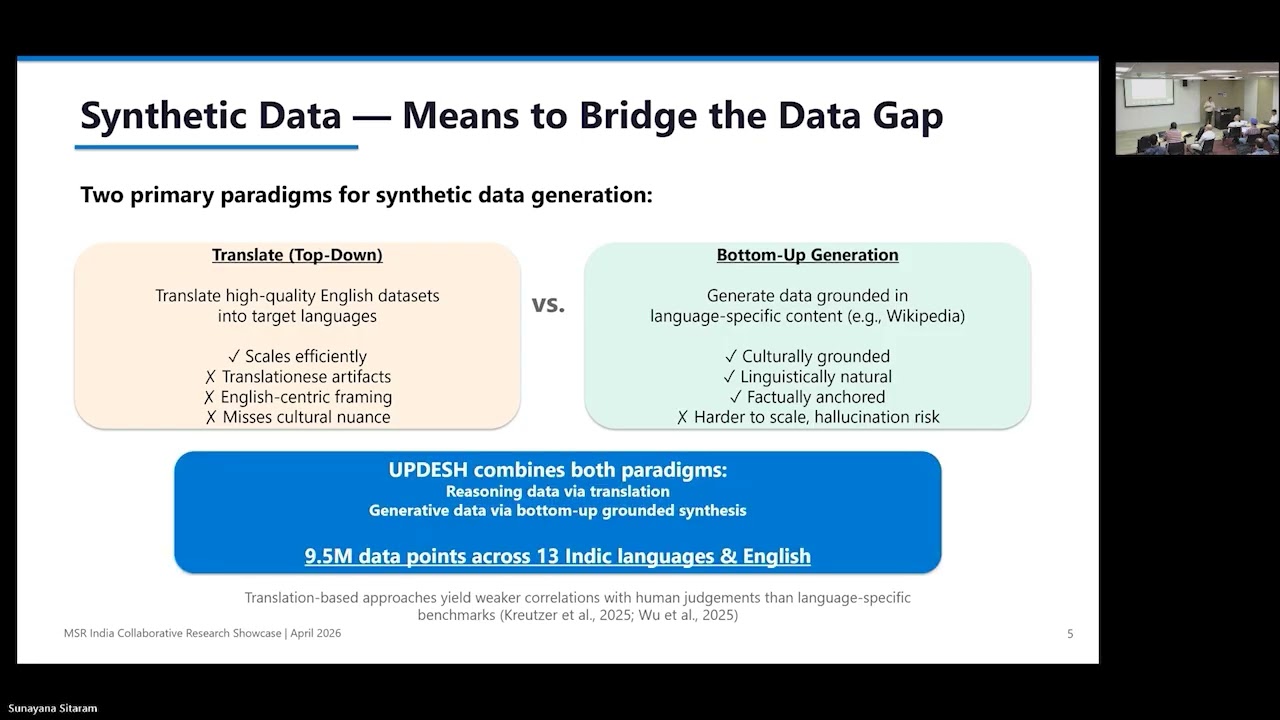
The Microsoft Research India Academic Research Summit 2026 session on "Inclusive AI" explored critical challenges in developing AI that serves diverse linguistic and cultural contexts. Speakers Niloy Ganguly, Danish Pruthi, Sunayana Sitaram, Anoop Kunchukuttan, and Ashutosh Modi addressed data gaps, model biases, and evaluation shortcomings, emphasizing the need for equitable and culturally relevant AI. Key themes included the use of synthetic data for low-resource languages, the impact of tokenization on model performance, geographical disparities in generative AI, and the application of AI for social good in legal and accessibility domains. The discussions underscored the importance of community involvement, open data, and designing AI for multilinguality from the outset, rather than as an afterthought.

The State of Frontier Post-Training Recipes | Conversation with Finbarr Timbers

The State of Frontier Post-Training Recipes | Conversation with Finbarr Timbers

This discussion with Finbarr Timbers reviews the evolution of frontier post-training recipes, highlighting the shift from simpler SFT-DPO-RL to complex multi-teacher on-policy distillation (MOPD). It covers the organizational challenges of building models like Olmo, the rise of synthetic data and reasoning-focused RL in DeepSeek, and the complexities of integrating expert teachers, while also exploring open questions on environments, specialized APIs, and career strategies in the rapidly changing AI landscape.

MagenticLite is here: A full-stack agentic experience powered by Small Models

MagenticLite is here: A full-stack agentic experience powered by Small Models

Microsoft Research introduces MagenticLite, an agentic framework powered by two new small, open-weight models: Magentic Orchestrator for planning and coding, and Fara-1.5 for browser automation. The talk details the novel synthetic data generation techniques and training strategies used to achieve state-of-the-art performance in small models, enabling them to compete with much larger ones.