Semantic layer

The 12 KB File That Replaces Weeks of Training (with Tristan Handy)

The 12 KB File That Replaces Weeks of Training (with Tristan Handy)

Tristan Handy, founder and CEO of dbt Labs, details the evolution of analytics engineering from a 2016 study into a tool used by over 100,000 data teams. He explains his decision to use SQL over Spark for accessibility, the concept of "progressive complexity," and how dbt projects transform raw data into modeled tables using a Directed Acyclic Graph. Handy elaborates on the critical role of the semantic layer in ensuring consistent metric definitions for both human users and AI agents, especially in large organizations. He introduces the dbt Fusion Engine, aiming to bring type safety and universal SQL understanding, and discusses how 12-kilobyte skill files can revolutionize large-scale dbt migrations, reducing them from years to weeks by enabling AI agents to absorb vast amounts of expert knowledge.

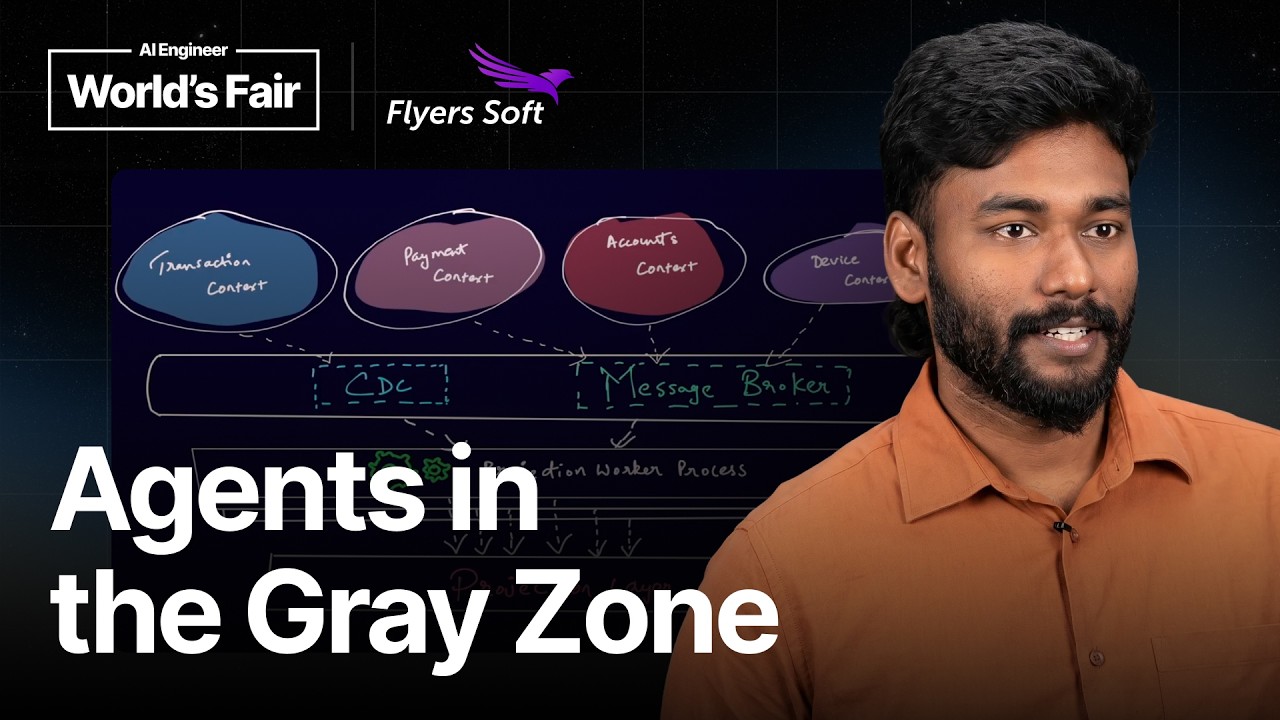
Let's integrate AI Agents in Event-Sourced Systems — Divakar Kumar, FlyersSoft

Let's integrate AI Agents in Event-Sourced Systems — Divakar Kumar, FlyersSoft

This presentation explores integrating AI agents into existing event-sourced architectures to resolve ambiguous cases in real-time fraud detection. By leveraging a semantic layer built from various bounded contexts (transaction, device, account), specialized agents like Risk Analyzer and Behavior Analyzer use tools and short-term memory to reach a verdict, addressing the "gray zone" where traditional rule-based and ML systems fall short. The approach emphasizes layering agents without replacing existing infrastructure, enhancing judgment in production systems.

AI on Your Lakehouse: Context Comes in Shapes, Not Queries — Zach Blumenfeld, Neo4j

AI on Your Lakehouse: Context Comes in Shapes, Not Queries — Zach Blumenfeld, Neo4j

AI agents often struggle with context in lakehouses, leading to confident but incorrect answers. This workshop by Zach Blumenfeld introduces three Neo4j graph shapes built on lakehouse data—Connections (semantic layer), Trees (document outlines), and Communities (themes)—to provide essential context, enabling agents to accurately navigate structured and unstructured data, answer complex estate-level questions, and overcome limitations of traditional Text2SQL and vector search.

Your Moat Is Your Data Model — Mike Phipps, Gates Foundation

Your Moat Is Your Data Model — Mike Phipps, Gates Foundation

Mike Phipps from the Gates Foundation details how they built a Strategic Intelligence Platform (SIP) using a Neo4j knowledge graph to serve AI agents. He argues that the true "moat" in an AI-commoditized world lies in an organization's unique data model and tacit knowledge, not in generic AI tools. The platform unifies 25 years of siloed grantmaking data, integrating structured and unstructured information through a rigorous curation pipeline, and is refined via continuous retrieval evaluations to ensure alignment with organizational reporting standards.

Enterprise Agents Have a Structure Problem - Ishita Daga, Tesla

Enterprise Agents Have a Structure Problem - Ishita Daga, Tesla

Ishita Daga, a Senior ML Engineer at Tesla, explains why enterprise AI agents fail, highlighting that current fixes like larger models or more RAG are insufficient. She identifies ambiguity, staleness, and user preference as key structural problems. Daga proposes a solution built on semantic retrieval infrastructure: a hierarchical approach to knowledge sources, including a curated semantic layer and metadata graphs. She also details a robust context life cycle with live data sources and continuous feedback loops to combat staleness. The challenge of integrating individual preferences, requiring agents to reason over business concepts rather than raw schemas, is also discussed.

How AI covered a human’s paternity leave // Quinten Rosseel

How AI covered a human’s paternity leave // Quinten Rosseel

A practitioner's guide to deploying a text-to-SQL agent in a real-world business environment. The talk covers the critical lessons learned in moving from concept to production, focusing on the importance of the communication channel (Slack), the necessity of a semantic layer over benchmark scores, and a pragmatic approach to system architecture, testing, and evaluation.