Self supervised learning

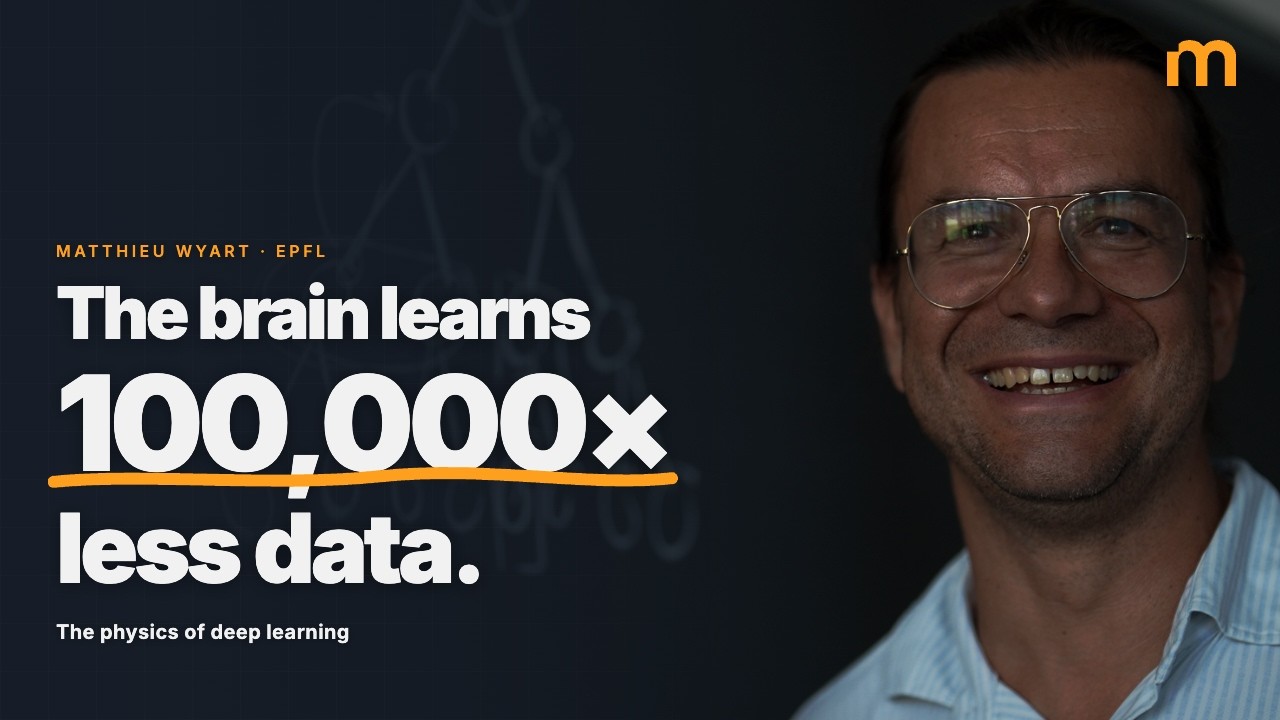
Why Deep Networks Don’t Need to Memorize Everything — Matthieu Wyart

Why Deep Networks Don’t Need to Memorize Everything — Matthieu Wyart

Matthieu Wyart, a statistical physicist, argues that deep networks discover abstractions by recovering hidden data hierarchies, allowing them to escape the curse of dimensionality. He explains how this mechanism, combined with predicting latent representations instead of raw tokens, can significantly improve sample efficiency. The discussion also covers the physics of rough loss landscapes, machine creativity, diffusion models, and a theoretical framework for neural scaling laws.

Why Robotics Still Isn't Solved - But Could Be Soon | YC Paper Club

Why Robotics Still Isn't Solved - But Could Be Soon | YC Paper Club

This Paper Club delves into the current state of robotics, addressing roadblocks like the sim-to-real gap and embodiment drift. Speakers present advancements in multi-scale memory for long-horizon tasks, self-supervised embodied reasoning, zero-shot dexterous manipulation via massive simulation, and the economic imperative of teleoperation-first robotics companies, concluding with optimizations for efficient, real-time World Action Models.

If You Can't See Inside, How Do You Know It's THINKING? [Dr. Jeff Beck]

If You Can't See Inside, How Do You Know It's THINKING? [Dr. Jeff Beck]

Dr. Jeff Beck explores the philosophical and technical definitions of agency, arguing that the distinction between an agent and an object lies in computational sophistication, particularly the capacity for planning and counterfactual reasoning. The conversation provides a deep dive into Energy-Based Models (EBMs), Yann LeCun's JEPA for learning in latent space, and a pragmatic approach to AI safety centered on inverse reinforcement learning rather than fears of rogue superintelligence.

The Mathematical Foundations of Intelligence [Professor Yi Ma]

The Mathematical Foundations of Intelligence [Professor Yi Ma]

Professor Yi Ma presents a unified mathematical theory of intelligence built on two principles: parsimony and self-consistency. He challenges the notion that large language models (LLMs) understand, arguing they are sophisticated memorization systems, and demonstrates how architectures like the Transformer can be derived from the first principle of compression.

Intern talk: Distilling Self-Supervised-Learning-Based Speech Quality Assessment into Compact Models

Intern talk: Distilling Self-Supervised-Learning-Based Speech Quality Assessment into Compact Models

This research explores the distillation and pruning of large, self-supervised speech quality assessment models into compact and efficient versions. Starting with the high-performing but large XLSR-SQA model, the work details a process of knowledge distillation using a teacher-student framework with a diverse, on-the-fly generated dataset. The resulting compact models successfully close over half the performance gap to the teacher, making them suitable for on-device and production applications where model size is a critical constraint.