
Redis

AI Agents Don't Read Your Policy Docs. They Hit Your APIs — Gravitee

AI Agents Don't Read Your Policy Docs. They Hit Your APIs — Gravitee

Sam, CTO at Gravity, argues that AI agent governance must be enforced in infrastructure rather than in prompts or policy documents. Through five live demos against a hotel-booking agent, he shows a gateway blocking destructive tool calls, preventing data exfiltration, rate-limiting runaway agents, serving cached semantic responses, and rejecting oversized prompts before any LLM call. He also covers observability, vendor decoupling via LLM routing, trimming bloated MCP tool lists, and managing shadow AI.
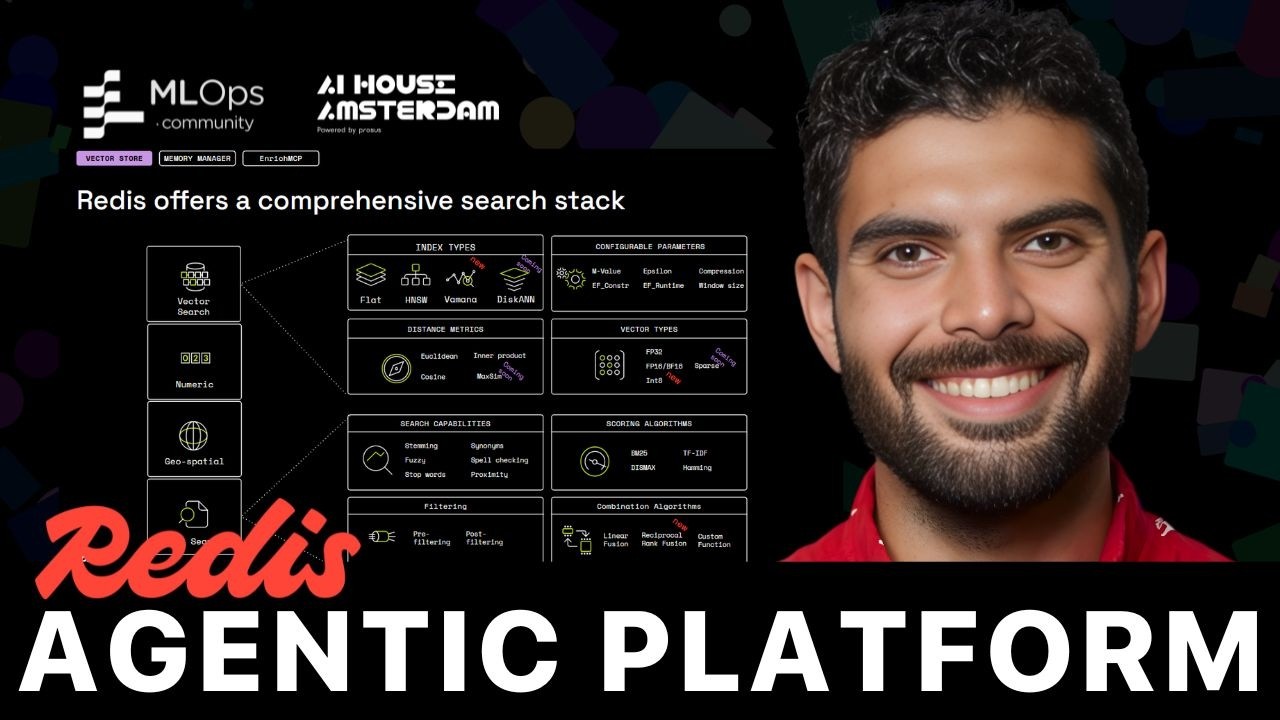
Context Engineering 2.0: MCP, Agentic RAG & Memory // Simba Khadder

Context Engineering 2.0: MCP, Agentic RAG & Memory // Simba Khadder

Simba Khadder of Redis introduces Context Engineering 2.0, a new paradigm for AI agents that unifies structured data, unstructured data (RAG), and memory into a single, schema-driven surface. He critiques current methods like Text-to-SQL and direct API wrapping, proposing a unified context engine to provide reliable, observable, and performant data access for agents.

Context Engineering 2.0

Context Engineering 2.0

Simba Khadder explains the evolution of feature stores and MLOps, detailing why they remain crucial in the age of LLMs for high-scale use cases. He discusses the acquisition of his company, Featureform, by Redis and outlines their new vision: building a "Context Engine" for AI. This engine aims to unify structured data, unstructured data, and memory into a single pane of glass, moving beyond simple RAG to a more sophisticated "Context Engineering 2.0" that empowers agents with rich, queryable context.