Rdma

Data Architecture for AI: From Training Pipelines to Agent Memory

Data Architecture for AI: From Training Pipelines to Agent Memory

Alan Kourev, co-founder and CTO of VAST Data, explains how AI workloads (training, inference with KV cache offload, RAG, and agents) access data in fundamentally different ways, and presents a disaggregated, shared-everything architecture, shaped in part by work with CoreWeave, that serves all of them from one unified platform.
The End of TCP for AI Clusters — John Ousterhout, Stanford

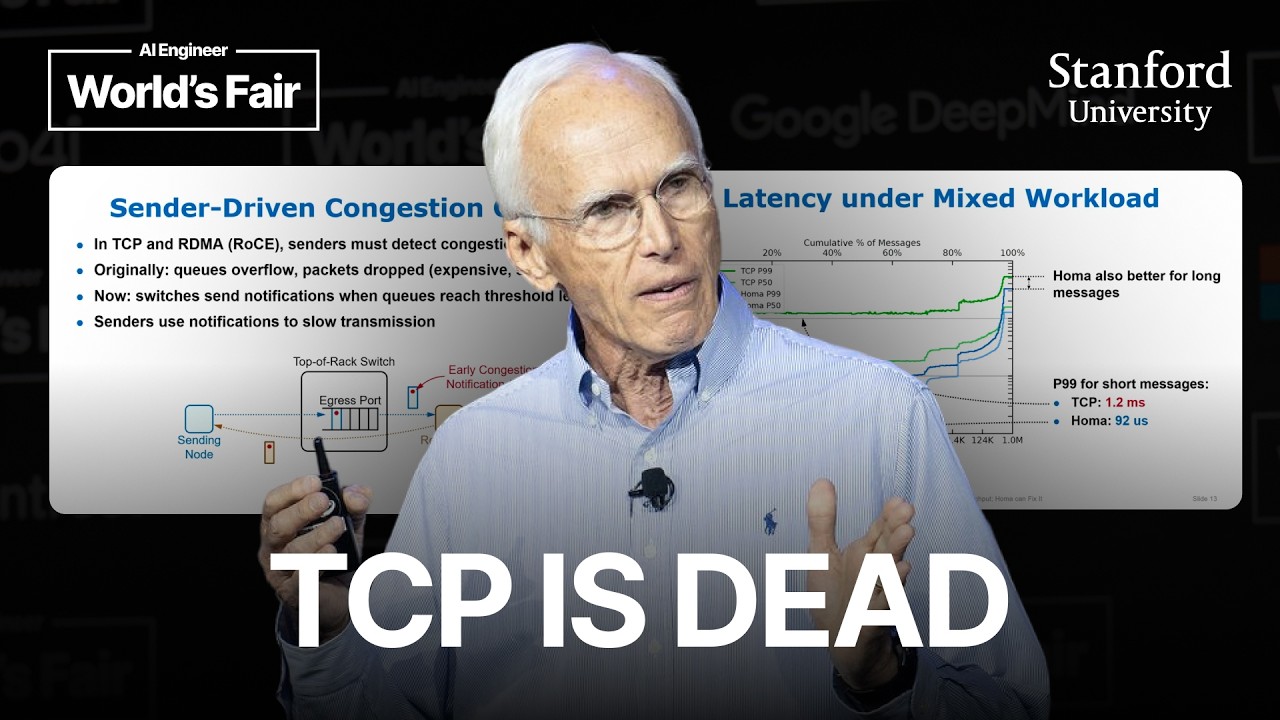
The End of TCP for AI Clusters — John Ousterhout, Stanford

John Ousterhout argues that AI workloads are shifting from large data transfers to small, frequent coordination messages, making network latency (especially tail latency) a critical bottleneck. He explains why traditional protocols like TCP and RDMA are ill-suited due to sender-side congestion control and their byte-stream model. Ousterhout then introduces Homa, a new protocol designed from scratch with message-based communication, receiver-side congestion control, and switch priority queue utilization, demonstrating significant improvements in tail latency for AI applications.

The 100,000 Sandbox Problem — Akshat Bubna, Modal CTO

The 100,000 Sandbox Problem — Akshat Bubna, Modal CTO

Modal CTO Akshat Bubna discusses the company's shift from developer to agent experience, highlighting why traditional cloud infrastructure fails for bursty AI workloads. He details Modal's primitives like elastic inference with GPU snapshotting and speculative decoding, agent sandboxes for RL rollouts, multi-node training with RDMA, and a "supercloud" strategy across 17 providers. The conversation also covers the importance of observability, hard guardrails for production agents, and AI's role in making infrastructure exciting again.

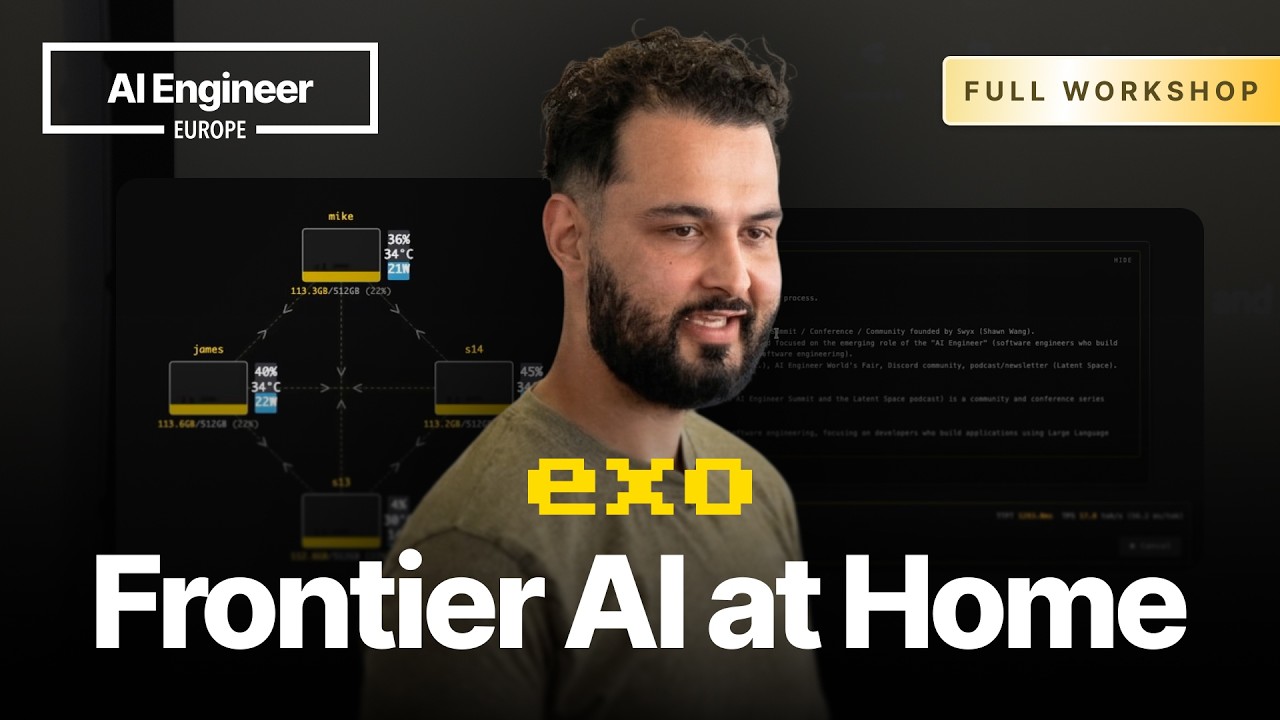
Frontier AI at Home — Alex Cheema, EXO Labs

Frontier AI at Home — Alex Cheema, EXO Labs

Alex Cheema from EXO Labs explores the path to a 100x improvement in the price-performance of running frontier AI models locally. The talk covers full-stack optimization strategies, including kernel fusion for a 30% performance boost, RDMA for scalable tensor parallelism, and a novel approach of splitting prefill and decode phases across heterogeneous hardware (e.g., an RTX GPU and Mac Studios) to significantly speed up large-prompt inference.