Prompt caching

Memory-Aware Agent Harnesses for Anti-Money Laundering — Nacho Martinez, Oracle

Memory-Aware Agent Harnesses for Anti-Money Laundering — Nacho Martinez, Oracle

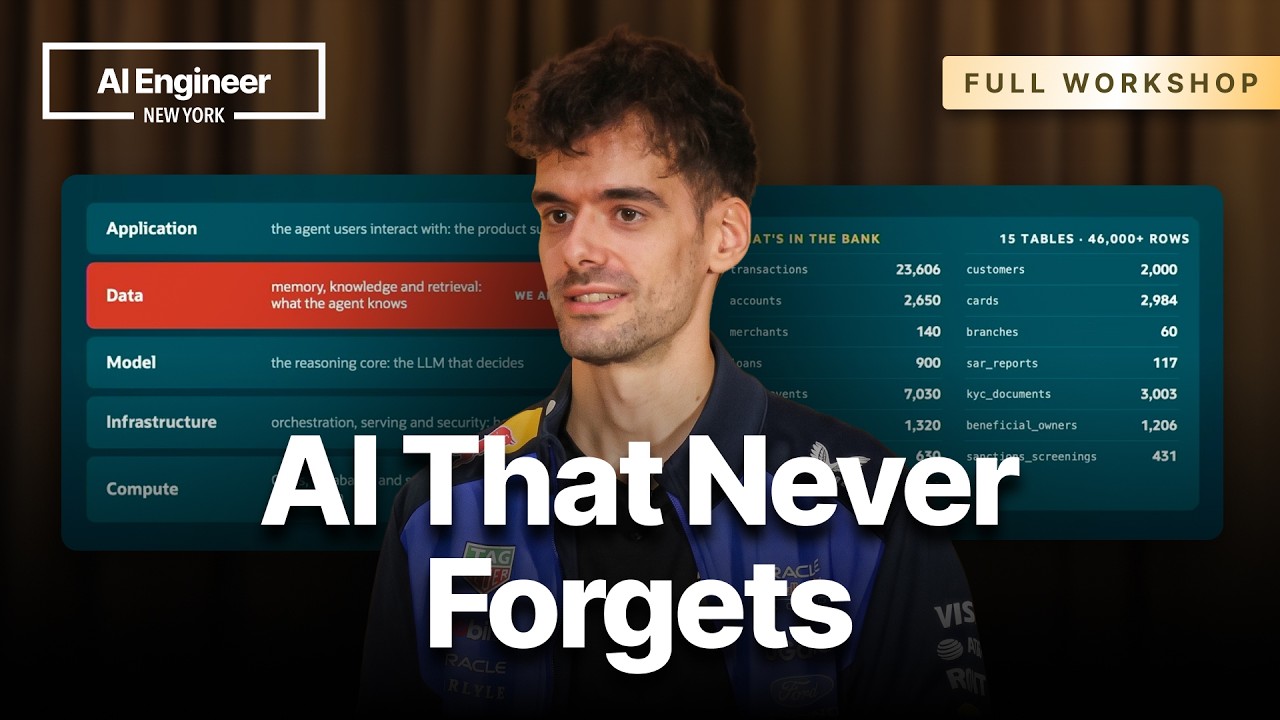
Nacho Martinez argues that the model is fixed while the harness (agent loop, memory, context engineering, tools and skills, continual learning) is where engineers can make real gains. He walks through the agent stack and applies it to an autonomous AML agent that flags suspicious bank transactions, then demonstrates the workshop environment and answers questions on memory design, skill retrieval, caching, and hybrid search.

How Cline Embraces an Open-Weights Model Ecosystem for AI Agents

How Cline Embraces an Open-Weights Model Ecosystem for AI Agents

Cline's CEO explains why open-weight models are rapidly taking over coding-agent workloads, and why the agent harness, not raw model capability, determines reliability. The talk covers model-specific tuning and failure handling, context and token optimization, self-improving harness loops, an SDK-first and UI-agnostic architecture, interactive evaluation built from real-world usage data, and production inference challenges such as KV cache hit rates.

Giving AI Agents Memory That Learns — Jake Broekhuizen, LangChain

Giving AI Agents Memory That Learns — Jake Broekhuizen, LangChain

Jake Broekhuizen of LangChain Labs argues that observability alone does not make agents improve. Using a financial services agent whose tone drifted from advisory to pushy, he shows how traces only become useful memory when a filtered lesson is written back as durable context the agent reads on its next run. The talk covers semantic, episodic, and procedural memory, the working versus long-term memory distinction, the read-write cycle, and how LangSmith and Context Hub support capture, analysis, and updates, along with lessons about keeping only signal, caching, and human review of procedural changes.

Stop Overpaying for Intelligence | DevDay 2026

Stop Overpaying for Intelligence | DevDay 2026

A practical session on cutting AI costs without sacrificing quality. The speakers argue for measuring cost per completed task rather than per-token list prices, show how to right-size models with accuracy-versus-cost Pareto analysis, and walk through four levers: prompt caching, programmatic tool calling, reasoning effort, and batch or flex processing. Customer case studies from Perplexity, Notion, Clio, and Blitzy ground the advice.

Inside OpenAI DevDay: Superhuman Computer Use, Decisions API, and the AI Cloud — Ari & Nikunj

Inside OpenAI DevDay: Superhuman Computer Use, Decisions API, and the AI Cloud — Ari & Nikunj

OpenAI has unveiled significant advancements in its AI agents and developer APIs, transforming Computer Use into a self-debugging system capable of superhuman speeds. Key innovations include multimodal interfaces, the Agents API for building on OpenAI's harness, and a new API stack featuring async tool calling, UltraFast inference, and the rapidly developed Decisions API for fast classification. These advancements, coupled with robust caching and context compaction, pave the way for an "AI cloud" with higher-level primitives for developers.

Context Engineering in 2026 — Louis-François Bouchard, Omar Solano & Samridhi Vaid, Towards AI

Context Engineering in 2026 — Louis-François Bouchard, Omar Solano & Samridhi Vaid, Towards AI

Experiments with an AI tutor reveal that not compacting context often outperforms summarization, leading to better recall, lower cost, and faster responses, primarily due to LLM API prompt caching. Compaction invalidates the cache, making it unexpectedly expensive. While cloud environments benefit from full history, local hardware limits necessitate compaction, highlighting the need to prioritize actual constraints over default compaction strategies.