Product thinking

Platform Engineering for Developers, Architects & the Rest of Us • Daniel Bryant • GOTO 2025

Platform Engineering for Developers, Architects & the Rest of Us • Daniel Bryant • GOTO 2025

Daniel Bryant discusses platform engineering for software developers and architects, emphasizing treating platforms as internal products with developers as customers. He outlines a three-layered architecture, the evolution from monolithic systems to microservices, and the importance of 'golden bricks' over 'golden paths' for composability. Key takeaways include API-first design, minimizing cognitive load, avoiding leaky abstractions, and measuring success through frameworks like DORA and DevEx to achieve speed, safety, and scale.
Modern Enterprise Architecture: Architecting for Outcomes • Simon Rohrer • GOTO 2025

Modern Enterprise Architecture: Architecting for Outcomes • Simon Rohrer • GOTO 2025

Simon Rohrer challenges traditional Enterprise Architecture (EA) principles, proposing a modern approach focused on outcomes, continuous evolution, and socio-technical alignment. He outlines five key tenets: Aligning Value, People & Technology; achieving Better Value Sooner, Safer, Happier; implementing Continuous Conversational & Automated Governance; scaling DevOps across the enterprise; and fostering Evolutionary Enterprise Architecture.

The Platform Engineer’s Handbook • Ajay Chankramath & Kaspar von Grünberg • GOTO 2026

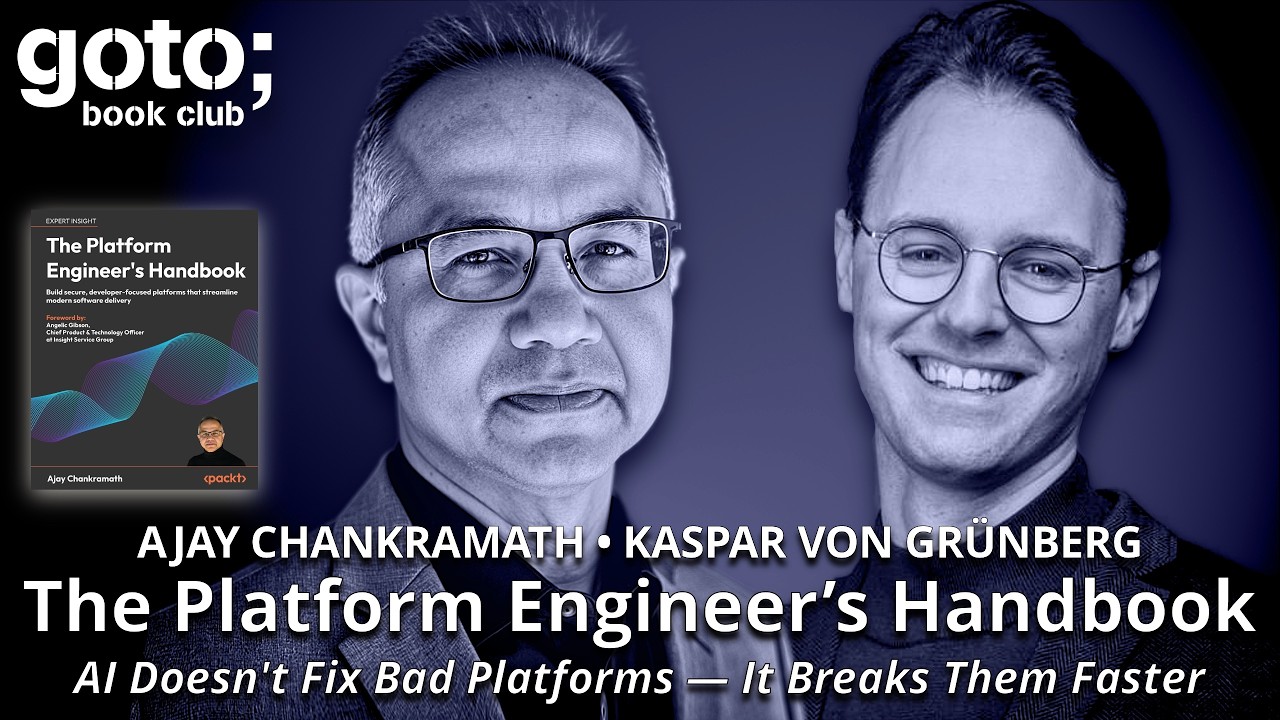
The Platform Engineer’s Handbook • Ajay Chankramath & Kaspar von Grünberg • GOTO 2026

This conversation with Ajay Chankramath, author of 'The Platform Engineer’s Handbook,' delves into why practical, code-first guidance is essential for building Internal Developer Platforms. He argues that developer adoption failures stem from a "product discipline gap," not a technology one, emphasizing developer experience as a first-class outcome. The discussion covers the book's arc from foundations to enterprise-grade features and its focus on 100% open-source, vendor-agnostic tooling. Crucially, it highlights how agentic AI raises the stakes for platform engineering, requiring new IDP layers for agent context, memory, and guardrails, asserting that these must be built, owned, and operated internally for safe and productive AI adoption.