Nvlink

Quota Isn't Enough: Topology Aware Scheduling on Modern GPU Clusters

Quota Isn't Enough: Topology Aware Scheduling on Modern GPU Clusters

A deep dive into why rack-scale NVL72 GPU hardware makes topology a scheduling requirement, and how Kueue's Topology Aware Scheduling (TAS) brings NVLink domains, rack boundaries, and PodSet slices into Kubernetes admission. Covers preferred vs. required placement, the performance cliff between NVLink and InfiniBand, and production lessons on sticky scheduling, quota debugging, fragmentation, node hot swaps, and the upstream path toward configurable preemption.
AI Tokenomics Explained

AI Tokenomics Explained

A product and go-to-market lead at NVIDIA examines the economics of AI inference as agentic AI multiplies token demand. The talk covers matching premium versus efficient models to use cases, model routing, open models, sizing token demand, and extreme co-design across mixture-of-experts models, NVLink systems, KV caching, software stacks, and CPUs to maximize tokens per watt and minimize cost per token.

Can LLMs Write Fast Multi-GPU Kernels? — Simran Arora, Together AI

Can LLMs Write Fast Multi-GPU Kernels? — Simran Arora, Together AI

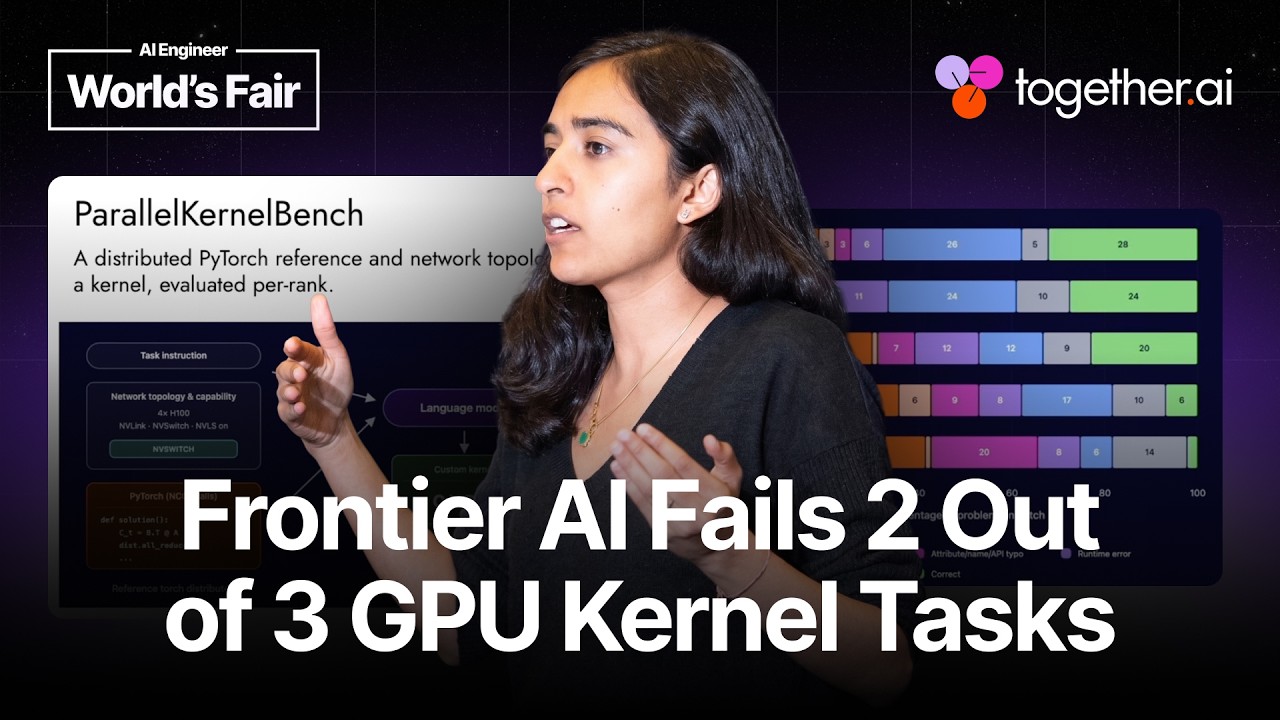
Simran Arora discusses the critical bottleneck shift in large AI workloads from GPU compute to inter-GPU communication. Her team's solution, ParallelKittens, offers a set of primitives to optimize multi-GPU kernels by leveraging fundamental transfer mechanisms and compute-communication overlapping. They introduce ParallelKernelBench, a benchmark to evaluate AI models' ability to generate such kernels, revealing that while models can handle syntax, they struggle with deeper reasoning about communication patterns and hardware trade-offs.

Infra behind Krea 2: How to train and serve at scale — Gabriel Jorge Menezes, Krea.ai

Infra behind Krea 2: How to train and serve at scale — Gabriel Jorge Menezes, Krea.ai

Krea's Gabriel Jorge Menezes shares critical insights into building the infrastructure for large-scale ML model training and serving. Key takeaways include the necessity of custom metrics beyond standard GPU utilization, aggressive checkpointing on ultra-fast storage to counter frequent cluster crashes, and a dynamic Kubernetes-based system using gang scheduling, virtual-kubelet, and taints to seamlessly shift inference workloads to external providers when training consumes on-prem GPUs. The approach highlights practical solutions for silent failures, thermal management, and optimizing resource utilization in a unified production and training environment.