Npu

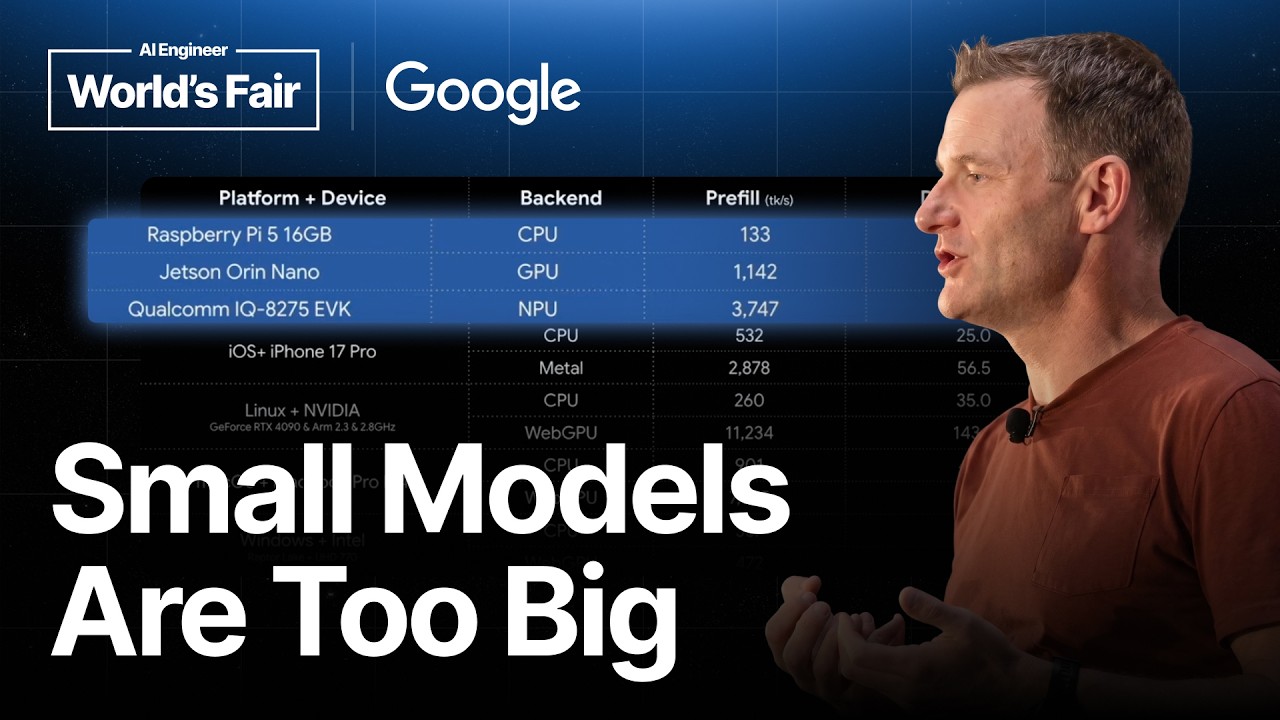
Why Large? Tiny LMs & Agents on Edge/Robotics — Cormac Brick, Google

Why Large? Tiny LMs & Agents on Edge/Robotics — Cormac Brick, Google

Cormac Brick from Google AI Edge discusses how the increasing constraint of DRAM cost on edge devices necessitates the development and deployment of increasingly smaller AI models. He outlines the work of his team in optimizing models like Gemma, achieving 2.9 bits per weight for a 2 billion parameter model capable of running on a Raspberry Pi at 7.6 tokens/second, or on an NPU at 31 tokens/second decode for vision tasks. The talk delves into 'tiny models' (50M-500M parameters) that extend AI to older devices and enable features like robust voice-to-function calling via fine-tuning with synthetic data, exemplified by an offline voice dictation app.

From 3 Months to 4 Days: How Dell Pro AI Studio Speeds AI Development (with Dell’s Experts)

From 3 Months to 4 Days: How Dell Pro AI Studio Speeds AI Development (with Dell’s Experts)

Dell's Shirish Gupta and Ish Shah discuss the complexities developers face in leveraging on-device accelerators like NPUs and GPUs. They introduce Dell ProAI Studio, a solution designed to abstract away hardware-specific toolchains, enabling developers to easily run AI workloads locally for benefits like speed, cost, security, and offline capability.

921: NPUs vs GPUs vs CPUs for Local AI Workloads — with Dell’s Ish Shah and Shirish Gupta

921: NPUs vs GPUs vs CPUs for Local AI Workloads — with Dell’s Ish Shah and Shirish Gupta

Shirish Gupta and Ish Shah from Dell Technologies explore the evolving landscape of AI hardware. They discuss why Windows, enhanced by WSL 2, remains a dominant platform for developers, and delve into the distinct roles of CPUs, GPUs, and the increasingly important Neural Processing Units (NPUs). The conversation covers the trade-offs between local and cloud computing for AI workloads and introduces new hardware, like workstations with discrete NPUs, that are making on-device AI more powerful and accessible than ever.