Mlflow

Omnigent: Composition, Control, and Collaboration for AI Agents

Omnigent: Composition, Control, and Collaboration for AI Agents

Denny Lee discusses the industry's shift to meta-harnesses like Omnigent, which enables hot-swappable AI models and agents, illustrated by his personal project of using debating agents to plan a matcha farm in Taiwan. He highlights how "tokenomics" is replaying the CapEx-to-OpEx cost shift, emphasizing the need for developer visibility, central governance, and auto-model selection to manage AI spend. The conversation also touches on the importance of databases for agent memory and accountability in AI-assisted workflows.
Big updates to mlflow 3.0

Big updates to mlflow 3.0

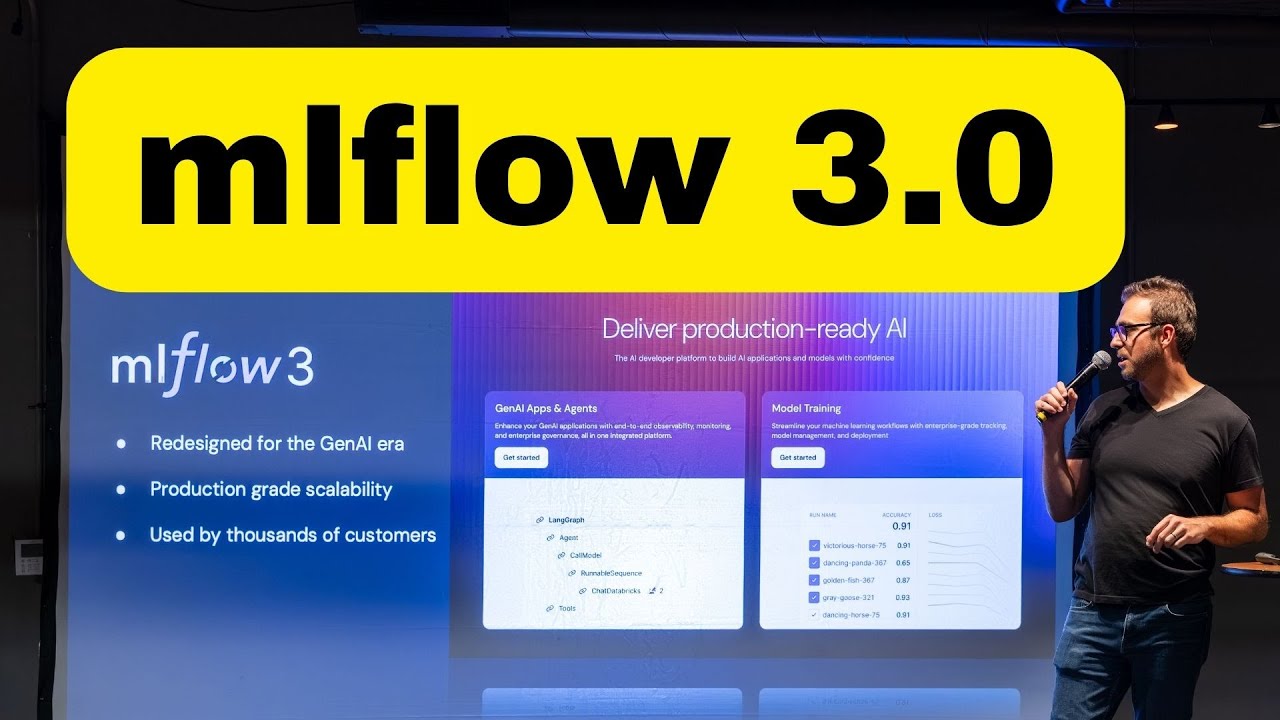
Databricks’ Eric Peter and Corey Zumar introduce MLflow 3.0, focusing on its new "Agentic Insights" capabilities. They demonstrate how MLflow is evolving from providing tools for manual quality assurance in Generative AI to using intelligent agents to automatically find, diagnose, and prioritize issues, significantly speeding up the development lifecycle.

Evaluation-Driven Development with MLflow 3.0

Evaluation-Driven Development with MLflow 3.0

Yuki Watanabe from Databricks introduces Evaluation-Driven Development (EDD) as a critical methodology for building production-ready AI agents. This talk explores the five pillars of EDD and demonstrates how MLflow 3.0's new features—including one-line tracing, automated evaluation, human-in-the-loop feedback, and monitoring—provide a comprehensive toolkit to ensure agent quality and reliability.

MLflow 3.0: The Future of AI Agents

MLflow 3.0: The Future of AI Agents

Eric Peter from Databricks outlines the evolution from the traditional MLOps lifecycle to the more complex Agent Ops lifecycle. He details the five essential components of a successful agent development platform and introduces MLflow 3.0, a new release designed to provide a comprehensive, open-standard solution for building, evaluating, and deploying AI agents.