Llm orchestration

100x More Reliable Voice Agents

100x More Reliable Voice Agents

SLNG.ai introduces Unmute, an open declarative standard for voice agents, addressing platform lock-in and the limitations of current agent architectures. It proposes a shift from LLM-centric, sequential pipelines to declared execution with structural guarantees, enabling portable, cost-effective, and robust voice agents by breaking down complex interactions into modular, context-aware steps. This approach minimizes token usage, enhances determinism, and improves agent reliability compared to traditional single-prompt designs.
Full Workshop: Setting Yourself Up for Success —Jason Liu, OpenAI Codex

Full Workshop: Setting Yourself Up for Success —Jason Liu, OpenAI Codex

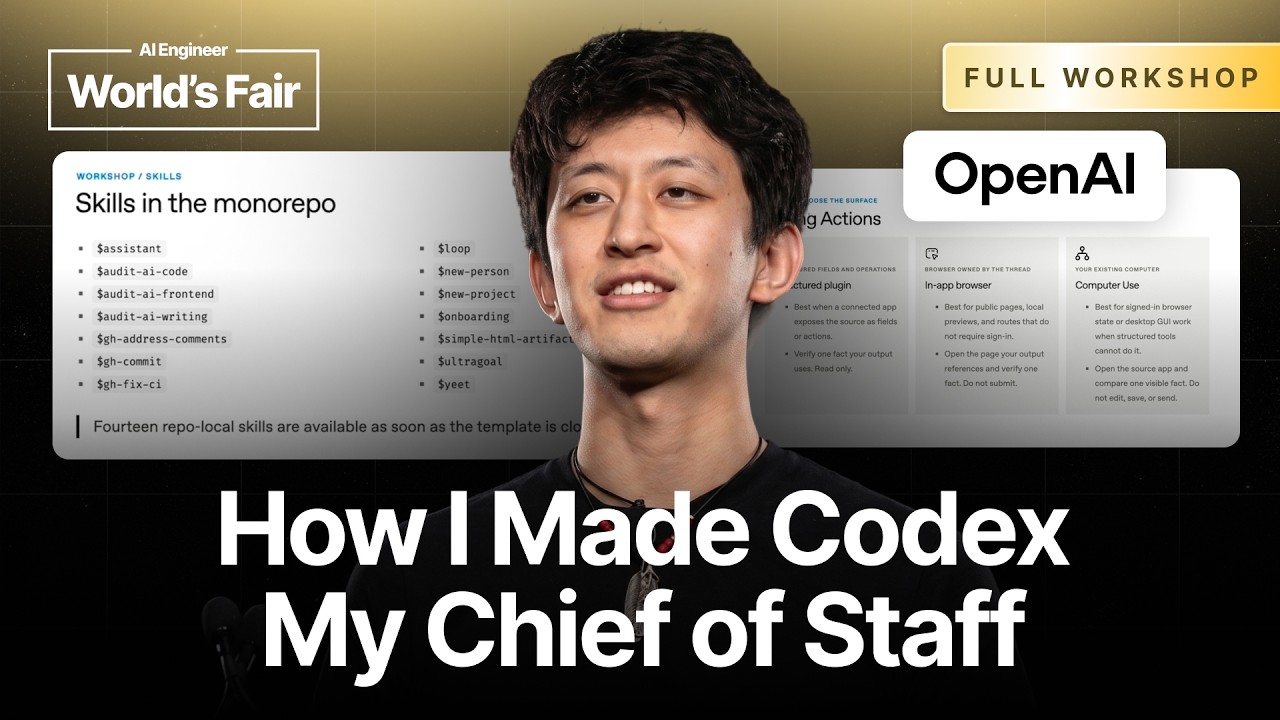
Jason Liu from OpenAI shares advanced strategies for using Codex to automate complex workflows and manage personal information. He introduces key concepts like "compaction," dictation for input, and "appshots" for contextual awareness. The talk covers bringing context into the system via plugins and a personal memory vault, working with AI through automations, goals, and interconnected threads, and taking actions out in the real world, emphasizing the transformative power of "Computer Use" for broad system control.

Beyond the Harness: A Journey Towards Adaptative Engineering - Rajiv Chandegra, Annicha Labs

Beyond the Harness: A Journey Towards Adaptative Engineering - Rajiv Chandegra, Annicha Labs

Rajiv Chandegra introduces adaptive engineering, a new AI design philosophy. He argues that as AI models become more powerful and interact with complex, dynamic real-world problems, the traditional 'fixed harness' approach—predictable but brittle—will become obsolete. Drawing on complexity science, he explains how adaptive engineering allows the AI system's structure (harness) to emerge and adapt dynamically during runtime, mirroring natural self-organizing systems. This shift redefines the engineer's role to designing constraints and fostering horizontal intelligence in multi-agent coordination.

What if the harness mattered more than the model? - Aditya Bhargava, Etsy

What if the harness mattered more than the model? - Aditya Bhargava, Etsy

Aditya Bhargava argues that the 'harness' (the surrounding logic and tools) is more critical than the underlying LLM model itself for building effective AI agents. He proposes that focusing on sophisticated harness design, supported by his new language Agency, can enable local, open-source models to achieve performance comparable to large proprietary models, thereby reducing dependency and fostering innovation.

Real-Time Voice Agents in Production

Real-Time Voice Agents in Production

Panos Stravopodis, CTO of Elyos AI, shares the infrastructure and orchestration challenges of building production-ready voice AI agents. He details the four pillars for success—latency, consistency, context, and recovery—and provides engineering patterns for error handling, context management, and achieving conversational coherence in real-time systems.