Lang chain

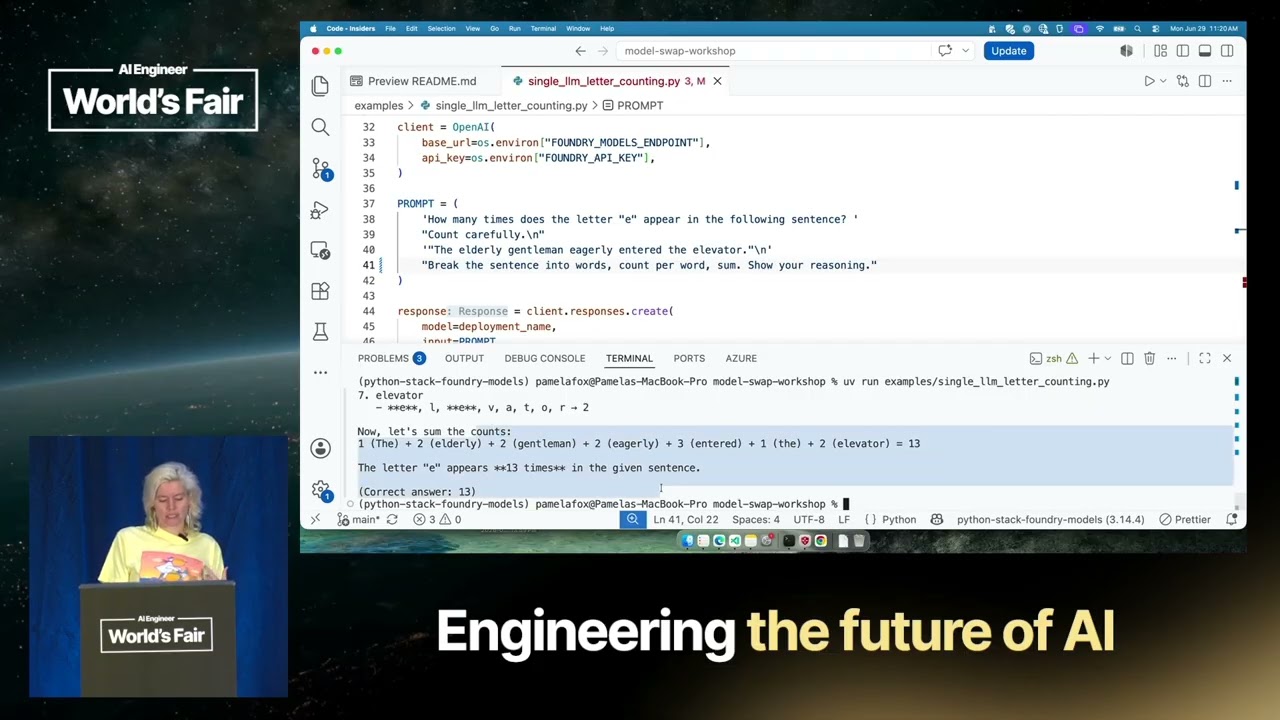
The Model Swap Workshop: GPT-5.5 vs Kimi vs DeepSeek vs Mistral

The Model Swap Workshop: GPT-5.5 vs Kimi vs DeepSeek vs Mistral

Pamela Fox runs a guided workshop comparing GPT-5.5, Kimi K2.6, DeepSeek V4 Flash, and Mistral Large 3 on Microsoft Foundry, showing that benchmarks cannot predict how a model will behave in a specific application. The talk covers counting, RAG groundedness, vision, multilingual failures, tool calling, parallel tool calls in agents, string-check and LLM-as-a-judge evals, Microsoft's ASSERT tool for generating test sets, and DSPy prompt optimization that lets a cheap model satisfy a spec.

Giving AI Agents Memory That Learns — Jake Broekhuizen, LangChain

Giving AI Agents Memory That Learns — Jake Broekhuizen, LangChain

Jake Broekhuizen of LangChain Labs argues that observability alone does not make agents improve. Using a financial services agent whose tone drifted from advisory to pushy, he shows how traces only become useful memory when a filtered lesson is written back as durable context the agent reads on its next run. The talk covers semantic, episodic, and procedural memory, the working versus long-term memory distinction, the read-write cycle, and how LangSmith and Context Hub support capture, analysis, and updates, along with lessons about keeping only signal, caching, and human review of procedural changes.

When to Build Your Own Agent Harness | Harrison Chase, LangChain

When to Build Your Own Agent Harness | Harrison Chase, LangChain

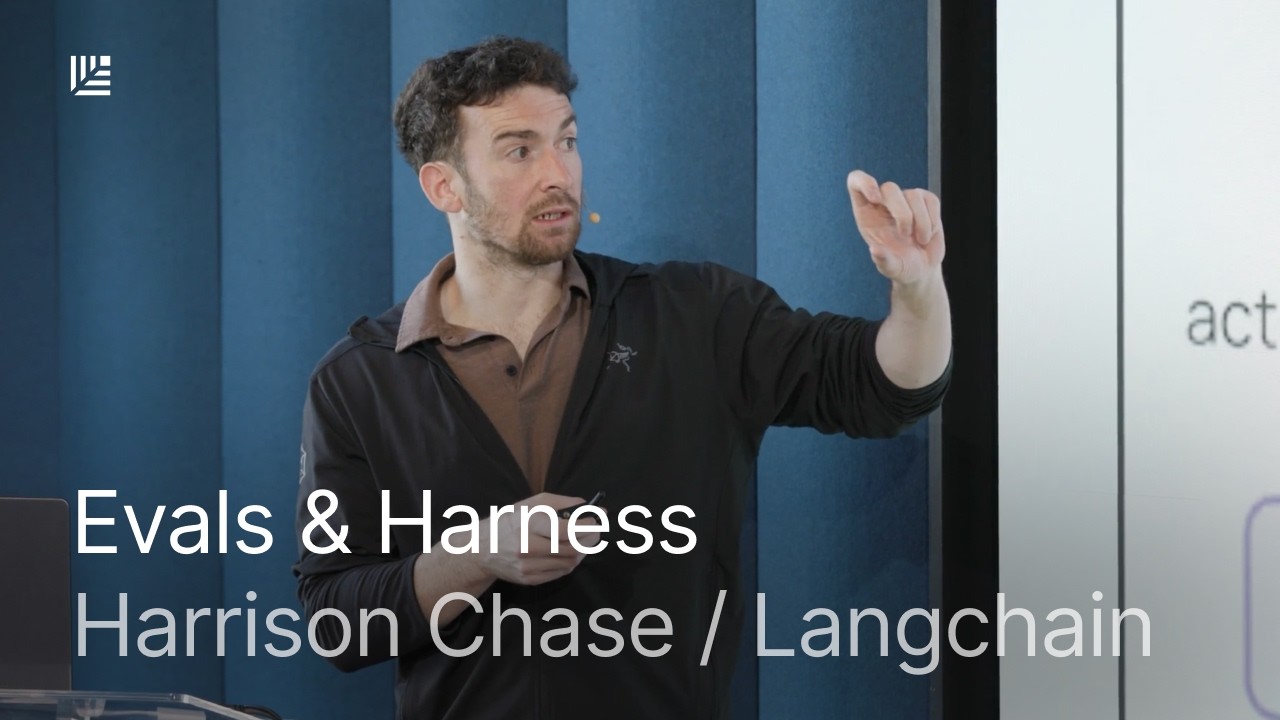
Harrison Chase, co-founder of LangChain, delves into the critical role of the 'harness' in LLM agents, explaining how it orchestrates models and context. He covers customizing harnesses with middleware and sub-agents, the trade-offs between off-the-shelf and custom solutions for in- and out-of-distribution tasks, and the importance of evaluations and observability for continuous agent improvement. The discussion culminates in the 'data flywheel' concept and the `LangSmith Engine` for automating agent intelligence through iterative refinement.

Agentic AI Frameworks Explained: Workflows, Multi-Agent, & Production

Agentic AI Frameworks Explained: Workflows, Multi-Agent, & Production

This video tackles the overwhelming choice of agentic AI frameworks by categorizing projects into five types: linear workflows, autonomous multi-agent systems, role-based AI, production orchestration, and rapid prototyping. It details each type with examples and recommends specific frameworks like LangChain, AutoGen, and CrewAI, guiding developers to select the optimal tool based on their system design and real-world needs.

Context Engineering Our Way to Long-Horizon Agents: LangChain’s Harrison Chase

Context Engineering Our Way to Long-Horizon Agents: LangChain’s Harrison Chase

Harrison Chase, co-founder of LangChain, explains the evolution of AI agents from early, rigid scaffolding to modern, flexible "harnesses." He argues that "context engineering"—managing what an LLM sees—is the key to building effective long-horizon agents. Chase also explores how agent development differs from traditional software, highlighting the critical role of traces as the new source of truth and memory systems that enable agents to improve themselves over time.

Prompt Engineering for LLMs, PDL, & LangChain in Action

Prompt Engineering for LLMs, PDL, & LangChain in Action

Martin Keen explains the evolution of prompt engineering from an art to a software engineering discipline. He introduces LangChain and Prompt Declaration Language (PDL) as tools to manage the probabilistic nature of LLMs, ensuring reliable, structured JSON output through concepts like contracts, control loops, and observability.